


Page 780 - Textbook of Pathology, 6th Edition
P. 780
764                                                      5. METAPLASTIC CARCINOMA.  Rarely, invasive
                                                               ductal carcinomas may have various types of metaplastic
                                                               alterations such as squamous metaplasia, cartilagenous and
                                                               osseous metaplasia, or their combinations. Development of
                                                               squamous cell carcinoma of the breast parenchyma is
                                                               exceedingly rare and must be separated from lesions of
                                                               epidermis or nipple region.

                                                               C. PAGET’S DISEASE OF THE NIPPLE
                                                               Paget’s disease of the nipple is an eczematoid lesion of the
                                                               nipple, often associated with an invasive or non-invasive
                                                               ductal carcinoma of the underlying breast. The nipple bears
                                                               a crusted, scaly and eczematoid lesion with a palpable
                                                               subareolar mass in about half the cases. Most of the patients
                                                               with palpable mass are found to have infiltrating duct
                                                               carcinoma, while those with no palpable breast lump are
                                                               usually subsequently found to have intraductal carcinoma.
                                                               Prognosis of patients with ductal carcinoma having Paget’s
                                                               disease is less favourable than of those who have ductal
                                                               carcinoma without Paget’s disease.
           Figure 25.12  Colloid (mucinous) carcinoma breast. The tumour cells
           are seen as clusters floating in pools of abundant mucin.  The  pathogenesis of Paget’s disease of the breast is
                                                               explained by the following 2 hypotheses:
           3. SECRETORY (JUVENILE) CARCINOMA. This pattern     1. The tumour cells from the underlying ductal carcinoma
           is found more frequently in children and has a better  have migrated up into the lactiferous ducts and invaded the
           prognosis. The tumour is generally circumscribed which  epidermis producing skin lesions.
           on histologic examination shows abundant intra- and  2. An alternate theory, though less reliable than the former,
           extracellular PAS-positive clear spaces due to secretory  is that Paget’s disease represents a form of carcinoma in situ
           activity of tumour cells.                           of the epidermis itself.
     SECTION III
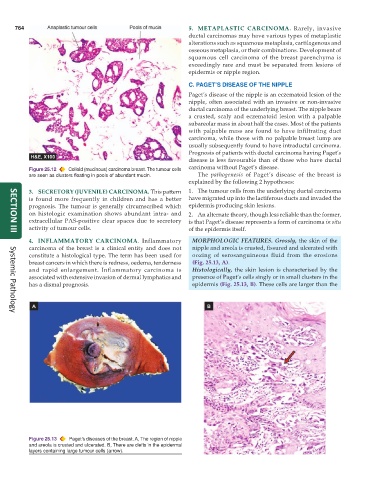
           4. INFLAMMATORY CARCINOMA.  Inflammatory              MORPHOLOGIC FEATURES. Grossly, the skin of the
           carcinoma of the breast is a clinical entity and does not  nipple and areola is crusted, fissured and ulcerated with
           constitute a histological type. The term has been used for  oozing of serosanguineous fluid from the erosions
           breast cancers in which there is redness, oedema, tenderness  (Fig. 25.13, A).
           and rapid enlargement. Inflammatory carcinoma is      Histologically, the skin lesion is characterised by the
           associated with extensive invasion of dermal lymphatics and  presence of Paget’s cells singly or in small clusters in the
           has a dismal prognosis.                               epidermis (Fig. 25.13, B). These cells are larger than the


     Systemic Pathology


           Figure 25.13  Paget’s diseases of the breast. A, The region of nipple
           and areola is crusted and ulcerated. B, There are clefts in the epidermal
           layers containing large tumour cells (arrow).

