


Page 840 - Textbook of Pathology, 6th Edition
P. 840
824 Type 1 DM:                                           Pathogenesis of Complications
           i) Patients of type 1 DM usually manifest at early age,  It is now known that in both type 1 and 2 DM, severity and
           generally below the age of 35.                      chronicity of hyperglycaemia  forms the main pathogenetic
           ii) The onset of symptoms is often abrupt.          mechanism for ‘microvascular complications’ (e.g.
           iii) At presentation, these patients have polyuria, polydipsia  retinopathy, nephropathy, neuropathy); therefore control of
           and polyphagia.                                     blood glucose level constitutes the mainstay of treatment for
           iv) The patients are not obese but have generally progressive  minimising development of these complications.
           loss of weight.                                     Longstanding cases of type 2 DM, however, in addition,
           v) These patients are prone to develop metabolic    frequently develop ‘macrovascular complications’
           complications such as ketoacidosis and hypoglycaemic  (e.g. atherosclerosis, coronary artery disease, peripheral
           episodes.                                           vascular disease, cerebrovascular disease) which are more
                                                               difficult to explain on the basis of hyperglycaemia alone.
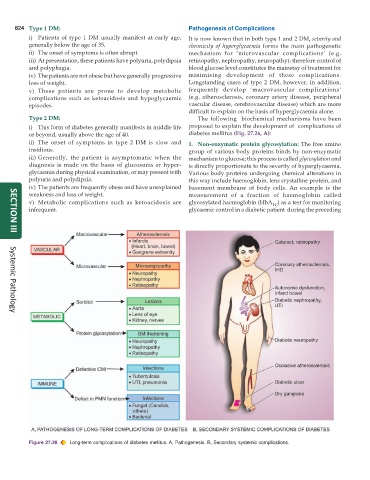
           Type 2 DM:                                             The following  biochemical mechanisms have been
           i) This form of diabetes generally manifests in middle life  proposed to explain the development of  complications of
           or beyond, usually above the age of 40.             diabetes mellitus (Fig. 27.26, A):
           ii) The onset of symptoms in type 2 DM is slow and  1. Non-enzymatic protein glycosylation: The free amino
           insidious.                                          group of various body proteins binds by non-enzymatic
           iii) Generally, the patient is asymptomatic when the  mechanism to glucose; this process is called glycosylation and
           diagnosis is made on the basis of glucosuria or hyper-  is directly proportionate to the severity of hyperglycaemia.
           glycaemia during physical examination, or may present with  Various body proteins undergoing chemical alterations in
           polyuria and polydipsia.                            this way include haemoglobin, lens crystalline protein, and
           iv) The patients are frequently obese and have unexplained  basement membrane of body cells. An example is the
           weakness and loss of weight.                        measurement of a fraction of haemoglobin called
           v) Metabolic complications such as ketoacidosis are  glycosylated haemoglobin (HbA ) as a test for monitoring
                                                                                           1C
           infrequent.                                         glycaemic control in a diabetic patient  during the preceding


     SECTION III


     Systemic Pathology


           Figure 27.26  Long-term complications of diabetes mellitus. A, Pathogenesis. B, Secondary systemic complications.

