


Page 837 - Textbook of Pathology, 6th Edition
P. 837
821


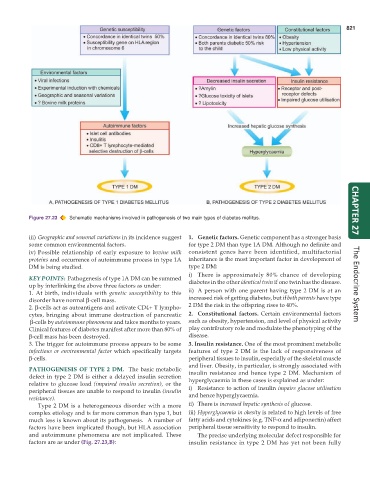
           Figure 27.23  Schematic mechanisms involved in pathogenesis of two main types of diabetes mellitus.        CHAPTER 27


           iii) Geographic and seasonal variations in its incidence suggest  1. Genetic factors. Genetic component has a stronger basis
           some common environmental factors.                  for type 2 DM than type 1A DM. Although no definite and
           iv) Possible relationship of early exposure to  bovine milk  consistent genes have been identified, multifactorial
           proteins and occurrence of autoimmune process in type 1A  inheritance is the most important factor in development of
           DM is being studied.                                type 2 DM:
                                                               i) There is approximately 80% chance of developing
           KEY POINTS:  Pathogenesis of type 1A DM can be summed  diabetes in the other identical twin if one twin has the disease.
           up by interlinking the above three factors as under:                                                       The Endocrine System
           1. At birth, individuals with  genetic susceptibility to this  ii) A person with one parent having type 2 DM is at an
           disorder have normal β-cell mass.                   increased risk of getting diabetes, but if both parents have type
           2. β-cells act as autoantigens and activate CD4+ T lympho-  2 DM the risk in the offspring rises to 40%.
           cytes, bringing about immune destruction of pancreatic  2. Constitutional factors.  Certain environmental factors
            β-cells by autoimmune phenomena and takes months to years.  such as obesity, hypertension, and level of physical activity
           Clinical features of diabetes manifest after more than 80% of  play contributory role and modulate the phenotyping of the
           β-cell mass has been destroyed.                     disease.
           3. The trigger for autoimmune process appears to be some  3. Insulin resistance. One of the most prominent metabolic
           infectious or environmental factor which specifically targets  features of type 2 DM is the lack of responsiveness of
           β-cells.                                            peripheral tissues to insulin, especially of the skeletal muscle
                                                               and liver. Obesity, in particular, is strongly associated with
           PATHOGENESIS OF TYPE 2 DM.  The basic metabolic     insulin resistance and hence type 2 DM. Mechanism of
           defect in type 2 DM is either a delayed insulin secretion  hyperglycaemia in these cases is explained as under:
           relative to glucose load (impaired insulin secretion), or the
                                                               i) Resistance to action of insulin impairs glucose utilisation
           peripheral tissues are unable to respond to insulin (insulin  and hence hyperglycaemia.
           resistance).
              Type 2 DM is a heterogeneous disorder with a more  ii) There is increased hepatic synthesis of glucose.
           complex etiology and is far more common than type 1, but  iii) Hyperglycaemia in obesity is related to high levels of free
           much less is known about its pathogenesis.  A number of  fatty acids and cytokines (e.g. TNF-α and adiponectin) affect
           factors have been implicated though, but HLA association  peripheral tissue sensitivity to respond to insulin.
           and autoimmune phenomena are not implicated. These     The precise underlying molecular defect responsible for
           factors are as under (Fig. 27.23,B):                insulin resistance in type 2 DM has yet not been fully

