


Page 874 - Textbook of Pathology, 6th Edition
P. 874
858
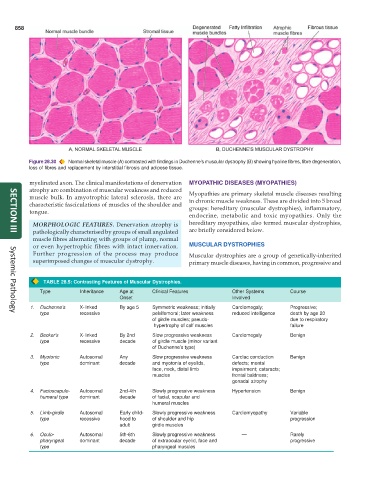
Figure 28.30 Normal skeletal muscle (A) contrasted with findings in Duchenne’s muscular dystrophy (B) showing hyaline fibres, fibre degeneration,
loss of fibres and replacement by interstitial fibrosis and adipose tissue.
myelinated axon. The clinical manifestations of denervation MYOPATHIC DISEASES (MYOPATHIES)
atrophy are combination of muscular weakness and reduced Myopathies are primary skeletal muscle diseases resulting
muscle bulk. In amyotrophic lateral sclerosis, there are in chronic muscle weakness. These are divided into 5 broad
characteristic fasciculations of muscles of the shoulder and groups: hereditary (muscular dystrophies), inflammatory,
tongue.
endocrine, metabolic and toxic myopathies. Only the
MORPHOLOGIC FEATURES. Denervation atrophy is hereditary myopathies, also termed muscular dystrophies,
pathologically characterised by groups of small angulated are briefly considered below.
SECTION III
muscle fibres alternating with groups of plump, normal
or even hypertrophic fibres with intact innervation. MUSCULAR DYSTROPHIES
Further progression of the process may produce Muscular dystrophies are a group of genetically-inherited
superimposed changes of muscular dystrophy. primary muscle diseases, having in common, progressive and
TABLE 28.5: Contrasting Features of Muscular Dystrophies.
Type Inheritance Age at Clinical Features Other Systems Course
Onset Involved
1. Duchenne’s X-linked By age 5 Symmetric weakness; initially Cardiomegaly; Progressive;
type recessive pelvifemoral; later weakness reduced intelligence death by age 20
Systemic Pathology
of girdle muscles; pseudo- due to respiratory
hypertrophy of calf muscles failure
2. Becker’s X-linked By 2nd Slow progressive weakness Cardiomegaly Benign
type recessive decade of girdle muscle (minor variant
of Duchenne’s type)
3. Myotonic Autosomal Any Slow progressive weakness Cardiac conduction Benign
type dominant decade and myotonia of eyelids, defects; mental
face, neck, distal limb impairment; cataracts;
muscles frontal baldness;
gonadal atrophy
4. Facioscapulo- Autosomal 2nd-4th Slowly progressive weakness Hypertension Benign
humeral type dominant decade of facial, scapular and
humeral muscles
5. Limb-girdle Autosomal Early child- Slowly progressive weakness Cardiomyopathy Variable
type recessive hood to of shoulder and hip progression
adult girdle muscles
6. Oculo- Autosomal 5th-6th Slowly progressive weakness — Rarely
pharyngeal dominant decade of extraocular eyelid, face and progressive
type pharyngeal muscles

