


Page 116 - 9780077418427.pdf
P. 116
/Users/user-f465/Desktop
          tiL12214_ch04_085-114.indd Page 93  9/1/10  9:37 PM user-f465
          tiL12214_ch04_085-114.indd Page 93  9/1/10  9:37 PM user-f465                                                 /Users/user-f465/Desktop


                                                  Internal
                                                  energy


                                      External energy


                                                                                          One liter          250 milliliter
                                                                                          of water           of water
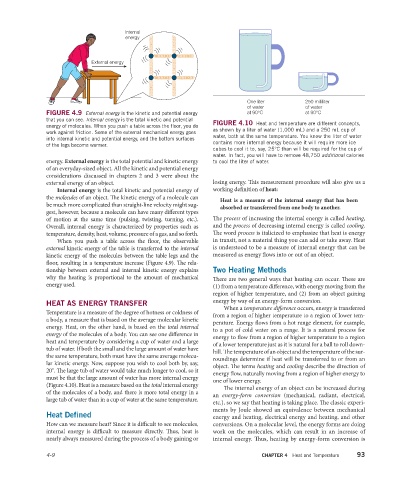
                       FIGURE 4.9  External energy is the kinetic and potential energy    at 90° C           at 90° C
                       that you can see. Internal energy is the total kinetic and potential
                                                                               FIGURE 4.10  Heat and temperature are different concepts,
                       energy of molecules. When you push a table across the floor, you do
                       work against friction. Some of the external mechanical energy goes   as shown by a liter of water (1,000 mL) and a 250 mL cup of
                                                                               water, both at the same temperature. You know the liter of water
                       into internal kinetic and potential energy, and the bottom surfaces
                       of the legs become warmer.                              contains more internal energy because it will require more ice
                                                                               cubes to cool it to, say, 25°C than will be required for the cup of
                                                                               water. In fact, you will have to remove 48,750 additional calories
                       energy. External energy is the total potential and kinetic energy   to cool the liter of water.
                       of an everyday-sized object. All the kinetic and potential energy
                       considerations discussed in chapters 2 and 3 were about the

                       external energy of an object.                           losing energy. This measurement procedure will also give us a
                           Internal energy is the total kinetic and potential energy of   working defi nition of heat:

                       the molecules of an object. The kinetic energy of a molecule can
                                                                                 Heat is a measure of the internal energy that has been
                       be much more complicated than straight-line velocity might sug-
                                                                                   absorbed or transferred from one body to another.
                       gest, however, because a molecule can have many diff erent types
                       of motion at the same time (pulsing, twisting, turning, etc.).   Th e process of increasing the internal energy is called heating,
                       Overall, internal energy is characterized by properties such as   and the process of decreasing internal energy is called cooling.
                       temperature, density, heat, volume, pressure of a gas, and so forth.  Th e word process is italicized to emphasize that heat is energy

                           When you push a table across the floor, the observable   in transit, not a material thing you can add or take away. Heat
                         external kinetic energy of the table is transferred to the internal   is understood to be a measure of internal energy that can be

                         kinetic energy of the molecules between the table legs and the   mea sured as energy flows into or out of an object.
                       floor, resulting in a temperature increase (Figure 4.9). Th e rela-

                       tionship between external and internal kinetic energy explains   Two Heating Methods
                       why the heating is proportional to the amount of mechanical   There are two general ways that heating can occur. Th ese are

                       energy used.                                            (1) from a temperature difference, with energy moving from the

                                                                               region of higher temperature, and (2) from an object gaining
                       HEAT AS ENERGY TRANSFER                                 energy by way of an energy-form conversion.
                                                                                  When a temperature diff erence occurs, energy is transferred
                       Temperature is a measure of the degree of hotness or coldness of
                                                                               from a region of higher temperature to a region of lower tem-
                       a body, a measure that is based on the average molecular kinetic
                                                                               perature. Energy flows from a hot range element, for example,

                       energy. Heat, on the other hand, is based on the total internal
                                                                               to a pot of cold water on a range. It is a natural process for
                       energy of the molecules of a body. You can see one diff erence in
                                                                                 energy to flow from a region of higher temperature to a region

                       heat and temperature by considering a cup of water and a large
                                                                               of a lower temperature just as it is natural for a ball to roll down-
                       tub of water. If both the small and the large amount of water have
                                                                               hill. The temperature of an object and the temperature of the sur-

                       the same temperature, both must have the same average molecu-
                                                                               roundings determine if heat will be transferred to or from an
                       lar kinetic energy. Now, suppose you wish to cool both by, say,
                                                                               object. Th e terms heating and cooling describe the direction of

                       20°. The large tub of water would take much longer to cool, so it

                                                                               energy flow, naturally moving from a region of higher energy to
                        must be that the large amount of water has more internal energy
                                                                               one of lower energy.
                          (Figure 4.10). Heat is a measure based on the total internal energy
                                                                                  The internal energy of an object can be increased during

                        of the molecules of a body, and there is more  total energy in a
                                                                               an  energy-form conversion (mechanical, radiant, electrical,
                        large tub of water than in a cup of water at the same temperature.

                                                                               etc.), so we say that heating is taking place. The classic experi-
                                                                               ments by Joule showed an equivalence between mechanical
                       Heat Defined                                            energy and heating, electrical energy and heating, and other
                       How can we measure heat? Since it is difficult to see molecules,   conversions. On a molecular level, the energy forms are doing


                       internal energy is difficult to measure directly. Thus, heat is   work on the molecules, which can result in an increase of


                       nearly always measured during the process of a body gaining or   internal energy. Thus, heating by energy-form conversion is

                       4-9                                                                     CHAPTER 4  Heat and Temperature   93

