


Page 146 - 9780077418427.pdf
P. 146
/Users/user-f465/Desktop
          tiL12214_ch05_115-138.indd Page 123  9/1/10  9:39 PM user-f465
          tiL12214_ch05_115-138.indd Page 123  9/1/10  9:39 PM user-f465                                                /Users/user-f465/Desktop


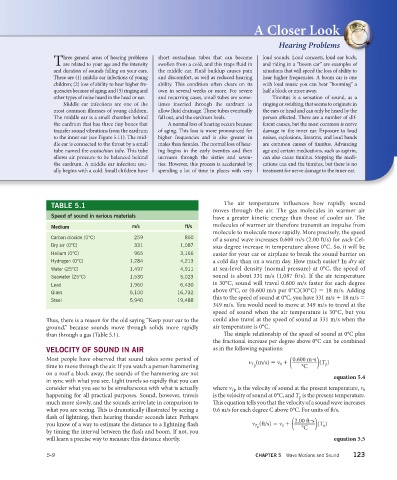
                                                                                            A Closer Look

                                                                                                    Hearing Problems

                             hree general areas of hearing problems   short  eustachian tubes that can become   loud sounds. Loud concerts, loud ear buds,
                          Tare related to your age and the intensity   swollen from a cold, and this traps fluid in   and riding in a “boom car” are examples of
                          and duration of sounds falling on your ears.   the middle ear. Fluid buildup causes pain   situations that will speed the loss of ability to
                          These are (1) middle ear infections of young   and discomfort, as well as reduced hearing   hear higher frequencies. A  boom car is one
                          children; (2) loss of ability to hear higher fre-  ability. This condition often clears on its   with loud music you can hear “booming” a
                          quencies because of aging; and (3) ringing and   own in several weeks or more. For severe   half a block or more away.
                          other types of noise heard in the head or ear.  and recurring cases, small tubes are some-  Tinnitus is a sensation of sound, as a
                             Middle ear infections are one of the   times inserted through the eardrum to   ringing or swishing, that seems to originate in
                          most common illnesses of young children.   allow fluid drainage. These tubes eventually   the ears or head and can only be heard by the
                          The middle ear is a small chamber behind   fall out, and the eardrum heals.   person affected. There are a number of dif-
                          the eardrum that has three tiny bones that   A normal loss of hearing occurs because   ferent causes, but the most common is nerve
                          transfer sound vibrations from the eardrum   of aging. This loss is more pronounced for   damage in the inner ear. Exposure to loud
                          to the inner ear (see Figure 5.11). The mid-  higher frequencies and is also greater in   noises, explosions, firearms, and loud bands
                          dle ear is connected to the throat by a small   males than females. The normal loss of hear-  are common causes of tinnitus. Advancing
                          tube named the eustachian tube. This tube   ing begins in the early twenties and then   age and certain medications, such as aspirin,
                          allows air pressure to be balanced behind   increases through the sixties and seven-  can also cause tinnitus. Stopping the medi-
                          the eardrum. A middle ear infection usu-  ties. However, this process is accelerated by   cations can end the tinnitus, but there is no
                          ally begins with a cold. Small children have   spending a lot of time in places with very   treatment for nerve damage to the inner ear.


                         TABLE 5.1                                                The air temperature influences how rapidly sound
                                                                               moves through the air. The gas molecules in warmer air
                         Speed of sound in various materials                   have a greater kinetic energy than those of cooler air. The
                         Medium                     m/s              ft/s      molecules of warmer air therefore transmit an impulse from
                                                                               molecule to molecule more rapidly. More precisely, the speed
                         Carbon dioxide (0°C)        259             850
                                                                               of a sound wave increases 0.600 m/s (2.00 ft/s) for each Cel-
                         Dry air (0°C)               331            1,087      sius degree increase in temperature above 0°C. So, it will be
                         Helium (0°C)                965            3,166      easier for your car or airplane to break the sound barrier on
                         Hydrogen (0°C)            1,284            4,213      a cold day than on a warm day. How much easier? In dry air
                         Water (25°C)              1,497            4,911      at sea-level density (normal pressure) at 0°C, the speed of
                         Seawater (25°C)           1,530            5,023      sound is about 331 m/s (1,087 ft/s). If the air temperature
                         Lead                      1,960            6,430      is 30°C, sound will travel 0.600 m/s faster for each degree
                                                                               above 0°C, or (0.600 m/s per 0°C)(30°C) = 18 m/s. Adding
                         Glass                     5,100           16,732
                                                                               this to the speed of sound at 0°C, you have 331 m/s + 18 m/s =
                         Steel                     5,940           19,488
                                                                               349 m/s. You would need to move at 349 m/s to travel at the
                                                                               speed of sound when the air temperature is 30°C, but you

                       Thus, there is a reason for the old saying “Keep your ear to the   could also travel at the speed of sound at 331 m/s when the
                       ground,” because sounds move through solids more rapidly   air temperature is 0°C.

                       than through a gas (Table 5.1).                            The simple relationship of the speed of sound at 0°C plus
                                                                               the fractional increase per degree above 0°C can be combined
                       VELOCITY OF SOUND IN AIR                                as in the following equations:
                       Most people have observed that sound takes some period of                         _
                                                                                                                 )
                                                                                                        (
                                                                                                         0.600 m∙s

                                                                                             (m/s) = v 0  +        T p )
                                                                                                                   (
                       time to move through the air. If you watch a person hammering                        °C
                                                                                           v T p
                       on a roof a block away, the sounds of the hammering are not
                                                                                                                       equation 5.4
                       in sync with what you see. Light travels so rapidly that you can
                       consider what you see to be simultaneous with what is actually   where v Tp  is the velocity of sound at the present temperature, v 0
                       happening for all practical purposes. Sound, however, travels   is the velocity of sound at 0°C, and T p  is the present temperature.
                       much more slowly, and the sounds arrive late in comparison to   This equation tells you that the velocity of a sound wave increases


                       what you are seeing. This is dramatically illustrated by seeing a   0.6 m/s for each degree C above 0°C. For units of ft /s,
                       flash of lightning, then hearing thunder seconds later. Perhaps                    _

                                                                                                                 )
                                                                                                          2.00 ft∙s
                                                                                                         (

                                                                                                                  (
                       you know of a way to estimate the distance to a lightning fl ash     v T p (ft/s) = v 0  +       °C     T p )
                       by timing the interval between the flash and boom. If not, you

                       will learn a precise way to measure this distance shortly.                                      equation 5.5
                       5-9                                                                   CHAPTER 5  Wave Motions and Sound   123

