


Page 147 - 9780077418427.pdf
P. 147
/Users/user-f465/Desktop
          tiL12214_ch05_115-138.indd Page 124  9/1/10  9:39 PM user-f465
          tiL12214_ch05_115-138.indd Page 124  9/1/10  9:39 PM user-f465                                                /Users/user-f465/Desktop


                   Equation 5.5 tells you that the velocity of a sound wave increases        Condensations

                   2.0 ft/s for each degree Celsius above 0°C.

                   EXAMPLE 5.4
                   What is the velocity of sound in m/s at room temperature (20.0°C)?
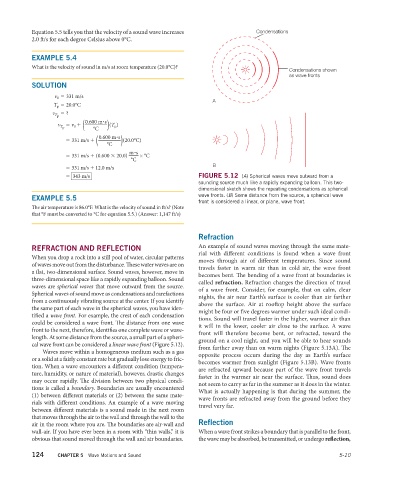
                                                                                                        Condensations shown
                                                                                                        as wave fronts
                   SOLUTION
                          v 0  = 331 m/s
                                                                               A
                          T p  = 20.0°C
                          v T  = ?
                           p
                                    0.600 m∙s
                                            )
                                   (

                           v T  = v 0  +      _  T p )
                                             (
                             p         °C
                                         0.600 m∙s
                                        ( _     )
                              = 331 m/s +         (20.0°C)
                                            °C
                                                   m∙s
                                                   _
                              = 331 m/s + (0.600 × 20.0)            × °C
                                                    °C
                                                                               B
                              = 331 m/s + 12.0 m/s
                              =  343 m/s                                  FIGURE 5.12  (A) Spherical waves move outward from a
                                                                          sounding source much like a rapidly expanding balloon. This two-
                                                                          dimensional sketch shows the repeating condensations as spherical
                                                                          wave fronts. (B) Some distance from the source, a spherical wave
                   EXAMPLE 5.5
                                                                          front is considered a linear, or plane, wave front.

                   The air temperature is 86.0°F. What is the velocity of sound in ft /s? (Note
                   that °F must be converted to °C for equation 5.5.) (Answer: 1,147 ft /s)
                                                                          Refraction
                   REFRACTION AND REFLECTION                              An example of sound waves moving through the same mate-
                                                                          rial with different conditions is found when a wave front

                   When you drop a rock into a still pool of water, circular patterns

                                                                          moves through air of different temperatures. Since sound

                   of waves move out from the disturbance. These water waves are on
                                                                          travels faster in warm air than in cold air, the wave front

                   a flat, two-dimensional surface. Sound waves, however, move in

                                                                          becomes bent. The bending of a wave front at boundaries is
                   three-dimensional space like a rapidly expanding balloon. Sound
                                                                          called refraction. Refraction changes the direction of travel
                   waves are spherical waves that move outward from the source.
                                                                          of a wave front. Consider, for example, that on calm, clear
                   Spherical waves of sound move as condensations and rarefactions
                                                                          nights, the air near Earth’s surface is cooler than air farther
                   from a continuously vibrating source at the center. If you identify
                                                                          above the surface. Air at rooftop height above the surface

                   the same part of each wave in the spherical waves, you have iden-

                                                                          might be four or five degrees warmer under such ideal condi-
                   tifi ed a wave front. For example, the crest of each condensation
                                                                          tions. Sound will travel faster in the higher, warmer air than
                   could be considered a wave front. The distance from one wave

                                                                          it will in the lower, cooler air close to the surface. A wave
                   front to the next, therefore, identifies one complete wave or wave-

                                                                          front will therefore become bent, or refracted, toward the
                   length. At some distance from the source, a small part of a spheri-
                                                                          ground on a cool night, and you will be able to hear sounds
                   cal wave front can be considered a linear wave front (Figure 5.12).
                                                                          from farther away than on warm nights (Figure 5.13A). Th e
                      Waves move within a homogeneous medium such as a gas
                                                                          opposite process occurs during the day as Earth’s surface
                   or a solid at a fairly constant rate but gradually lose energy to fric-
                                                                          becomes warmer from sunlight (Figure 5.13B). Wave fronts

                   tion. When a wave encounters a different condition (tempera-
                                                                          are refracted upward because part of the wave front travels
                   ture, humidity, or nature of material), however, drastic changes
                                                                          faster in the warmer air near the surface. Thus, sound does

                   may occur rapidly. The division between two physical condi-

                                                                          not seem to carry as far in the summer as it does in the winter.
                   tions is called a boundary. Boundaries are usually encountered
                                                                          What is actually happening is that during the summer, the
                   (1) between different materials or (2) between the same mate-

                                                                          wave fronts are refracted away from the ground before they

                   rials with different conditions. An example of a wave moving
                                                                          travel very far.
                   between different materials is a sound made in the next room

                   that moves through the air to the wall and through the wall to the
                   air in the room where you are. The boundaries are air-wall and   Reflection

                   wall-air. If you have ever been in a room with “thin walls,” it is   When a wave front strikes a boundary that is parallel to the front,
                   obvious that sound moved through the wall and air boundaries.  the wave may be absorbed, be transmitted, or undergo refl ection,
                   124     CHAPTER 5  Wave Motions and Sound                                                            5-10

