


Page 237 - 9780077418427.pdf
P. 237
/Users/user-f465/Desktop
          tiL12214_ch08_203-228.indd Page 214  9/1/10  9:45 PM user-f465
          tiL12214_ch08_203-228.indd Page 214  9/1/10  9:45 PM user-f465                                                /Users/user-f465/Desktop


                           Science and Society


                           Atomic Research
                        here are two types of scientific research:     1.  J. J. Thomson investigates cathode rays.
                                                                                          QUESTIONS TO DISCUSS
                     Tbasic and applied. Basic research is     2.  Robert Millikan measures the charge
                     driven by a search for understanding and   of an electron.             1.  Were the five research topics basic or
                     may or may not have practical applications.
                                                          3.  Ernest Rutherford studies radioactive   applied research?
                     Applied research has a goal of solving some
                                                           particles striking gold foil.    2.  Would we ever have developed a
                     practical problem rather than just looking
                                                          4.  Niels Bohr proposes a solar system   model of the atom if all research had
                     for answers.
                                                           model of the atom by applying the   to be practical?
                        Some people feel that all research should
                                                           quantum concept.
                     result in something practical, so all research
                     should be applied. Hold that thought while     5.  Erwin Schrödinger proposes a model
                     considering if the following research dis-  of the atom based on the wave nature
                     cussed in this chapter is basic or applied:  of the electron.


                      and p  sublevels. Th e n = 3 main energy level can have the   z              z                z
                      s, p, and d sublevels. Finally, the n = 4 main energy level
                      can have all four sublevels, with s, p, d, and f. Th erefore,
                      the number of possible sublevels is the same as the
                      principal quantum number.                           y                y                y
                          The Bohr model considered the location of an electron         x                x                x

                      as certain, like a tiny shrunken marble in an orbit. Th e
                      quantum mechanical model considers the electron as a        A                B               C
                      wave, and knowledge of its location is very uncertain. Th e   s orbitals:  p orbitals:     d orbitals:
                      Heisenberg  uncertainty principle states that you cannot   hold 2 electrons  each of 3 pairs of  each of 5 sets of
                                                                             (outer orbitals of  lobes holds 2 electrons   lobes holds 2 electrons
                      measure the exact position of a wave because a wave
                                                                             elements in groups  = 6 electrons  = 10 electrons
                      is spread out. One cannot specify the position and the   IA and 2A of   (outer orbitals of  (found in elements
                                                                                                            with atomic numbers of 21

                      momentum of a spread-out electron. The location of the   the periodic table)  groups IIIA to VIIIA)
                                                                                                                 and higher)
                      electron can only be described in terms of probabilities

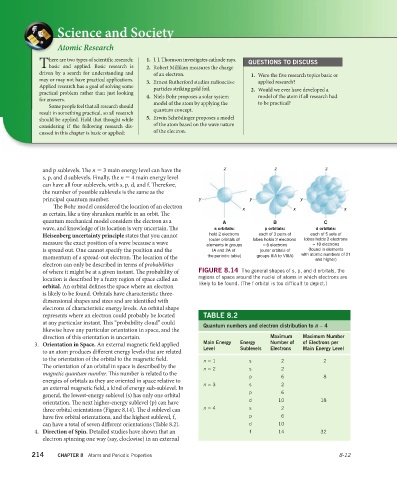
                      of where it might be at a given instant. The probability of   FIGURE 8.14  The general shapes of s, p, and d orbitals, the
                      location is described by a fuzzy  region of space called an   regions of space around the nuclei of atoms in which electrons are
                                                                          likely to be found. (The f orbital is too difficult to depict.)
                      orbital. An  orbital defines the space where an electron

                      is likely to be found. Orbitals have characteristic three-
                      dimensional shapes and sizes and are identifi ed with
                      electrons of characteristic energy levels. An orbital shape
                      represents where an electron could probably be located   TABLE 8.2
                      at any particular instant. This “probability cloud” could

                                                                           Quantum numbers and electron distribution to n = 4
                      likewise have any particular orientation in space, and the
                      direction of this orientation is uncertain.                                 Maximum    Maximum Number
                     3.  Orientation in Space. An external magnetic fi eld applied   Main Energy   Energy    Number of   of Electrons per
                                                                           Level        Sublevels   Electrons   Main Energy Level

                      to an atom produces different energy levels that are related
                      to the orientation of the orbital to the magnetic fi eld.   n = 1    s         2             2

                      The orientation of an orbital in space is described by the
                                                                           n = 2           s         2
                      magnetic quantum number. This number is related to the

                                                                                           p         6             8
                      energies of orbitals as they are oriented in space relative to
                                                                           n = 3           s         2
                      an external magnetic field, a kind of  energy sub-sublevel. In

                                                                                           p         6
                      general, the lowest-energy  sublevel (s) has only one orbital
                      orientation. The next  higher-energy sublevel (p) can have           d        10            18


                      three orbital orientations (Figure 8.14). The d sublevel can   n = 4  s        2

                      have five orbital orientations, and the highest sublevel, f,         p         6

                      can have a total of seven different orientations (Table 8.2).        d        10
                     4.  Direction of Spin. Detailed studies have shown that an            f        14            32
                        electron spinning one way (say, clockwise) in an external
                   214     CHAPTER 8  Atoms and Periodic Properties                                                     8-12

