Page 238 - 9780077418427.pdf
P. 238

/Users/user-f465/Desktop
          tiL12214_ch08_203-228.indd Page 215  9/1/10  9:45 PM user-f465
          tiL12214_ch08_203-228.indd Page 215  9/1/10  9:45 PM user-f465                                                /Users/user-f465/Desktop


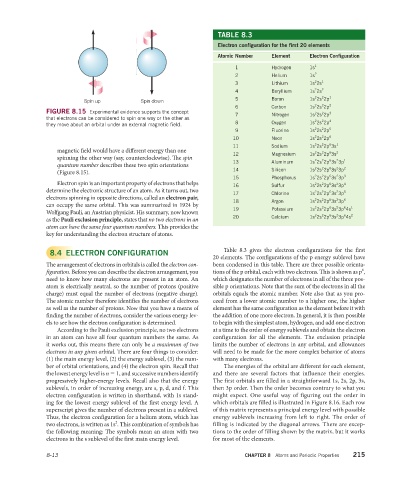
                                                                                TABLE 8.3

                                                                                Electron configuration for the first 20 elements
                                                                                Atomic Number     Element      Electron Configuration
                                                                                      1           Hydrogen     1s 1
                                                                                      2           Helium       1s 2
                                                                                                                2
                                                                                      3           Lithium      1s 2s 1
                                                                                                                2
                                                                                      4           Beryllium    1s 2s 2
                                                                                                                2
                                                                                                                   2
                                    Spin up            Spin down                      5           Boron        1s 2s 2p 1
                                                                                                                2
                                                                                                                   2
                                                                                      6           Carbon       1s 2s 2p 2
                       FIGURE 8.15  Experimental evidence supports the concept
                                                                                                                2
                                                                                                                   2
                                                                                      7           Nitrogen     1s 2s 2p 3
                       that electrons can be considered to spin one way or the other as                         2  2  4
                       they move about an orbital under an external magnetic field.   8           Oxygen       1s 2s 2p
                                                                                                                   2
                                                                                                                2
                                                                                      9           Fluorine     1s 2s 2p 5
                                                                                                                2
                                                                                                                   2
                                                                                     10           Neon         1s 2s 2p 6
                                                                                                                     6
                                                                                                                2
                                                                                                                   2
                                                                                     11           Sodium       1s 2s 2p 3s 1


                            magnetic field would have a different energy than one
                                                                                                                     6
                                                                                                                   2
                                                                                                                2
                                                                                     12           Magnesium    1s 2s 2p 3s 2
                           spinning the other way (say, counterclockwise). Th e spin
                                                                                                                   2
                                                                                                                2
                                                                                                                        2
                                                                                                                     6
                                                                                     13           Aluminum     1s 2s 2p 3s 3p 1
                           quantum number describes these two spin orientations
                                                                                                                        2
                                                                                                                     6
                                                                                                                   2
                                                                                                                2
                                                                                     14           Silicon      1s 2s 2p 3s 3p 2
                           (Figure 8.15).
                                                                                                                2
                                                                                                                   2
                                                                                                                        2
                                                                                                                     6
                                                                                     15           Phosphorus   1s 2s 2p 3s 3p 3
                           Electron spin is an important property of electrons that helps   16    Sulfur       1s 2s 2p 3s 3p 4
                                                                                                                        2
                                                                                                                2
                                                                                                                   2
                                                                                                                     6
                       determine the electronic structure of an atom. As it turns out, two                      2  2  6  2  5
                                                                                     17           Chlorine     1s 2s 2p 3s 3p
                       electrons spinning in opposite directions, called an electron pair,
                                                                                                                        2
                                                                                                                   2
                                                                                                                     6
                                                                                                                2
                                                                                     18           Argon        1s 2s 2p 3s 3p 6
                       can occupy the same orbital. This was summarized in 1924 by
                                                                                                                        2
                                                                                                                     6
                                                                                                                2
                                                                                                                          6
                                                                                                                   2
                                                                                     19           Potassium    1s 2s 2p 3s 3p 4s 1
                       Wolfgang Pauli, an Austrian physicist. His summary, now known
                                                                                                                   2
                                                                                                                2
                                                                                                                     6
                                                                                                                        2
                                                                                                                          6
                                                                                     20           Calcium      1s 2s 2p 3s 3p 4s 2
                       as the Pauli exclusion principle, states that no two electrons in an
                       atom can have the same four quantum numbers. This provides the
                       key for understanding the electron structure of atoms.
                                                                                  Table 8.3 gives the electron configurations for the first
                         8.4 ELECTRON CONFIGURATION
                                                                                 20 elements. The configurations of the p energy sublevel have
                       The arrangement of electrons in orbitals is called the electron con-  been condensed in this table. There are three possible orienta-
                                                                                                                                6
                       figuration. Before you can describe the electron arrangement, you   tions of the p orbital, each with two electrons. This is shown as p ,
                       need to know how many electrons are present in an atom. An   which designates the number of electrons in all of the three pos-
                       atom is electrically neutral, so the number of protons (positive   sible p orientations. Note that the sum of the electrons in all the
                       charge) must equal the number of electrons (negative charge).   orbitals equals the atomic number. Note also that as you pro-
                       The atomic number therefore identifies the number of electrons   ceed from a lower atomic number to a higher one, the higher
                       as well as the number of protons. Now that you have a means of   element has the same configuration as the element before it with
                       finding the number of electrons, consider the various energy lev-  the addition of one more electron. In general, it is then possible
                       els to see how the electron configuration is  determined.   to begin with the simplest atom, hydrogen, and add one electron
                           According to the Pauli exclusion principle, no two  electrons   at a time to the order of energy sublevels and obtain the electron
                       in an atom can have all four quantum numbers the same. As   configuration for all the elements. The exclusion principle
                       it works out, this means there can only be a maximum of two   limits the number of electrons in any orbital, and allowances
                       e lectrons in any given orbital. There are four things to consider:   will need to be made for the more complex behavior of atoms
                       (1) the main energy level, (2) the energy sublevel, (3) the num-  with many electrons.
                       ber of orbital orientations, and (4) the electron spin. Recall that   The energies of the orbital are different for each element,
                       the lowest energy level is n = 1, and successive numbers identify   and there are several factors that influence their energies.
                       progressively higher-energy levels.  Recall also that the energy   The first orbitals are filled in a straightforward 1s, 2s, 2p, 3s,
                       sublevels, in order of increasing energy, are s, p, d, and f. This   then 3p order. Then the order becomes contrary to what you
                       electron configuration is written in shorthand, with 1s stand-  might expect. One useful way of figuring out the order in
                       ing for the lowest energy sublevel of the first energy level. A   which orbitals are filled is illustrated in Figure 8.16. Each row
                       superscript gives the number of electrons present in a sublevel.   of this matrix represents a principal energy level with possible
                       Thus, the electron configuration for a helium atom, which has   energy sublevels increasing from left to right. The order of
                                              2
                       two electrons, is written as 1s . This combination of symbols has   filling is  indicated by the diagonal arrows. There are excep-
                       the following meaning: The symbols mean an atom with two   tions to the order of filling shown by the matrix, but it works
                       electrons in the s sublevel of the first main  energy level.  for most of the elements.
                       8-13                                                              CHAPTER 8  Atoms and Periodic Properties   215
   233   234   235   236   237   238   239   240   241   242   243