Page 259 - 9780077418427.pdf
P. 259

/Users/user-f465/Desktop
          tiL12214_ch09_229-250.indd Page 236  9/3/10  10:07 PM user-f465
          tiL12214_ch09_229-250.indd Page 236  9/3/10  10:07 PM user-f465                                               /Users/user-f465/Desktop


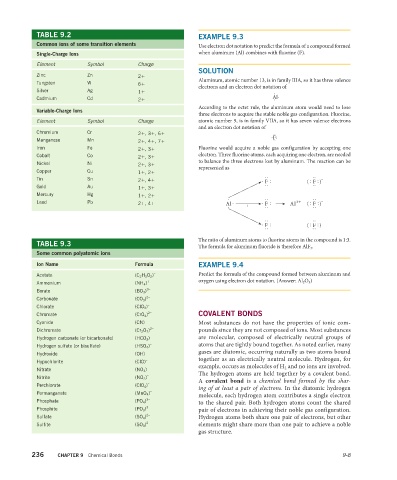
                    TABLE 9.2                                             EXAMPLE 9.3
                    Common ions of some transition elements               Use electron dot notation to predict the formula of a compound formed
                    Single-Charge Ions                                    when aluminum (Al) combines with fluorine (F).

                    Element          Symbol           Charge
                                                                          SOLUTION
                    Zinc             Zn               2+
                                                                          Aluminum, atomic number 13, is in family IIIA, so it has three  valence
                    Tungsten         W                6+
                                                                          electrons and an electron dot notation of
                    Silver           Ag               1+                                           ·
                    Cadmium          Cd               2+                                          Al·
                                                                                                   ·
                                                                          According to the octet rule, the aluminum atom would need to lose
                    Variable-Charge Ions
                                                                          three electrons to acquire the stable noble gas configuration.  Fluorine,
                    Element          Symbol           Charge              atomic number 9, is in family VIIA, so it has seven valence electrons
                                                                          and an electron dot notation of
                    Chromium         Cr               2+, 3+, 6+
                                                                                                  ·F ¨
                    Manganese        Mn               2+, 4+, 7+                                   ¨ ˙ ˙
                    Iron             Fe               2+, 3+              Fluorine would acquire a noble gas configuration by accepting one
                    Cobalt           Co               2+, 3+              electron. Three fluorine atoms, each acquiring one electron, are needed
                                                                          to balance the three electrons lost by aluminum. The  reaction can be
                    Nickel           Ni               2+, 3+
                                                                          represented as
                    Copper           Cu               1+, 2+
                    Tin              Sn               2+, 4+                                  N O             (F) S
                                                                                                              S O
                                                                                                F S
                                                                                                Q
                                                                                                                Q
                    Gold             Au               1+, 3+
                    Mercury          Hg               1+, 2+
                                                                                                              S O
                    Lead             Pb               2+, 4+                       Al         N F O S   Al  3   (F) S
                                                                                   P T
                                                                                                Q
                                                                                                                Q
                                                                                   R
                                                                                                              S O
                                                                                              N O             (F) S
                                                                                                F S
                                                                                                Q
                                                                                                                Q
                                                                          The ratio of aluminum atoms to fluorine atoms in the compound is 1:3.
                    TABLE 9.3                                             The formula for aluminum fluoride is therefore AlF 3 .
                    Some common polyatomic ions
                    Ion Name                         Formula              EXAMPLE 9.4
                    Acetate                          (C 2 H 3 O 2 ) –     Predict the formula of the compound formed between aluminum and
                    Ammonium                         (NH 4 ) +            oxygen using electron dot notation. (Answer: Al 2 O 3 )
                    Borate                           (BO 3 ) 3–
                    Carbonate                        (CO 3 ) 2–
                    Chlorate                         (ClO 3 ) –
                    Chromate                         (CrO 4 ) 2–          COVALENT BONDS
                    Cyanide                          (CN) –               Most substances do not have the properties of ionic com-
                    Dichromate                       (Cr 2 O 7 ) 2–       pounds since they are not composed of ions. Most substances
                    Hydrogen carbonate (or bicarbonate)   (HCO 3 ) –      are molecular, composed of electrically neutral groups of
                    Hydrogen sulfate (or bisulfate)   (HSO 4 ) –          atoms that are tightly bound together. As noted earlier, many
                    Hydroxide                        (OH) –               gases are  diatomic, occurring naturally as two atoms bound
                    Hypochlorite                     (ClO) –              together as an electrically neutral molecule. Hydrogen, for
                                                                          example, occurs as molecules of H 2  and no ions are involved.
                                                         –
                    Nitrate                          (NO 3 )
                                                                          The hydrogen atoms are held together by a covalent bond.
                    Nitrite                          (NO 2 ) –
                                                                          A  covalent bond is a  chemical bond formed by the shar-
                    Perchlorate                      (ClO 4 ) –
                                                                          ing of at least a pair of electrons. In the diatomic hydrogen
                    Permanganate                     (MnO 4 ) –
                                                                          molecule, each hydrogen atom contributes a single electron
                    Phosphate                        (PO 4 ) 3–           to the shared pair. Both hydrogen atoms count the shared
                    Phosphite                        (PO 3 ) 3–           pair of electrons in achieving their  noble gas configuration.
                    Sulfate                          (SO 4 ) 2–           Hydrogen atoms both share one pair of electrons, but other
                    Sulfite                          (SO 3 ) 2–           elements might share more than one pair to achieve a noble
                                                                          gas structure.


                   236     CHAPTER 9 Chemical Bonds                                                                       9-8
   254   255   256   257   258   259   260   261   262   263   264