


Page 258 - 9780077418427.pdf
P. 258
/Users/user-f465/Desktop
          tiL12214_ch09_229-250.indd Page 235  9/3/10  10:07 PM user-f465
          tiL12214_ch09_229-250.indd Page 235  9/3/10  10:07 PM user-f465                                               /Users/user-f465/Desktop


                       the reaction. There are two rules you can use for keeping track   TABLE 9.1
                       of electrons in ionic bonding reactions:
                                                                                Common ions of some representative elements
                         1.  Ions are formed as atoms gain or lose valence electrons to
                                                                                Element          Symbol           Ion
                           achieve the stable noble gas structure.
                         2. There must be a balance between the number of electrons lost   Lithium  Li            1+

                           and the number of electrons gained by atoms in the reaction.  Sodium    Na             1+
                           The sodium-chlorine reaction follows these two rules.   Potassium       K              1+
                       The loss of one valence electron from a sodium atom formed   Magnesium      Mg             2+
                       a stable sodium ion. The gain of one valence electron by the   Calcium      Ca             2+
                       chlorine atom formed a stable chlorine ion. Thus, both ions   Barium        Ba             2+
                       have noble gas configurations (rule 1), and one electron was   Aluminum     Al             3+
                       lost and one was gained, so there is a balance in the number of   Oxygen    O              2–
                       electrons lost and the number gained (rule 2).           Sulfur             S              2–
                                                                                Hydrogen           H              1+, 1–
                       Ionic Compounds and Formulas
                                                                                Fluorine           F              1–
                       The formula of a compound describes what elements are in the   Chlorine     Cl             1–
                       compound and in what proportions. Sodium chloride contains
                                                                                Bromine            Br             1–
                       one positive sodium ion for each negative chlorine ion. The for-
                                                                                Iodine             I              1–
                       mula of the compound sodium chloride is NaCl. If there are no
                       subscripts at the lower right part of each symbol, it is under-
                       stood that the symbol has a number 1. Thus, NaCl indicates a
                       compound made up of the elements sodium and chlorine, and
                       there is one sodium atom for each chlorine atom.
                           Calcium (Ca) is an alkaline metal in family IIA, and fluo-
                       rine (F) is a halogen in family VIIA. Since calcium is a metal and
                       fluorine is a nonmetal, you would expect calcium and fluo rine   The formula of the compound is therefore CaF 2 , with the sub-
                       atoms to react, forming a compound with ionic bonds. Calcium   script 2 for fluorine and the understood subscript 1 for calcium.
                       must lose two valence electrons to acquire a noble gas configu-  This means that there are two fluorine atoms for each calcium
                       ration. Fluorine needs one valence electron to acquire a noble   atom in the compound.
                       gas configuration. So calcium needs to lose two electrons and      Sodium chloride (NaCl) and calcium fluoride (CaF 2 ) are
                       fluorine needs to gain one electron to achieve a stable configu-  examples of compounds held together by ionic bonds. Such
                       ration (rule 1). Two fluorine atoms, each acquiring one elec-  compounds are called  ionic compounds. Ionic compounds
                       tron, are needed to balance the number of electrons lost and   of the representative elements are generally white, crystalline
                       the number of electrons gained. The compound formed from   solids that form colorless solutions. Sodium chloride, the most
                       the reaction, calcium fluoride, will therefore have a calcium   common example, is common table salt. Many of the transition
                       ion with a charge of plus two for every two fluorine ions with a   elements form colored compounds that make colored solutions.
                       charge of –1. Recalling that electron dot symbols show only the   Ionic compounds dissolve in water, producing a solution of ions
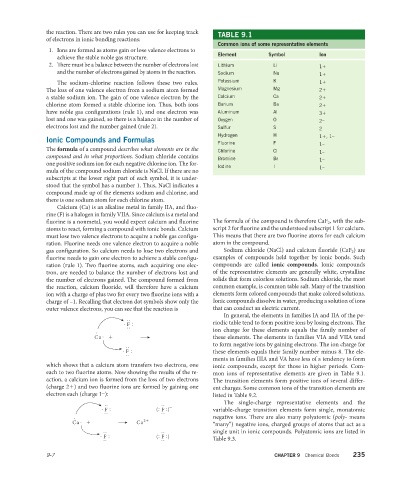
                       outer valence electrons, you can see that the reaction is  that can conduct an electric current.
                                                                                  In general, the elements in families IA and IIA of the pe-
                                                  F O S
                                                 N Q                           riodic table tend to form positive ions by losing electrons. The
                                                                               ion charge for these elements equals the family number of
                                       P                                       these elements. The elements in families VIA and VIIA tend
                                       CaN
                                                                               to form negative ions by gaining electrons. The ion charge for
                                                  F O S
                                                N Q                            these elements equals their family number minus 8. The ele-
                                                                               ments in families IIIA and VA have less of a tendency to form
                       which shows that a calcium atom transfers two electrons, one   ionic compounds, except for those in higher periods. Com-
                       each to two fluorine atoms. Now showing the results of the re-  mon ions of representative elements are given in Table 9.1.
                       action, a calcium ion is formed from the loss of two electrons   The transition elements form positive ions of several differ-
                       (charge 2+) and two fluorine ions are formed by gaining one   ent charges. Some common ions of the transition elements are
                       electron each (charge 1–):                              listed in Table 9.2.
                                                                                  The single-charge representative elements and the
                                                            S O
                                           F O S
                                         N Q                (F) S                variable-charge transition elements form single, monatomic
                                                             Q
                                                                               negative ions. There are also many polyatomic (poly- means
                                P                    Ca 2                      “many”) negative ions, charged groups of atoms that act as a
                                CaN
                                                                               single unit in ionic compounds. Polyatomic ions are listed in
                                                            S O
                                          F O S
                                         N Q                (F) S              Table 9.3.
                                                             Q
                       9-7                                                                         CHAPTER 9  Chemical Bonds   235

