


Page 260 - 9780077418427.pdf
P. 260
/Users/user-f465/Desktop
          tiL12214_ch09_229-250.indd Page 237  9/3/10  10:07 PM user-f465
          tiL12214_ch09_229-250.indd Page 237  9/3/10  10:07 PM user-f465                                               /Users/user-f465/Desktop


                                                                                            HN    S O S       HS Cl
                                                                                                   Cl
                                                                                                    Q
                                                                               Each atom shares a pair of electrons to achieve a noble gas con-
                                                                               figuration. Hydrogen achieves the helium configuration, and
                                                                               chlorine achieves the neon configuration. All the halogens have
                                                                               seven valence electrons, and all need to gain one electron (ionic
                              A                                                bond) or share an electron pair (covalent bond) to achieve a no-
                                                                               ble gas configuration. This also explains why the halogen gases
                                                                               occur as diatomic molecules. Two chlorine atoms can achieve a
                                                                               noble gas configuration by sharing a pair of electrons:

                                                                                                    Cl
                                                                                             Cl
                                                                                           N O S    N O S    S Cl  O S
                                                                                                              O SCl
                                                                                                                  Q
                                                                                                              Q
                                                                                                    Q
                                                                                             Q
                              B                                                Each chlorine atom thus achieves the neon configuration by
                                                                               bonding together. Note that there are two types of electron
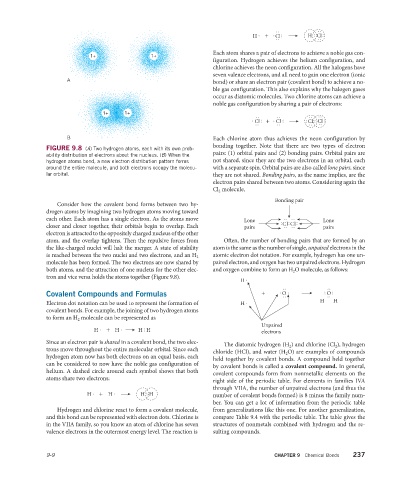
                       FIGURE 9.8  (A) Two hydrogen atoms, each with its own prob-
                                                                               pairs: (1) orbital pairs and (2) bonding pairs. Orbital pairs are
                        ability distribution of electrons about the nucleus. (B) When the
                        hydrogen atoms bond, a new electron distribution pattern forms   not shared, since they are the two electrons in an orbital, each
                        around the entire molecule, and both electrons occupy the molecu-  with a separate spin. Orbital pairs are also called lone pairs, since
                        lar orbital.                                           they are not shared. Bonding pairs, as the name implies, are the
                                                                               electron pairs shared between two atoms. Considering again the
                                                                               Cl 2  molecule,
                                                                                                   Bonding pair
                           Consider how the covalent bond forms between two hy-
                       drogen atoms by imagining two hydrogen atoms moving toward
                       each other. Each atom has a single electron. As the atoms move    Lone            O         Lone
                                                                                                      Cl Cl
                                                                                                      Q Q
                       closer and closer together, their orbitals begin to overlap. Each   pairs     S O S S       pairs
                       electron is attracted to the oppositely charged nucleus of the other
                       atom, and the overlap tightens. Then the repulsive forces from      Often, the number of bonding pairs that are formed by an
                       the like-charged nuclei will halt the merger. A state of stability   atom is the same as the number of single, unpaired electrons in the
                       is reached between the two nuclei and two electrons, and an H 2    atomic electron dot notation. For example, hydrogen has one un-
                       molecule has been formed. The two electrons are now shared by   paired electron, and oxygen has two unpaired electrons. Hydrogen
                       both atoms, and the attraction of one nucleus for the other elec-  and oxygen combine to form an H 2 O molecule, as follows:
                       tron and vice versa holds the atoms together (Figure 9.8).
                                                                                        HN

                       Covalent Compounds and Formulas                                              N O O N        S O O S
                                                                                                                    Q
                                                                                                      Q
                       Electron dot notation can be used to represent the formation of   HN                       H    H
                       covalent bonds. For example, the joining of two hydrogen atoms
                       to form an H 2  molecule can be represented as
                                                                                               Unpaired
                                       HN     HN        HSH                                    electrons

                       Since an electron pair is shared in a covalent bond, the two elec-
                                                                                  The diatomic hydrogen (H 2 ) and chlorine (Cl 2 ), hydrogen
                       trons move throughout the entire molecular orbital. Since each
                                                                               chloride (HCl), and water (H 2 O) are examples of compounds
                       hydrogen atom now has both electrons on an equal basis, each
                                                                               held together by covalent bonds. A compound held together
                       can be considered to now have the noble gas configuration of
                                                                               by covalent bonds is called a covalent compound. In general,
                       helium. A dashed circle around each symbol shows that both
                                                                               covalent compounds form from nonmetallic elements on the
                       atoms share two electrons:
                                                                               right side of the periodic table. For elements in families IVA
                                                                               through VIIA, the number of unpaired electrons (and thus the
                                     HN   HN           HSH                     number of covalent bonds formed) is 8 minus the family num-
                                                                               ber. You can get a lot of information from the periodic table
                           Hydrogen and chlorine react to form a covalent molecule,   from generalizations like this one. For another generalization,
                       and this bond can be represented with electron dots. Chlorine is   compare Table 9.4 with the periodic table. The table gives the
                       in the VIIA family, so you know an atom of chlorine has seven   structures of nonmetals combined with hydrogen and the re-
                       valence electrons in the outermost energy level. The  reaction is  sulting compounds.


                       9-9                                                                         CHAPTER 9  Chemical Bonds   237

