


Page 307 - 9780077418427.pdf
P. 307
/Users/user-f465/Desktop
          tiL12214_ch11_275-298.indd Page 284  9/3/10  6:12 PM user-f465
          tiL12214_ch11_275-298.indd Page 284  9/3/10  6:12 PM user-f465                                                /Users/user-f465/Desktop


                       150
                       140
                       130
                       120
                                                                                    9
                       110             NaNO 3                                   A  volts
                     Solubility (g solute/100 g water)  90  KNO 3  KCl
                       100


                        80
                        70
                        60
                        50
                        40
                                                           NaCl
                                                                                    9
                        30                                                         volts
                        20
                                                                                B
                        10
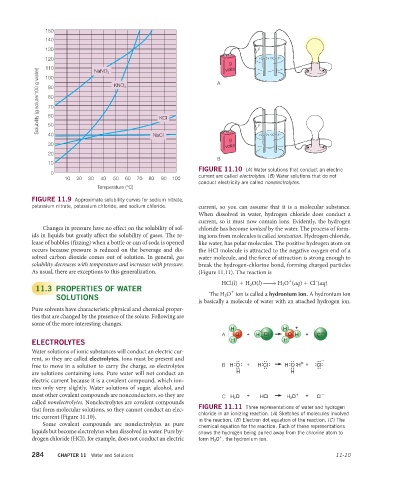
                         0                                                FIGURE 11.10  (A) Water solutions that conduct an electric
                              10  20  30  40  50  60  70  80  90  100     current are called electrolytes. (B) Water solutions that do not
                                                                            conduct electricity are called nonelectrolytes.
                                        Temperature (°C)

                   FIGURE 11.9  Approximate solubility curves for sodium nitrate,
                   potassium nitrate, potassium chloride, and sodium chloride.  current, so you can assume that it is a molecular  substance.
                                                                          When dissolved in water, hydrogen chloride does conduct a
                                                                          current, so it must now contain ions. Evidently, the hydrogen
                      Changes in pressure have no effect on the solubility of sol-  chloride has become ionized by the water. The process of form-
                   ids in liquids but greatly affect the solubility of gases. The re-  ing ions from molecules is called ionization. Hydrogen chloride,
                   lease of bubbles (fizzing) when a bottle or can of soda is opened   like  water, has polar molecules. The positive hydrogen atom on
                   occurs because pressure is reduced on the bever age and dis-  the HCl molecule is attracted to the negative oxygen end of a
                   solved carbon dioxide comes out of solution. In general,  gas   water molecule, and the force of attraction is strong enough to
                     solubility decreases with temperature and increases with pressure.   break the hydrogen-chlorine bond, forming charged particles
                   As usual, there are exceptions to this generalization.  (Figure 11.11). The reaction is
                                                                                                        +        –
                                                                                  HCl(l) + H 2 O(l)  → H 3 O (aq) + Cl (aq)
                    11.3  PROPERTIES OF WATER                                        +
                                                                             The H 3 O  ion is called a hydronium ion. A hydronium ion
                           SOLUTIONS
                                                                          is basically a molecule of water with an attached hydrogen ion.
                   Pure solvents have characteristic physical and chemical proper-
                   ties that are changed by the presence of the solute. Following are
                   some of the more interesting changes.
                                                                                     H                H   +
                                                                                  A   O   +  H  Cl      O H  +   Cl –
                   ELECTROLYTES                                                      H                H
                   Water solutions of ionic substances will conduct an electric cur-
                   rent, so they are called electrolytes. Ions must be present and    ....     ....       .. ..  +  .. ..–
                                                                                      ..
                                                                                                        O H
                                                                                               Cl
                   free to move in a solution to carry the charge, so electrolytes   B H  O  ..  +  H  ..  ..  H  ..  ..  +  Cl ..  ..
                   are solutions containing ions. Pure water will not conduct an      H                  H
                   electric current because it is a covalent compound, which ion-
                   izes only very slightly. Water solutions of sugar, alcohol, and
                   most other covalent compounds are nonconductors, so they are   C  H 2 O  +  HCl     H 3 O +  +  Cl –
                   called nonelectrolytes. Nonelectrolytes are covalent compounds
                   that form molecular solutions, so they cannot conduct an elec-  FIGURE 11.11  Three representations of water and hydrogen
                                                                          chloride in an ionizing reaction. (A) Sketches of molecules involved
                   tric current (Figure 11.10).
                                                                          in the reaction. (B) Electron dot equation of the reaction. (C) The
                      Some covalent compounds are nonelectrolytes as pure   chemical equation for the reaction. Each of these representations
                     liquids but become electrolytes when dissolved in water. Pure hy-  shows the hydrogen being pulled away from the chlorine atom to
                                                                                 +
                   drogen chloride (HCl), for example, does not conduct an  electric   form H 3 O , the hydronium ion.
                   284     CHAPTER 11  Water and Solutions                                                             11-10

