


Page 309 - 9780077418427.pdf
P. 309
/Users/user-f465/Desktop
          tiL12214_ch11_275-298.indd Page 286  9/3/10  6:12 PM user-f465
          tiL12214_ch11_275-298.indd Page 286  9/3/10  6:12 PM user-f465                                                /Users/user-f465/Desktop


                                   H       H  H      H                    the presence of solute particles lowers the freezing point, and so-
                                    O  H    O    H  O                     lutions freeze at a lower temperature than the pure solvent.
                                                                             The freezing-point depression of a solution has a num-
                                   H                 H
                   C 12 H 22 O 11    O                                    ber of interesting implications for solutions such as seawater.
                   dissolved             C 12 H 22 O 11  O
                   in water        H                 H                    When seawater freezes, the water molecules must work their
                                                                          way around the salt particles, as was described in the section
                                    O  H    O    H  O                     on the structure of water molecules. Thus, the solute particles
                   A               H       H  H      H                    are not normally included in the hexagonal structure of ice. Ice
                                                                          formed in seawater is practically pure water. Since the solute was
                                       H  H           H            H        excluded when the ice formed, the freezing of seawater increases
                                        O              O  H     H  O      the salinity. Increased salinity means  increased concentration,
                   NaCl           H      +    H              –            so the freezing point of seawater is  further depressed and more
                   dissolved        O  Na    O              Cl            ice forms only at a lower temperature. When this additional ice
                   in water       H           H           H     H         forms, more pure water is removed, and the process goes on.
                                        O              O          O
                   B                   H  H           H            H      Thus, seawater does not have a fixed freezing point but has a
                                                                          lower and lower freezing point as more and more ice freezes.
                                                                             The depression of the freezing point by a solute has a num-
                                                                          ber of interesting applications in colder climates. Salt, for ex-
                                      H            H
                                       O  H     H  O                      ample, is spread on icy roads to lower the freezing point (and
                                                                          thus the melting point) of the ice. Calcium chloride, CaCl 2 , is a
                                            Cl –                          salt that is often used for this purpose. Water in a car radiator
                                                                          would also freeze in colder climates if a solute, called antifreeze,
                                       O  H     H  O
                                      H            H                      were not added to the radiator water. Methyl alcohol has been
                                                                          used as an antifreeze because it is soluble in water and does not
                                           H   H                          damage the cooling system. Methyl alcohol, however, has a low
                                             O                            boiling point and tends to boil away. Ethylene glycol has a higher
                                       H           H                      boiling point, so it is called a permanent antifreeze. Like other
                   CaCl 2
                   dissolved            O   Ca 2+  O                      solutes, ethylene glycol also raises the boiling point, which is an
                   in water            H           H                      added benefit for summer driving.
                                             O
                                           H  H
                   C
                                      H            H                       11.4  ACIDS, BASES, AND SALTS
                                       O  H     H  O
                                            Cl –                          The electrolytes known as acids, bases, and salts are evident in
                                                                          environmental quality, foods, and everyday living. Environ-
                                       O  H     H  O                      mental quality includes the hardness of water, which is de-
                                      H            H                      termined by the presence of certain salts; the acidity of soils,
                                                                          which determines how well plants grow; and acid rain, which
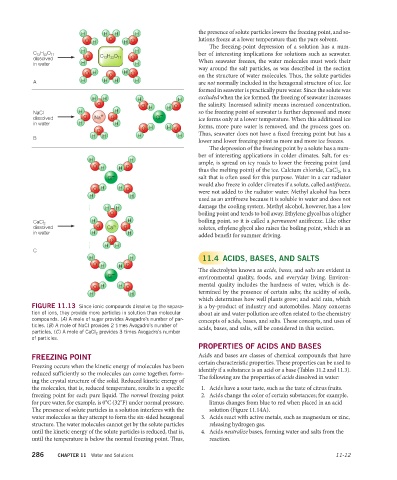
                   FIGURE 11.13  Since ionic compounds dissolve by the separa-  is a by-product of industry and automobiles. Many concerns
                   tion of ions, they provide more particles in solution than molecular   about air and water pollution are often related to the chemistry
                   compounds. (A) A mole of sugar provides Avogadro’s number of par-  concepts of acids, bases, and salts. These concepts, and uses of
                   ticles. (B) A mole of NaCl provides 2 times Avogadro’s number of   acids, bases, and salts, will be considered in this  section.
                   particles. (C) A mole of CaCl 2  provides 3 times Avogadro’s number
                   of particles.
                                                                          PROPERTIES OF ACIDS AND BASES
                   FREEZING POINT                                         Acids and bases are classes of chemical compounds that have
                                                                          certain characteristic properties. These properties can be used to
                   Freezing occurs when the kinetic energy of molecules has been
                                                                          identify if a substance is an acid or a base (Tables 11.2 and 11.3).
                   reduced sufficiently so the molecules can come together, form-
                                                                          The following are the properties of acids dissolved in  water:
                   ing the crystal structure of the solid. Reduced kinetic energy of
                   the molecules, that is, reduced temperature, results in a specific     1.  Acids have a sour taste, such as the taste of citrus fruits.
                   freezing point for each pure liquid. The normal freezing point     2.  Acids change the color of certain substances; for example,
                   for pure water, for example, is 0°C (32°F) under normal pressure.   litmus changes from blue to red when placed in an acid
                   The presence of solute particles in a solution interferes with the   solution (Figure 11.14A).
                   water molecules as they attempt to form the six-sided hexagonal     3.  Acids react with active metals, such as magnesium or zinc,
                   structure. The water molecules cannot get by the solute particles     releasing hydrogen gas.
                   until the kinetic energy of the solute particles is reduced, that is,     4.  Acids neutralize bases, forming water and salts from the
                   until the temperature is below the normal freezing point. Thus,    reaction.

                   286     CHAPTER 11  Water and Solutions                                                             11-12

