


Page 315 - 9780077418427.pdf
P. 315
/Users/user-f465/Desktop
          tiL12214_ch11_275-298.indd Page 292  9/3/10  6:12 PM user-f465
          tiL12214_ch11_275-298.indd Page 292  9/3/10  6:12 PM user-f465                                                /Users/user-f465/Desktop


                           A Closer Look


                           Acid Rain
                         cid rain is a general term used to de-  pollution led to the replacement of short
                     Ascribe any acidic substances, wet or   smokestacks of about 60 m (about 200 ft)
                     dry, that fall from the atmosphere. Wet   with taller smokestacks of about 200 m
                     acidic deposition could be in the form of   (about 650 ft). This did reduce the local
                     rain, but snow, sleet, and fog could also be   levels of pollution by dumping the exhaust
                     involved. Dry acidic deposition could in-  higher in the atmo sphere where winds
                     clude gases, dust, or any solid particles that   could carry it away. It also set the stage for
                     settle out of the atmosphere to produce an   longer-range transport of SO x  and NO x
                     acid condition.                    and their eventual conversion into acids.
                        Pure, unpolluted rain is naturally   There are two main reaction pathways
                     acidic. Carbon dioxide in the atmosphere   by which SO x  and NO x  are converted to
                     is absorbed by rainfall, forming carbonic     acids: (1) reactions in the gas phase and
                     acid (H 2 CO 3 ). Carbonic acid lowers the pH   (2) reactions in the liquid phase, such as in
                     of pure rainfall to a range of 5.6 to 6.2. De-  water droplets in clouds and fog. In the gas
                     caying vegetation in local areas can provide   phase, SO x  and NO x  are oxidized to acids,
                     more CO 2 , making the pH even lower. A pH   mainly by hydroxyl ions and ozone, and the
                     range of 4.5 to 5.0, for example, has been   acid is absorbed by cloud droplets and pre-
                     measured in remote areas of the Amazon   cipitated as rain or snow. Most of the  nitric
                     jungle. Human-produced exhaust emissions   acid in acid rain and about one-fourth of
                     of sulfur and nitrogen oxides can lower the   the sulfuric acid are formed in gas-phase
                     pH of rainfall even more, to a 4.0 to 5.5     reactions. Most of the liquid-phase reac-
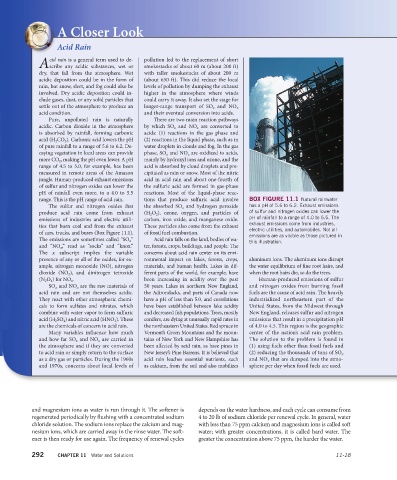
                     range. This is the pH range of acid rain.  tions that produce sulfuric acid involve   BOX FIGURE 11.1 Natural rainwater
                        The sulfur and nitrogen oxides that   the absorbed SO x  and hydrogen peroxide   has a pH of 5.6 to 6.2. Exhaust emissions
                     produce acid rain come from exhaust   (H 2 O 2 ), ozone, oxygen, and particles of   of sulfur and nitrogen oxides can lower the
                     emissions of industries and electric utili-  carbon, iron oxide, and manganese oxide.   pH of rainfall to a range of 4.0 to 5.5. The
                                                                                           exhaust emissions come from industries,
                     ties that burn coal and from the exhaust   These particles also come from the exhaust
                                                                                           electric utilities, and automobiles. Not all
                     of cars, trucks, and buses (Box  Figure 11.1).   of fossil fuel combustion.
                                                                                           emissions are as visible as those pictured in
                     The emissions are sometimes called “SO x ”   Acid rain falls on the land, bodies of wa-
                                                                                           this illustration.
                     and “NO x ,” read as “socks” and “knox.”   ter, forests, crops, buildings, and people. The
                     The  x subscript implies the variable   concerns about acid rain center on its envi-
                     presence of any or all of the oxides, for ex-  ronmental impact on lakes, forests, crops,     aluminum ions. The aluminum ions disrupt
                     ample, nitrogen monoxide (NO), nitrogen   materials, and human health. Lakes in dif-  the water equilibrium of fine root hairs, and
                     dioxide (NO 2 ), and dinitrogen tetroxide   ferent parts of the world, for example, have   when the root hairs die, so do the trees.
                     (N 2 O 4 ) for NO x .              been increasing in acidity over the past   Human-produced emissions of sulfur
                        SO x  and NO x  are the raw materials of     50  years. Lakes in northern New England,   and nitrogen oxides from burning fossil
                     acid rain and are not themselves acidic.   the Adirondacks, and parts of Canada now   fuels are the cause of acid rain. The heavily
                     They react with other atmospheric chemi-  have a pH of less than 5.0, and correlations   industrialized northeastern part of the
                     cals to form sulfates and nitrates, which   have been established between lake acidity   United States, from the Midwest through
                     combine with water vapor to form sulfuric   and decreased fish populations. Trees, mostly   New  England, releases sulfur and nitrogen
                     acid (H 2 SO 4 ) and nitric acid (HNO 3 ). These   conifers, are dying at unusually rapid rates in   emissions that result in a precipitation pH
                     are the chemicals of concern in acid rain.  the northeastern United States. Red spruce in   of 4.0 to 4.5. This region is the geographic
                        Many variables influence how much   Vermont’s Green Mountains and the moun-  center of the nation’s acid rain problem.
                     and how far SO x  and NO x  are carried in   tains of New York and New Hampshire has   The solution to the problem is found in
                     the atmosphere and if they are converted   been affected by acid rain, as have pines in     (1) using fuels other than fossil fuels and
                     to acid rain or simply return to the surface   New Jersey’s Pine Barrens. It is believed that     (2) reducing the thousands of tons of SO x
                     as a dry gas or particles. During the 1960s   acid rain leaches essential nutrients, such   and NO x  that are dumped into the atmo-
                     and 1970s, concerns about local levels of   as calcium, from the soil and also mobilizes   sphere per day when fossil fuels are used.


                   and magnesium ions as water is run through it. The softener is   depends on the water hardness, and each cycle can consume from
                   regenerated periodically by flushing with a concentrated sodium   4 to 20 lb of sodium chloride per renewal cycle. In general,  water
                   chloride solution. The sodium ions replace the calcium and mag-  with less than 75 ppm calcium and magnesium ions is called soft
                   nesium ions, which are carried away in the rinse water. The soft-  water; with greater concentrations, it is called hard water. The
                   ener is then ready for use again. The frequency of renewal cycles   greater the concentration above 75 ppm, the harder the water.

                   292     CHAPTER 11  Water and Solutions                                                             11-18

