


Page 313 - 9780077418427.pdf
P. 313
/Users/user-f465/Desktop
          tiL12214_ch11_275-298.indd Page 290  9/3/10  6:12 PM user-f465
          tiL12214_ch11_275-298.indd Page 290  9/3/10  6:12 PM user-f465                                                /Users/user-f465/Desktop


                    TABLE 11.5

                    The approximate pH of some common substances
                    Substance                         pH (or pH Range)
                    Hydrochloric acid (4%)                  0
                    Gastric (stomach) solution            1.6–1.8
                    Lemon juice                           2.2–2.4
                    Vinegar                               2.4–3.4
                    Carbonated soft drinks                2.0–4.0
                    Grapefruit                            3.0–3.2
                    Oranges                               3.2–3.6
                    Acid rain                             4.0–5.5
                    Tomatoes                              4.2–4.4
                    Potatoes                              5.7–5.8
                    Natural rainwater                     5.6–6.2
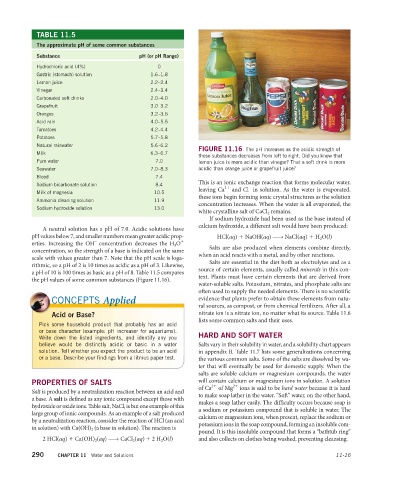
                                                                          FIGURE 11.16  The pH increases as the acidic strength of
                    Milk                                  6.3–6.7
                                                                          these substances decreases from left to right. Did you know that
                    Pure water                              7.0           lemon juice is more acidic than vinegar? That a soft drink is more
                    Seawater                              7.0–8.3         acidic than orange juice or grapefruit juice?
                    Blood                                   7.4
                                                                          This is an ionic exchange reaction that forms molecular water,
                    Sodium bicarbonate solution             8.4                    2+      –
                                                                          leaving Ca  and Cl  in solution. As the water is evaporated,
                    Milk of magnesia                       10.5
                                                                          these ions begin forming ionic crystal structures as the solution
                    Ammonia cleaning solution              11.9
                                                                          concentration increases. When the water is all evaporated, the
                    Sodium hydroxide solution              13.0
                                                                          white crystalline salt of CaCl 2  remains.
                                                                             If sodium hydroxide had been used as the base in stead of
                                                                          calcium hydroxide, a different salt would have been  produced:
                      A neutral solution has a pH of 7.0. Acidic solutions have
                   pH values below 7, and smaller numbers mean greater acidic prop-  HCl(aq) + NaOH(aq)  → NaCl(aq) + H 2 O(l)
                                       –                            +
                   erties. Increasing the OH  concentration decreases the H 3 O
                                                                             Salts are also produced when elements combine directly,
                   concentration, so the strength of a base is indicated on the same
                                                                          when an acid reacts with a metal, and by other reactions.
                   scale with values greater than 7. Note that the pH scale is loga-
                                                                             Salts are essential in the diet both as electrolytes and as a
                   rithmic, so a pH of 2 is 10 times as acidic as a pH of 3. Likewise,
                                                                          source of certain elements, usually called minerals in this con-
                   a pH of 10 is 100 times as basic as a pH of 8. Table 11.5 compares
                                                                          text. Plants must have certain elements that are derived from
                   the pH values of some common substances (Figure 11.16).
                                                                          water-soluble salts. Potassium, nitrates, and phosphate salts are
                                                                          often used to supply the needed elements. There is no scientific
                         CONCEPTS Applied                                 evidence that plants prefer to obtain these elements from natu-
                                                                          ral sources, as compost, or from chemical fertilizers. After all, a
                         Acid or Base?                                    nitrate ion is a nitrate ion, no matter what its source. Table 11.6
                                                                          lists some common salts and their uses.
                     Pick some household product that probably has an acid
                     or base character (example: pH increaser for aquariums).
                     Write down the listed ingredients, and identify any you   HARD AND SOFT WATER
                     believe would be distinctly acidic or basic in a water   Salts vary in their solubility in water, and a solubility chart  appears
                       solution. Tell whether you expect the product to be an acid   in appendix B. Table 11.7 lists some generalizations concerning
                     or a base.  Describe your findings from a litmus paper test.  the various common salts. Some of the salts are dissolved by wa-
                                                                          ter that will eventually be used for domestic supply. When the
                                                                          salts are soluble calcium or magnesium compounds, the water
                   PROPERTIES OF SALTS                                    will contain calcium or magnesium ions in solution. A solution
                                                                                     2+
                                                                              2+
                                                                          of Ca  of Mg  ions is said to be hard water because it is hard
                   Salt is produced by a neutralization reaction between an acid and
                                                                          to make soap lather in the water. “Soft” water, on the other hand,
                   a base. A salt is defined as any ionic compound except those with
                                                                          makes a soap lather easily. The difficulty occurs  because soap is
                   hydroxide or oxide ions. Table salt, NaCl, is but one example of this
                                                                          a sodium or potassium compound that is soluble in water. The
                   large group of ionic compounds. As an example of a salt produced
                                                                          calcium or  magnesium ions, when present,  replace the sodium or
                   by a neutralization reaction, consider the reaction of HCl (an acid
                                                                            potassium ions in the soap compound, forming an insoluble com-
                   in solution) with Ca(OH) 2  (a base in solution). The reaction is
                                                                          pound. It is this insoluble compound that forms a  “bathtub ring”
                                                                          and also collects on clothes being washed,  preventing cleansing.
                      2 HCl(aq) + Ca(OH) 2 (aq)  → CaCl 2 (aq)   + 2 H 2 O(l)
                   290     CHAPTER 11  Water and Solutions                                                             11-16

