


Page 312 - 9780077418427.pdf
P. 312
/Users/user-f465/Desktop
tiL12214_ch11_275-298.indd Page 289 9/3/10 6:12 PM user-f465
tiL12214_ch11_275-298.indd Page 289 9/3/10 6:12 PM user-f465 /Users/user-f465/Desktop
an acidic or a basic solution. To understand how the scale is
able to express both acid and base strength in terms of the
hydronium ion, first note that pure water is very slightly ion-
ized in the reaction:
+ –
H 2 O(l) + H 2 O(l) → H 3 O (aq) + OH (aq)
The amount of self-ionization by water has been determined
through measurements. In pure water at 25°C or any neutral
+
water solution at that temperature, the H 3 O concentra-
–
–7
tion is 1 × 10 mole/L, and the OH concentration is also
–7
1 × 10 mole/L. Since both ions are produced in equal
+ –
numbers, the H 3 O concentration equals the OH concentra-
tion, and pure water is neutral, neither acidic nor basic.
In general, adding an acid substance to pure water in-
+
creases the H 3 O concentration. Adding a base substance to
–
pure water increases the OH concentration. Adding a base
+ –
also reduces the H 3 O concentration as the additional OH
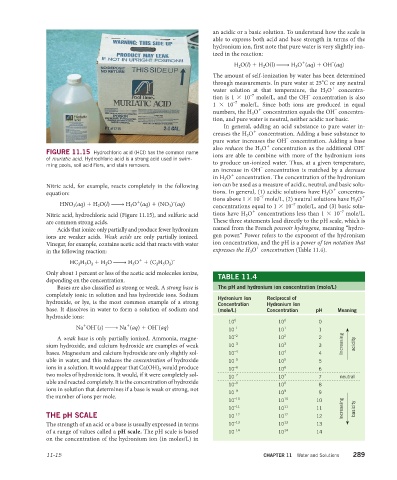
FIGURE 11.15 Hydrochloric acid (HCl) has the common name ions are able to combine with more of the hydronium ions
of muriatic acid. Hydrochloric acid is a strong acid used in swim-
ming pools, soil acidifiers, and stain removers. to produce un-ionized water. Thus, at a given temperature,
–
an increase in OH concentration is matched by a decrease
+
in H 3 O concentration. The concentration of the hydronium
Nitric acid, for example, reacts completely in the following ion can be used as a measure of acidic, neutral, and basic solu-
+
equation: tions. In general, (1) acidic solutions have H 3 O concentra-
+
–7
tions above 1 × 10 mole/L, (2) neutral solutions have H 3 O
+ –
concentrations equal to 1 × 10 mole/L, and (3) basic solu-
HNO 3 (aq) + H 2 O(l) → H 3 O (aq) + (NO 3 ) (aq) –7
+ –7
Nitric acid, hydrochloric acid (Figure 11.15), and sulfuric acid tions have H 3 O concentrations less than 1 × 10 mole/L.
are common strong acids. These three statements lead directly to the pH scale, which is
Acids that ionize only partially and produce fewer hydronium named from the French pouvoir hydrogene, meaning “hydro-
ions are weaker acids. Weak acids are only partially ionized. gen power.” Power refers to the exponent of the hydronium
Vinegar, for example, contains acetic acid that reacts with water ion concentration, and the pH is a power of ten notation that
+
in the following reaction: expresses the H 3 O concentration (Table 11.4).
+
HC 2 H 3 O 2 + H 2 O → H 3 O + (C 2 H 3 O 2 ) –
Only about 1 percent or less of the acetic acid molecules ionize, TABLE 11.4
depending on the concentration.
Bases are also classified as strong or weak. A strong base is The pH and hydronium ion concentration (mole/L)
completely ionic in solution and has hydroxide ions. Sodium
Hydronium Ion Reciprocal of
hydroxide, or lye, is the most common example of a strong Concentration Hydronium Ion
base. It dissolves in water to form a solution of sodium and (mole/L) Concentration pH Meaning
hydroxide ions:
10 0 10 0 0
+ – + –
Na OH (s) → Na (aq) + OH (aq) 10 –1 10 1 1
A weak base is only partially ionized. Ammonia, magne- 10 –2 10 2 2
sium hydroxide, and calcium hydroxide are examples of weak 10 –3 10 3 3 Increasing acidity
bases. Magnesium and calcium hydroxide are only slightly sol- 10 –4 10 4 4
uble in water, and this reduces the concentration of hydroxide 10 –5 10 5 5
ions in a solution. It would appear that Ca(OH) 2 would produce 10 –6 10 6 6
two moles of hydroxide ions. It would, if it were completely sol- 10 –7 10 7 7 neutral
uble and reacted completely. It is the concentration of hydroxide –8 8
10 10 8
ions in solution that determines if a base is weak or strong, not
10 –9 10 9 9
the number of ions per mole.
10 –10 10 10 10
10 –11 10 11 11 Increasing basicity
THE pH SCALE 10 –12 10 12 12
The strength of an acid or a base is usually expressed in terms 10 –13 10 13 13
of a range of values called a pH scale. The pH scale is based 10 –14 10 14 14
on the concentration of the hydronium ion (in moles/L) in
11-15 CHAPTER 11 Water and Solutions 289

