


Page 314 - 9780077418427.pdf
P. 314
/Users/user-f465/Desktop
          tiL12214_ch11_275-298.indd Page 291  9/3/10  6:12 PM user-f465
          tiL12214_ch11_275-298.indd Page 291  9/3/10  6:12 PM user-f465                                                /Users/user-f465/Desktop


                                                                                  The key to “softening” hard water is to remove the trouble-
                         TABLE 11.6
                                                                               some calcium and magnesium ions. If the hardness is caused by
                         Some common salts and their uses                      magnesium or calcium bicarbonates, the removal is accomplished
                                                                               by simply heating the water. Upon heating, they decompose,
                         Common Name     Formula      Use
                                                                               forming an insoluble compound that effectively  removes the ions
                         Alum            KAI(SO 4 ) 2    Medicine, canning, baking  from solution. The decomposition reaction for calcium bicarbon-
                                                       powder
                                                                               ate is
                         Baking soda     NaHCO 3      Fire extinguisher, antacid,    2+
                                                       deodorizer, baking          Ca (HCO 3 ) 2 (aq)  → CaCO 3 (s) + H 2 O(l) + CO 2  ↑
                                                       powder
                                                                               The reaction is the same for magnesium bicarbonate. As the
                         Bleaching powder   CaOCl 2   Bleaching, deodorizer,
                            (chlorine tablets)          disinfectant in          solubility chart in appendix B shows, magnesium and calcium car-
                                                       swimming pools          bonates are insoluble, so the ions are removed from solution in the
                         Borax           Na 2 B 4 O 7  Water softener          solid that is formed. Perhaps you have noticed such a white com-
                                                                               pound forming around faucets if you live where  bicarbonates are
                         Chalk           CaCO 3       Antacid tablets, scouring
                                                       powder                  a problem. Commercial products to remove such deposits usually
                         Cobalt chloride   CoCl 2     Hygrometer (pink in      contain an acid, which reacts with the  carbonate to make a new,
                                                        damp weather, blue in  soluble salt that can be washed away.
                                                       dry weather)               Water hardness is also caused by magnesium or calcium
                         Chile saltpeter   NaNO 3     Fertilizer                 sulfate, which requires a different removal method. Certain
                         Epsom salt      MgSO 4 ⋅7 H 2 O  Laxative             chemicals such as sodium carbonate (washing soda), trisodium
                         Fluorspar       CaF 2        Metallurgy flux          phosphate (TSP), and borax will react with the troublesome ions,
                         Gypsum          CaSO 4 ⋅2 H 2 O   Plaster of Paris, soil  forming an insoluble solid that removes them from solution. For
                                                       conditioner             example, washing soda and calcium sulfate react as follows:
                         Lunar caustic   AgNO 3       Germicide and cauterizing   Na 2 CO 3 (aq) + CaSO 4 (aq)  → Na 2 SO 4 (aq) + CaCO 3  ↓
                                                       agent
                         Niter (or saltpeter)   KNO 3    Meat preservative, makes  Calcium carbonate is insoluble; thus, the calcium ions are re-
                                                       black gunpowder         moved from solution before they can react with the soap. Many
                                                        (75 parts KNO 3 , 15   laundry detergents have Na 2 CO 3 , TSP, or borax (Na 2 B 4 O 7 )
                                                        of carbon, 10 of sulfur)
                                                                               added to soften the water. TSP causes problems, however,
                         Potash          K 2 CO 3     Makes soap, glass
                                                                               because the additional phosphates in the wastewater can act as a
                         Rochelle salt   KNaC 4 H 4 O 6    Baking powder ingredient  fertilizer, stimulating the growth of algae to such an extent that
                         TSP             Na 3 PO 4    Water softener, fertilizer  other organisms in the water die.
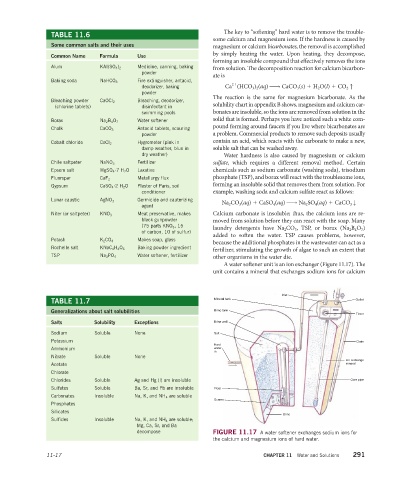
                                                                                  A water softener unit is an ion exchanger (Figure 11.17). The
                                                                               unit contains a mineral that exchanges sodium ions for calcium


                                                                                                     Inlet
                         TABLE 11.7                                            Mineral tank                                   Outlet
                         Generalizations about salt solubilities               Brine tank
                                                                                                                              Timer
                         Salts         Solubility    Exceptions                Brine well
                         Sodium        Soluble       None                      Salt
                         Potassium                                                                                            Drain
                                                                               Hard
                         Ammonium                                              water
                                                                               in
                         Nitrate       Soluble       None
                                                                                                                           Ion exchange
                         Acetate                                                                                           mineral
                         Chlorate
                         Chlorides      Soluble      Ag and Hg (l) are insoluble                                            Core pipe
                         Sulfates       Soluble      Ba, Sr, and Pb are insoluble  Float
                         Carbonates     Insoluble    Na, K, and NH 4  are soluble
                                                                               Screen
                         Phosphates
                         Silicates
                                                                                                      Brine
                         Sulfides       Insoluble    Na, K, and NH 4  are soluble;
                                                       Mg, Ca, Sr, and Ba
                                                      decompose                FIGURE 11.17  A water softener exchanges sodium ions for
                                                                               the calcium and magnesium ions of hard water.

                       11-17                                                                   CHAPTER 11  Water and Solutions   291

