


Page 311 - 9780077418427.pdf
P. 311
/Users/user-f465/Desktop
          tiL12214_ch11_275-298.indd Page 288  9/3/10  6:12 PM user-f465
          tiL12214_ch11_275-298.indd Page 288  9/3/10  6:12 PM user-f465                                                /Users/user-f465/Desktop


                      Examples of bases include solutions of sodium hydroxide   For example, hydrogen chloride dissolved in water has the fol-
                   (NaOH), which has a common name of lye or caustic soda,   lowing reaction:
                   and potassium hydroxide (KOH), which has a common name
                   of caustic potash. These two bases are used in products known


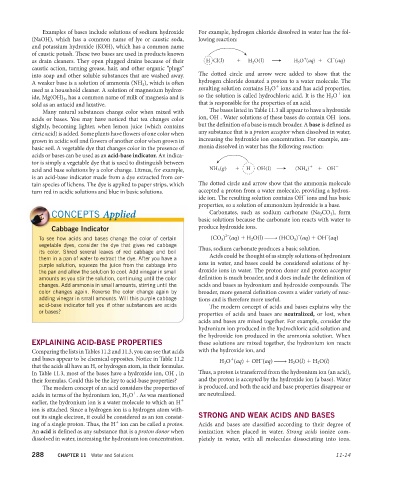
                   as drain cleaners. They open plugged drains because of their   HCl(l)          H 2 O(l)             H 3 O     (aq)    Cl     (aq)
                   caustic action, turning grease, hair, and other organic “plugs”
                   into soap and other soluble substances that are washed away.   The dotted circle and arrow were added to show that the
                   A weaker base is a solution of ammonia (NH 3 ), which is often     hydrogen chloride donated a proton to a water molecule. The
                                                                                                   +
                   used as a household cleaner. A solution of  magnesium hydrox-  resulting solution contains H 3 O  ions and has acid properties,
                                                                                                                        +
                   ide, Mg(OH) 2 , has a common name of milk of magnesia and is   so the solution is called hydrochloric acid. It is the H 3 O  ion
                   sold as an antacid and laxative.                       that is responsible for the properties of an acid.
                      Many natural substances change color when mixed with   The bases listed in Table 11.3 all appear to have a hydroxide
                                                                                 –
                                                                                                                       –
                   acids or bases. You may have noticed that tea changes color   ion, OH . Water solutions of these bases do contain OH  ions,
                   slightly, becoming lighter, when lemon juice (which contains   but the definition of a base is much broader. A base is defined as
                   citric acid) is added. Some plants have flowers of one color when   any substance that is a proton acceptor when dissolved in water,
                   grown in acidic soil and flowers of another color when grown in   increasing the hydroxide ion concentration. For example, am-
                   basic soil. A vegetable dye that changes color in the presence of   monia dissolved in water has the following reaction:
                   acids or bases can be used as an acid-base indicator. An indica-
                   tor is simply a vegetable dye that is used to distinguish between
                   acid and base solutions by a color change.  Litmus, for example,   NH 3 (g)       H      OH(l)          (NH 4 )    OH
                   is an acid-base indicator made from a dye extracted from cer-
                   tain species of lichens. The dye is  applied to paper strips, which   The dotted circle and arrow show that the ammonia molecule
                   turn red in acidic solutions and blue in  basic solutions.  accepted a proton from a water molecule, providing a hydrox-
                                                                                                             –
                                                                          ide ion. The resulting solution contains OH  ions and has basic
                                                                          properties, so a solution of ammonium hydroxide is a base.
                         CONCEPTS Applied                                    Carbonates, such as sodium carbonate (Na 2 CO 3 ), form
                                                                            basic solutions because the carbonate ion reacts with water to
                         Cabbage Indicator                                produce hydroxide ions.
                                                                                   2–                      –        –

                     To see how acids and bases change the color of certain   (CO 3 ) (aq) +H 2 O(l)  → (HCO 3 ) (aq)   + OH (aq)
                     vegetable dyes, consider the dye that gives red cabbage
                                                                          Thus, sodium carbonate produces a basic solution.
                     its color. Shred several leaves of red cabbage and boil
                                                                             Acids could be thought of as simply solutions of hydronium
                     them in a pan of water to extract the dye. After you have a
                                                                          ions in water, and bases could be considered solutions of hy-
                     purple solution, squeeze the juice from the cabbage into
                     the pan and allow the solution to cool. Add vinegar in small   droxide ions in water. The proton donor and proton acceptor
                     amounts as you stir the  solution, continuing until the color   definition is much broader, and it does include the definition of
                     changes. Add ammonia in small amounts, stirring until the   acids and bases as hydronium and hydroxide compounds. The
                     color changes again. Reverse the color change again by   broader, more general definition covers a wider variety of reac-
                     adding vinegar in small amounts. Will this purple cabbage   tions and is therefore more useful.
                     acid-base indicator tell you if other substances are acids   The modern concept of acids and bases explains why the
                     or bases?
                                                                          properties of acids and bases are  neutralized, or lost, when
                                                                          acids and bases are mixed together. For example, consider the
                                                                          hydronium ion produced in the hydrochloric acid solution and
                                                                          the hydroxide ion produced in the ammonia solution. When
                   EXPLAINING ACID-BASE PROPERTIES                        these solutions are mixed together, the hydronium ion reacts
                   Comparing the lists in Tables 11.2 and 11.3, you can see that acids   with the hydroxide ion, and
                   and bases appear to be chemical opposites. Notice in Table 11.2   +         –
                                                                                 H 3 O (aq) + OH (aq)  → H 2 O(l) + H 2 O(l)
                   that the acids all have an H, or hydrogen atom, in their formulas.
                                                                  –
                   In Table 11.3, most of the bases have a hydroxide ion, OH , in   Thus, a proton is transferred from the hydronium ion (an acid),
                   their formulas. Could this be the key to acid-base properties?  and the proton is accepted by the hydroxide ion (a base). Water
                      The modern concept of an acid considers the properties of   is produced, and both the acid and base properties  disappear or
                                                    +
                   acids in terms of the hydronium ion, H 3 O . As was mentioned   are neutralized.
                                                                    +
                   earlier, the hydronium ion is a water molecule to which an H
                   ion is attached. Since a hydrogen ion is a hydrogen atom with-
                   out its single electron, it could be considered as an ion consist-  STRONG AND WEAK ACIDS AND BASES
                                              +
                   ing of a single proton. Thus, the H  ion can be called a proton.   Acids and bases are classified according to their degree of
                   An acid is defined as any substance that is a proton donor when     ionization when placed in water.  Strong acids ionize com-
                   dissolved in water, increasing the hydronium ion concentration.   pletely in water, with all molecules dissociating into ions.

                   288     CHAPTER 11  Water and Solutions                                                             11-14

