


Page 331 - 9780077418427.pdf
P. 331
/Users/user-f465/Desktop
          tiL12214_ch12_299-322.indd Page 308  9/3/10  6:13 PM user-f465
          tiL12214_ch12_299-322.indd Page 308  9/3/10  6:13 PM user-f465                                                /Users/user-f465/Desktop


                    TABLE 12.5                                                            Methanol
                                                                                              H
                    Selected organic functional groups
                                                                                          H   C   OH
                    Name of               General       General
                    Functional Group      Formula       Structure
                                                                                              H
                    Organic halide       RCl            R  Cl                             (methyl alcohol)

                    Alcohol              ROH            R  O   H                          Ethanol
                                                                                              H   H
                    Ether                ROR´           R  O   R´
                                                                                          H   C   C   OH
                    Aldehyde             RCHO           R  C   H                              H   H
                                                           O                              (ethyl alcohol)

                    Ketone               RCOR´          R  C   R´                         1-propanol
                                                           O                                  H   H   H
                    Organic acid         RCOOH          R  C   O  H                       H   C   C   C  OH
                                                           O                                  H   H   H
                                                                                          (n-propyl alcohol)
                    Ester                RCOOR´         R R  C C  O O  R´

                                                           O O                            2-propanol
                                                                                              H  OH   H
                    Amine                RNH 2          R  N   H
                                                                                          H   C   C   C  H
                                                           H
                                                                                              H   H   H
                                                                                          (isopropyl alcohol)
                   ALCOHOLS
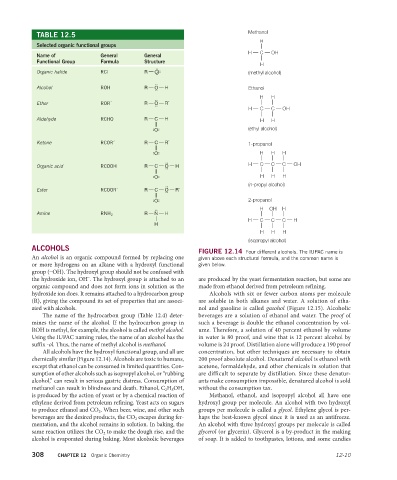
                                                                          FIGURE 12.14  Four different alcohols. The IUPAC name is
                   An alcohol is an organic compound formed by replacing one   given above each structural formula, and the common name is
                   or more hydrogens on an alkane with a hydroxyl functional   given below.
                   group (–OH). The hydroxyl group should not be confused with
                                     –
                   the hydroxide ion, OH . The hydroxyl group is attached to an   are produced by the yeast  fermentation  reaction, but some are
                     organic compound and does not form ions in solution as the   made from ethanol derived from petroleum refining.
                   hydroxide ion does. It remains attached to a hydrocarbon group   Alcohols with six or fewer carbon atoms per molecule
                   (R), giving the compound its set of properties that are associ-  are soluble in both alkanes and water. A solution of etha-
                   ated with alcohols.                                    nol and gasoline is called gasohol (Figure 12.15). Alcoholic
                      The name of the hydrocarbon group (Table 12.4) deter-  beverages are a solution of ethanol and water. The proof of
                   mines the name of the alcohol. If the hydrocarbon group in   such a  beverage is double the ethanol concentration by vol-
                   ROH is methyl, for example, the alcohol is called methyl  alcohol.   ume. Therefore, a solution of 40 percent ethanol by volume
                   Using the IUPAC naming rules, the name of an alcohol has the   in water is 80 proof, and wine that is 12 percent alcohol by
                   suffix -ol. Thus, the name of methyl alcohol is methanol.  volume is 24 proof. Distillation alone will produce a 190 proof
                      All alcohols have the hydroxyl functional group, and all are   concentration, but other techniques are necessary to obtain
                   chemically similar (Figure 12.14). Alcohols are toxic to humans,   200 proof absolute  alcohol. Denatured alcohol is ethanol with
                   except that ethanol can be consumed in limited quantities. Con-  acetone,  formaldehyde, and other chemicals in solution that
                   sumption of other alcohols such as isopropyl alcohol, or “rubbing   are difficult to  separate by  distillation. Since these denatur-
                   alcohol,” can result in serious gastric distress. Consumption of   ants make consump tion impossible, denatured alcohol is sold
                   methanol can result in blindness and death. Ethanol, C 2 H 5 OH,   without the consumption tax.
                   is produced by the action of yeast or by a chemical reaction of   Methanol, ethanol, and isopropyl alcohol all have one
                   ethylene derived from petroleum refining. Yeast acts on sugars   hydroxyl group per molecule. An alcohol with two hydroxyl
                   to produce ethanol and CO 2 . When beer, wine, and other such   groups per molecule is called a glycol. Ethylene glycol is per-
                   beverages are the desired products, the CO 2  escapes during fer-  haps the best-known glycol since it is used as an antifreeze.
                   mentation, and the alcohol remains in solution. In baking, the   An alcohol with three hydroxyl groups per molecule is called
                   same reaction utilizes the CO 2  to make the dough rise, and the   glycerol (or glycerin). Glycerol is a by-product in the making
                   alcohol is evaporated during  baking. Most alcoholic beverages   of soap. It is added to toothpastes, lotions, and some candies

                   308     CHAPTER 12 Organic Chemistry                                                                12-10

