


Page 355 - 9780077418427.pdf
P. 355
/Users/user-f465/Desktop
          tiL12214_ch13_323-350.indd Page 332  9/3/10  6:14 PM user-f465
          tiL12214_ch13_323-350.indd Page 332  9/3/10  6:14 PM user-f465                                                /Users/user-f465/Desktop


                           A Closer Look


                           How Is Half-Life Determined?
                       t is not possible to predict when a radio-  isotope has its own decay constant that can   The half-life of uranium-238 is therefore
                     Iactive nucleus will decay because it is a   be measured. For example, a 238 g  sample of   __
                                                                                      6


                     random process. It is possible, however, to   uranium-238 (1 mole) that has 2.93  × 10    half-life =     a mathematical constant
                                                                                                           decay constant
                     deal with nuclear disintegration statistically,   disintegrations per second would have a
                                                                                                           0.693

                     since the rate of decay is not changed by any     decay constant of                =   __


                                                                                                              –18
                     external conditions of temperature or pres-  radioactive decay  decay rate        4.87 × 10  l∙s
                                                                      =


                                                                                                              17
                     sure, or any chemical state. When dealing                __                      = 1.42 × 10  s


                     with a large number of nuclei, the ratio of   constant  number of nuclei
                                                                               6
                                                                        2.93 × 10  nuclei∙s
                     the rate of nuclear disintegration per unit                               =   __     This is the half-life of uranium-238 in


                                                                               23
                     of time to the total number of radioactive         6.02 × 10  nuclei  seconds. There are 60 × 60 × 24 × 365, or
                                                                                                  7
                     nuclei is a constant, or                                      = 4.87 × 10  l/s  3.15 × 10 , seconds in a year, so
                                                                               –18
                                                                                                       17
                                                                                                1.42 × 10  s
                       radioactive decay  decay rate                                           __                  9


                               __                          The half-life of a radioactive nucleus is         7    = 4.5 × 10  yr
                                    =


                       constant       number of nuclei  related to its radioactive decay constant by  3.15 × 10  s∙yr
                                                                                           The half-life of uranium-238 is thus 4.5
                     The radioactive decay constant is a specific   __
                                                                    a mathematical constant

                                                            half-life =                    billion years.
                     constant for a particular isotope, and each        decay constant
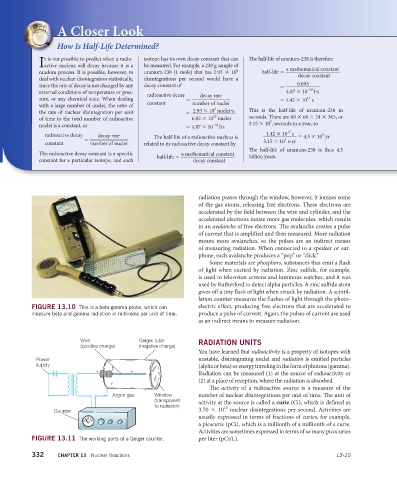
                                                                            radiation passes through the window, however, it ionizes some
                                                                          of the gas atoms, releasing free electrons. These electrons are
                                                                          accelerated by the field between the wire and cylinder, and the
                                                                          accelerated electrons ionize more gas molecules, which results
                                                                          in an  avalanche of free electrons. The avalanche creates a pulse
                                                                          of current that is amplified and then measured. More radiation
                                                                          means more avalanches, so the pulses are an indirect means
                                                                          of measuring radiation. When connected to a speaker or ear-
                                                                          phone, each avalanche produces a “pop” or “click.”
                                                                             Some materials are phosphors, substances that emit a flash
                                                                          of light when excited by radiation. Zinc sulfide, for  example,
                                                                          is used in television screens and luminous watches, and it was
                                                                          used by Rutherford to detect alpha particles. A zinc sulfide atom
                                                                          gives off a tiny flash of light when struck by radiation. A scintil-
                                                                          lation counter measures the flashes of light through the photo-
                   FIGURE 13.10  This is a beta-gamma probe, which can    electric effect, producing free electrons that are accelerated to
                   measure beta and gamma radiation in millirems per unit of time.  produce a pulse of current. Again, the pulses of current are used
                                                                          as an indirect means to measure  radiation.
                                   Wire               Geiger tube         RADIATION UNITS
                                   (positive charge)  (negative charge)
                                                                          You have learned that radioactivity is a property of isotopes with
                    Power                                                 unstable, disintegrating nuclei and radiation is emitted particles
                    supply                                                (alpha or beta) or energy traveling in the form of photons (gamma).
                                        +          +
                                                                          Radiation can be measured (1) at the source of radio activity or
                                                                          (2) at a place of reception, where the radiation is absorbed.
                                                   –                         The  activity of a radioactive source is a measure of the
                                          –  Argon gas     Window         number of nuclear disintegrations per unit of time. The unit of
                                                           (transparent
                                                           to radiation)  activity at the source is called a curie (Ci), which is defined as
                                                                                  10
                          Counter                                         3.70 × 10  nuclear disintegrations per second. Activities are
                                                                          usually expressed in terms of fractions of curies, for example,
                                                                          a picocurie (pCi), which is a millionth of a millionth of a curie.
                                                                          Activities are sometimes expressed in terms of so many pi cocuries
                   FIGURE 13.11  The working parts of a Geiger counter.   per liter (pCi/L).
                   332     CHAPTER 13 Nuclear Reactions                                                                13-10

