


Page 352 - 9780077418427.pdf
P. 352
/Users/user-f465/Desktop
          tiL12214_ch13_323-350.indd Page 329  9/3/10  6:14 PM user-f465
          tiL12214_ch13_323-350.indd Page 329  9/3/10  6:14 PM user-f465                                                /Users/user-f465/Desktop


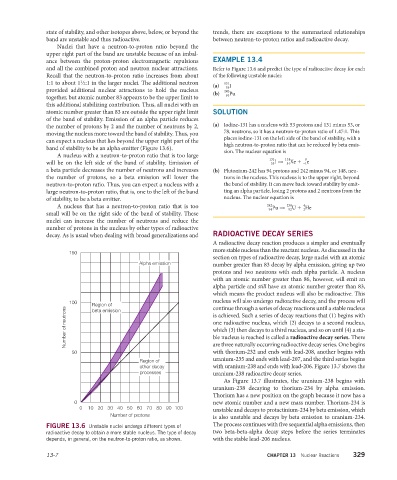
                       state of stability, and other isotopes above, below, or beyond the   trends, there are exceptions to the summarized  relationships
                       band are unstable and thus radioactive.                 between neutron-to-proton ratios and radioactive decay.
                           Nuclei that have a neutron-to-proton ratio beyond the
                       upper right part of the band are unstable because of an imbal-
                       ance between the proton-proton electromagnetic repulsions   EXAMPLE 13.4
                       and all the combined proton and neutron nuclear attractions.   Refer to Figure 13.6 and predict the type of radioactive decay for each
                       Recall that the neutron-to-proton ratio increases from about   of the following unstable nuclei:
                                   1
                       1:1 to about 1 ⁄2:1 in the larger nuclei. The additional neutron   131
                                                                               (a)         I
                                                                                      53
                         provided additional nuclear attractions to hold the nucleus   242
                                                                               (b)         Pu
                                                                                      94
                         together, but atomic number 83 appears to be the upper limit to
                       this additional stabilizing contribution. Thus, all nuclei with an
                       atomic number greater than 83 are outside the upper right limit   SOLUTION
                       of the band of stability. Emission of an alpha particle reduces
                       the number of protons by 2 and the number of neutrons by 2,   (a)  Iodine-131 has a nucleus with 53 protons and 131 minus 53, or
                                                                                  78, neutrons, so it has a neutron-to-proton ratio of 1.47:1. This
                       moving the nucleus more toward the band of stability. Thus, you
                                                                                  places iodine-131 on the left side of the band of stability, with a
                       can expect a nucleus that lies beyond the upper right part of the
                                                                                  high neutron-to-proton ratio that can be reduced by beta emis-
                       band of stability to be an alpha emitter (Figure 13.6).
                                                                                  sion. The nuclear equation is
                           A nucleus with a neutron-to-proton ratio that is too large
                                                                                                       131
                                                                                                 131
                                                                                                               0
                       will be on the left side of the band of stability. Emission of                     I →          Xe +           e
                                                                                                         54
                                                                                                             –1
                                                                                                   53
                       a beta particle decreases the number of neutrons and increases   (b)  Plutonium-242 has 94 protons and 242 minus 94, or 148, neu-
                       the number of protons, so a beta emission will lower the   trons in the nucleus. This nucleus is to the upper right, beyond
                       neutron-to-proton ratio. Thus, you can expect a nucleus with a   the band of stability. It can move back toward stability by emit-
                       large  neutron-to-proton ratio, that is, one to the left of the band   ting an alpha particle, losing 2 protons and 2 neutrons from the
                       of stability, to be a beta emitter.                        nucleus. The nuclear equation is
                           A nucleus that has a neutron-to-proton ratio that is too              242   238   4 2
                                                                                                          Pu →          U +         He
                                                                                                         92
                                                                                                   94
                       small will be on the right side of the band of stability. These
                       nuclei can increase the number of neutrons and reduce the
                       number of protons in the nucleus by other types of radioactive
                       decay. As is usual when dealing with broad generalizations and   RADIOACTIVE DECAY SERIES
                                                                               A radioactive decay reaction produces a simpler and eventually
                               150                                             more stable nucleus than the reactant nucleus. As discussed in the
                                                                               section on types of radioactive decay, large nuclei with an atomic
                                                      Alpha emission           number greater than 83 decay by alpha emission, giving up two
                                                                               protons and two neutrons with each alpha particle. A nucleus
                                                                               with an atomic number greater than 86, however, will emit an
                                                                               alpha particle and still have an atomic number greater than 83,
                                                                               which means the product nucleus will also be radioactive. This
                               100     Region of                               nucleus will also undergo radioactive decay, and the process will
                                                                               continue through a series of decay reactions until a stable nucleus
                              Number of neutrons                               is achieved. Such a series of decay reactions that (1) begins with
                                       beta emission
                                                                               one radioactive nucleus, which (2) decays to a second nucleus,
                                                                               which (3) then decays to a third nucleus, and so on until (4) a sta-
                                                                               ble nucleus is reached is called a radioactive  decay series. There
                                                                               with thorium-232 and ends with lead-208, another begins with
                                50                                             are three naturally occurring radioactive decay series. One begins
                                                      Region of                uranium-235 and ends with lead-207, and the third series begins
                                                      other decay              with uranium-238 and ends with lead-206. Figure 13.7 shows the
                                                      processes                uranium-238 radioactive decay series.
                                                                                  As Figure 13.7 illustrates, the uranium-238 begins with
                                                                                 uranium-238 decaying to thorium-234 by alpha emission.
                                                                               Thorium has a new position on the graph because it now has a
                                 0                                             new atomic number and a new mass number. Thorium-234 is
                                   0  10 20 30 40 50 60 70 80 90 100           unstable and decays to protactinium-234 by beta emission, which
                                             Number of protons                 is also unstable and decays by beta emission to uranium-234.
                                                                               The process continues with five sequential alpha emissions, then
                       FIGURE 13.6  Unstable nuclei undergo different types of
                       radioactive decay to obtain a more stable nucleus. The type of decay   two beta-beta-alpha decay steps before the series terminates
                       depends, in general, on the neutron-to-proton ratio, as shown.  with the stable lead-206 nucleus.

                       13-7                                                                      CHAPTER 13  Nuclear Reactions   329

