


Page 356 - 9780077418427.pdf
P. 356
/Users/user-f465/Desktop
          tiL12214_ch13_323-350.indd Page 333  9/3/10  6:14 PM user-f465
          tiL12214_ch13_323-350.indd Page 333  9/3/10  6:14 PM user-f465                                                /Users/user-f465/Desktop


                                                                                            A Closer Look


                                                                                                        Carbon Dating
                             arbon is an element that occurs natu-  carbon dioxide from the atmosphere, and   The half-life of carbon-14 is 5,730
                          Crally as several isotopes. The most   animals obtain carbon from the food they   years. Therefore, a bone containing one-
                          common form is carbon-12. A second,   eat. While an organism is alive, the propor-  half the normal proportion of carbon-14
                          heavier radioactive isotope, carbon-14, is   tion of  carbon-14 to carbon-12 within its   is 5,730 years old. If the bone contains
                          constantly being produced in the atmo-  body is equal to its surroundings. When an   one-quarter of the normal proportion of
                          sphere by cosmic rays. Radioactive ele-  organism dies, the carbon-14 within its tis-  carbon-14, it is 2 × 5,730 =  11,460 years
                          ments are unstable and break down into   sues disintegrates, but no new carbon-14 is   old,  and if it contains one-eighth of
                          other forms of matter. Hence, radioactive   added. Therefore, the age of plant and ani-  the naturally occurring proportion of
                          carbon-14 naturally decays. The rate at   mal remains can be determined by the ratio   carbon-14, it is 3 × 5,730 = 17,190 years
                          which carbon-14 is formed and the rate at   of carbon-14 to carbon-12 in the tissues.   old. As the amount of carbon-14 in a
                          which it decays are about the same; there-  The older the specimen, the less carbon-14   sample becomes smaller, it becomes more
                          fore, the concentration of carbon-14 on the   is present. Radioactive decay rates are mea-  difficult to mea sure the amount remaining.
                          earth stays relatively constant. All living   sured in half-life. One half-life is the amount   Therefore,  carbon-14 is generally only
                          things contain large quantities of the element   of time it takes for one-half of a radioactive   useful for dating things that are less than
                          carbon. Plants take in carbon in the form of   sample to decay.      50,000 years old.


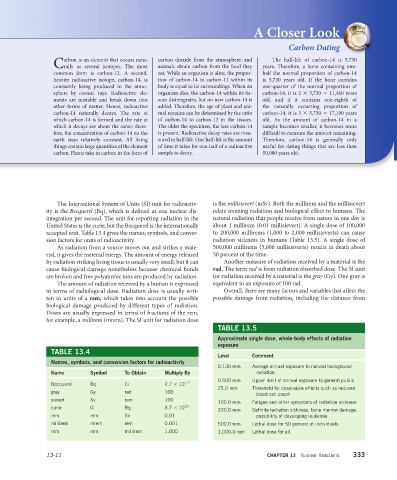
                           The International System of Units (SI) unit for radioactiv-  is the millisievert (mSv). Both the millirem and the millisievert
                       ity is the Becquerel (Bq), which is defined as one nuclear dis-  relate ionizing radiation and biological effect to humans. The
                       integration per second. The unit for reporting radiation in the   natural radiation that people receive from nature in one day is
                       United States is the curie, but the Becquerel is the internationally   about 1 millirem (0.01 millisievert). A  single dose of 100,000
                       accepted unit. Table 13.4 gives the names, symbols, and conver-  to 200,000 millirems (1,000 to 2,000 millisieverts) can cause
                       sion factors for units of radioactivity.                radiation sickness in humans (Table 13.5). A single dose of
                           As radiation from a source moves out and strikes a mate-  500,000  millirems (5,000 millisieverts) results in death about
                       rial, it gives the material energy. The amount of energy released   50 percent of the time.
                       by radiation striking living tissue is usually very small, but it can   Another measure of radiation received by a material is the
                       cause biological damage nonetheless because chemical bonds   rad. The term rad is from radiation absorbed dose. The SI unit
                       are broken and free polyatomic ions are produced by radiation.  for radiation received by a material is the gray (Gy). One gray is
                           The amount of radiation received by a human is expressed   equivalent to an exposure of 100 rad.
                       in terms of radiological dose. Radiation dose is usually writ-  Overall, there are many factors and variables that affect the
                       ten in units of a rem, which takes into account the possible   possible damage from radiation, including the distance from
                       biological damage produced by different types of radiation.
                       Doses are usually expressed in terms of fractions of the rem,
                       for example, a millirem (mrem). The SI unit for radiation dose
                                                                                TABLE 13.5
                                                                                Approximate single dose, whole-body effects of radiation
                                                                                exposure
                         TABLE 13.4
                                                                                Level       Comment
                         Names, symbols, and conversion factors for radioactivity
                                                                                0.130 rem   Average annual exposure to natural background
                         Name         Symbol      To Obtain    Multiply By                   radiation
                                                                                0.500 rem   Upper limit of annual exposure to general public
                         Becquerel    Bq          Ci           2.7 × 10 –11
                                                                                25.0 rem    Threshold for observable effects such as reduced
                         gray         Gy         rad           100
                                                                                               blood cell count
                         sievert      Sv         rem           100
                                                                                100.0 rem   Fatigue and other symptoms of radiation sickness
                         curie        Ci         Bq            3.7 × 10 10
                                                                                200.0 rem   Definite radiation sickness, bone marrow damage,
                         rem          rem        Sv            0.01                            possibility of developing leukemia
                         millirem     mrem        rem          0.001            500.0 rem   Lethal dose for 50 percent of individuals
                         rem          rem        millirem      1,000            1,000.0 rem   Lethal dose for all


                       13-11                                                                     CHAPTER 13  Nuclear Reactions   333

