


Page 379 - 9780077418427.pdf
P. 379
/Users/user-f465/Desktop
tiL12214_ch14_351-376.indd Page 356 9/3/10 6:16 PM user-f465
tiL12214_ch14_351-376.indd Page 356 9/3/10 6:16 PM user-f465 /Users/user-f465/Desktop
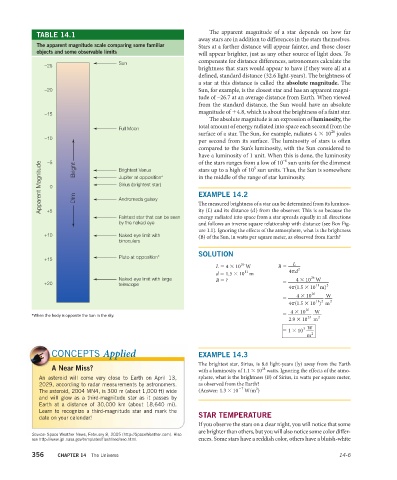
The apparent magnitude of a star depends on how far
TABLE 14.1
away stars are in addition to differences in the stars themselves.
The apparent magnitude scale comparing some familiar Stars at a farther distance will appear fainter, and those closer
objects and some observable limits
will appear brighter, just as any other source of light does. To
–25 Sun compensate for distance differences, astronomers calculate the
brightness that stars would appear to have if they were all at a
defined, standard distance (32.6 light-years). The brightness of
a star at this distance is called the absolute magnitude. The
–20 Sun, for example, is the closest star and has an apparent magni-
tude of –26.7 at an average distance from Earth. When viewed
from the standard distance, the Sun would have an absolute
–15 magnitude of +4.8, which is about the brightness of a faint star.
The absolute magnitude is an expression of luminosity, the
Full Moon total amount of energy radiated into space each second from the
26
surface of a star. The Sun, for example, radiates 4 × 10 joules
–10
per second from its surface. The luminosity of stars is often
compared to the Sun’s luminosity, with the Sun considered to
have a luminosity of 1 unit. When this is done, the luminosity
–6
–5
of the stars ranges from a low of 10 sun units for the dimmest
Apparent Magnitude 0 Dim Jupiter at opposition* in the middle of the range of star luminosity.
Bright
5
Brightest Venus
stars up to a high of 10 sun units. Thus, the Sun is somewhere
Sirius (brightest star)
EXAMPLE 14.2
Andromeda galaxy
+5
ity (L) and its distance (d ) from the observer. This is so because the
Faintest star that can be seen The measured brightness of a star can be determined from its luminos-
energy radiated into space from a star spreads equally in all directions
by the naked eye and follows an inverse square relationship with distance (see Box Fig-
ure 1.1). Ignoring the effects of the atmosphere, what is the brightness
+10 Naked eye limit with (B) of the Sun, in watts per square meter, as observed from Earth?
binoculars
SOLUTION
+15 Pluto at opposition*
L
26
L = 4 × 1 0 W B = _ 2
11
d = 1.5 × 1 0 m 4π d
Naked eye limit with large B = ? __
26
4 × 1 0 W
+20 telescope =
2
11
4π (1.5 × 10 m)
26
__ W _
4 × 10
=
11 2
2
4π (1.5 × 10 ) m
26
4 × 1 0 W _
_
*When the body is opposite the Sun in the sky. =
23
2
2.9 × 1 0 m
3 W _
= 1 × 1 0
2
m
CONCEPTS Applied EXAMPLE 14.3
The brightest star, Sirius, is 8.6 light-years (ly) away from the Earth
A Near Miss? with a luminosity of 1.1 × 10 watts. Ignoring the effects of the atmo-
28
An asteroid will come very close to Earth on April 13, sphere, what is the brightness (B) of Sirius, in watts per square meter,
2029, according to radar measurements by astronomers. as observed from the Earth?
−7 2
The asteroid, 2004 MN4, is 300 m (about 1,000 ft) wide (Answer: 1.3 × 1 0 W/m )
and will glow as a third-magnitude star as it passes by
Earth at a distance of 30,000 km (about 18,640 mi).
Learn to recognize a third- magnitude star and mark the
date on your calendar! STAR TEMPERATURE
If you observe the stars on a clear night, you will notice that some
are brighter than others, but you will also notice some color differ-
Source: Space Weather News, February 8, 2005 (http://SpaceWeather.com). Also
see http://www.jpl.nasa.gov/templates/flash/neo/neo.html. ences. Some stars have a reddish color, others have a bluish-white
356 CHAPTER 14 The Universe 14-6

