


Page 377 - 9780077418427.pdf
P. 377
/Users/user-f465/Desktop
          tiL12214_ch14_351-376.indd Page 354  9/3/10  6:16 PM user-f465
          tiL12214_ch14_351-376.indd Page 354  9/3/10  6:16 PM user-f465                                                /Users/user-f465/Desktop


                         CONCEPTS Applied                                 is just an ordinary star with an average brightness. Like the
                                                                          other stars, the Sun is a massive, dense ball of gases with a sur-
                         The Night Sky                                    face heated to incandescence by energy released from fusion
                                                                            reactions deep within. Since the Sun is an average star, it can be
                     Become acquainted with the night sky by first locating the   used as a reference for understanding all the other stars.
                     Big Dipper. In autumn, the Big Dipper is close to the north-
                     ern horizon.  During fall the Big Dipper cup opens upward,
                     straight up at midnight on September 8. During spring the cup   ORIGIN OF STARS
                     opens downward, straight down at midnight on March 8. The
                                                                          Theoretically, stars are born from swirling clouds of hydrogen gas
                     stars of the far end of the cup are called the pointer stars.
                                                                          in the deep space between other stars. Such interstellar (between
                     Trace an  imaginary line through the pointer stars to find the
                                                                          stars) clouds are called nebulae. These clouds consist of random,
                     Little Dipper. The bright star at the end of the Little Dipper
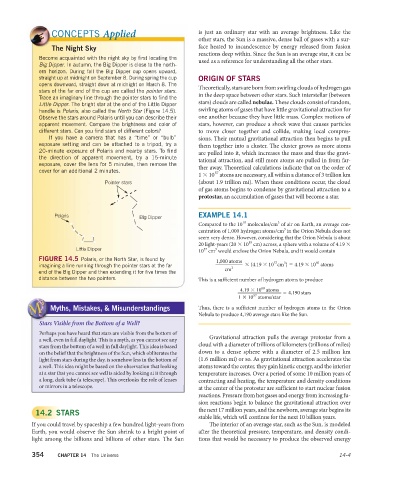
                     handle is Polaris, also called the North Star (Figure 14.5).   swirling atoms of gases that have little gravitational  attraction for
                     Observe the stars around Polaris until you can describe their   one another because they have little mass. Complex motions of
                     apparent movement. Compare the brightness and color of   stars, however, can  produce a shock wave that causes particles
                     different stars. Can you find stars of different colors?  to move closer  together and collide, making  local compres-
                        If you have a camera that has a “time” or “bulb”   sions. Their mutual gravitational attraction then begins to pull
                     exposure setting and can be attached to a tripod, try a   them together into a cluster. The cluster grows as more atoms
                     20-minute  exposure of Polaris and nearby stars. To find
                                                                          are pulled into it, which increases the mass and thus the gravi-
                     the direction of  apparent movement, try a 15-minute
                                                                          tational attraction, and still more atoms are pulled in from far-
                     exposure, cover the lens for 5 minutes, then remove the
                                                                          ther away. Theoretical calculations indicate  that on the order of
                     cover for an additional 2 minutes.                        57
                                                                          1 × 10   atoms are necessary, all within a distance of 3  trillion km
                                           Pointer stars                  (about 1.9 trillion mi). When these conditions occur, the cloud
                                                                          of gas atoms  begins to condense by gravitational attraction to a
                                                                          protostar, an accumulation of gases that will become a star.

                          Polaris                     Big Dipper          EXAMPLE 14.1
                                                                                                    3
                                                                                        19
                                                                          Compared to the 10  molecules/cm  of air on Earth, an  average con-
                                                                                                      3
                                                                          centration of 1,000 hydrogen atoms/cm  in the Orion Nebula does not
                                                                          seem very dense. However, considering that the Orion Nebula is about
                                                                          20 light-years (20 × 10  cm) across, a sphere with a volume of 4.19 ×
                                                                                           18
                                 Little Dipper                            10  cm  would enclose the Orion Nebula, and it would contain
                                                                            57
                                                                               3
                     FIGURE 14.5  Polaris, or the North Star, is found by       _
                                                                                1,000 atoms
                                                                                         ×

                                                                                                   57
                                                                                                                 60
                                                                                                      3
                     imagining a line running through the pointer stars at the far       3    (4.19 × 10 cm ) = 4.19 × 10  atoms
                     end of the Big Dipper and then extending it for five times the   cm
                     distance between the two pointers.                   This is a sufficient number of hydrogen atoms to produce
                                                                                       __               4,190 stars
                                                                                               60
                                                                                        4.19 × 10  atoms
                                                                                                       =


                                                                                            57
                                                                                       1 × 10  atoms/star
                         Myths, Mistakes, & Misunderstandings             Thus, there is a sufficient number of hydrogen atoms in the Orion
                                                                          Nebula to produce 4,190 average stars like the Sun.
                     Stars Visible from the Bottom of a Well?
                     Perhaps you have heard that stars are visible from the bottom of
                                                                             Gravitational attraction pulls the average protostar from a
                     a well, even in full daylight. This is a myth, as you cannot see any
                                                                          cloud with a diameter of trillions of kilometers (trillions of miles)
                     stars from the bottom of a well in full daylight. This idea is based
                     on the belief that the brightness of the Sun, which obliterates the   down to a dense sphere with a diameter of 2.5 million km
                     light from stars during the day, is somehow less in the bottom of   (1.6 million mi) or so. As gravitational attraction accelerates the
                     a well. This idea might be based on the observation that looking   atoms toward the center, they gain kinetic energy, and the interior
                     at a star that you cannot see well is aided by looking at it through   temperature increases. Over a period of some 10 million years of
                     a long, dark tube (a telescope). This overlooks the role of lenses   contracting and heating, the temperature and density conditions
                     or mirrors in a telescope.                           at the center of the protostar are sufficient to start nuclear fusion
                                                                          reactions. Pressure from hot gases and energy from increasing fu-
                                                                          sion reactions begin to balance the gravitational attraction over
                                                                          the next 17 million years, and the newborn, average star begins its
                    14.2 STARS
                                                                          stable life, which will continue for the next 10 billion years.
                   If you could travel by spaceship a few hundred light-years from   The interior of an average star, such as the Sun, is modeled
                   Earth, you would observe the Sun shrink to a bright point of   after the theoretical pressure, temperature, and density condi-
                   light among the billions and billions of other stars. The Sun   tions that would be necessary to produce the observed energy
                   354     CHAPTER 14 The Universe                                                                      14-4

