


Page 376 - 9780077418427.pdf
P. 376
/Users/user-f465/Desktop
          tiL12214_ch14_351-376.indd Page 353  9/3/10  6:16 PM user-f465
          tiL12214_ch14_351-376.indd Page 353  9/3/10  6:16 PM user-f465                                                /Users/user-f465/Desktop


                                                                                                         North celestial pole


                                                                                                      Earth

                                                                                                                     Celestial
                                                                                                                     equator


                                                                                                  South celestial pole

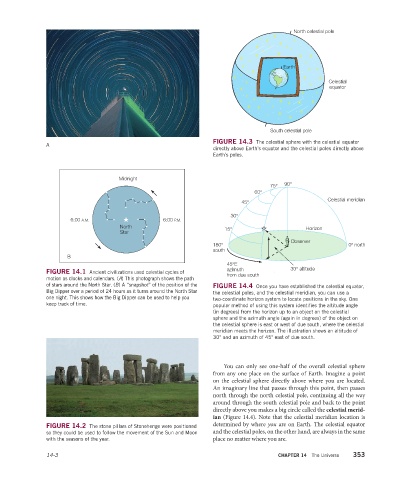
                                                                               FIGURE 14.3  The celestial sphere with the celestial equator
                       A
                                                                               directly above Earth’s equator and the celestial poles directly above
                                                                               Earth’s poles.


                                                Midnight
                                                                                                  75°  90°
                                                                                            60°
                                                                                        45°                          Celestial meridian
                                                                                     30°
                                6:00 A.M.                     6:00 P.M.
                                                North                              15°                       Horizon
                                                Star
                                                                                                        Observer
                                                                               180°                                         0° north
                                                                               south
                              B
                                                                                   45°E
                                                                                   azimuth              30° altitude
                       FIGURE 14.1  Ancient civilizations used celestial cycles of   from due south
                         motion as clocks and calendars. (A) This photograph shows the path
                       of stars around the North Star. (B) A “snapshot” of the position of the   FIGURE 14.4  Once you have established the celestial  equator,
                       Big Dipper over a period of 24 hours as it turns around the North Star   the celestial poles, and the celestial meridian, you can use a
                       one night. This shows how the Big Dipper can be used to help you   two-coordinate horizon system to locate positions in the sky. One
                       keep track of time.                                     popular method of using this system identifies the altitude angle
                                                                               (in degrees) from the horizon up to an object on the celestial
                                                                               sphere and the azimuth angle (again in degrees) of the object on
                                                                               the celestial sphere is east or west of due south, where the celestial
                                                                               meridian meets the horizon. The illustration shows an altitude of
                                                                               30° and an azimuth of 45° east of due south.


                                                                                  You can only see one-half of the overall celestial sphere
                                                                               from any one place on the surface of Earth. Imagine a point
                                                                               on the  celestial sphere directly above where you are located.
                                                                               An imaginary line that passes through this point, then passes
                                                                               north through the north celestial pole, continuing all the way
                                                                               around through the south celestial pole and back to the point
                                                                               directly above you makes a big circle called the celestial merid-
                                                                               ian (Figure 14.4). Note that the celestial meridian location is
                                                                               determined by where you are on Earth. The celestial equator
                       FIGURE 14.2  The stone pillars of Stonehenge were positioned
                       so they could be used to follow the movement of the Sun and Moon   and the celestial poles, on the other hand, are always in the same
                       with the seasons of the year.                           place no matter where you are.

                       14-3                                                                         CHAPTER 14  The Universe   353

