


Page 378 - 9780077418427.pdf
P. 378
/Users/user-f465/Desktop
          tiL12214_ch14_351-376.indd Page 355  9/3/10  6:16 PM user-f465
          tiL12214_ch14_351-376.indd Page 355  9/3/10  6:16 PM user-f465                                                /Users/user-f465/Desktop


                                                                  Convection zone
                                                                                    100%
                                                                                                   Convection
                                                                                                   carries energy
                                                                                     70%           outward.
                                                                                                 Energy produced in
                                                                                                 the core is carried
                                                                          Nuclear    25%         outward by
                                                                          burning core           photons.
                                                                                       0
                                                                                      (Core)  Nuclear reactions
                                                                                             produce energy in the
                                                                                             Sun’s core.


                                                                       Radiative zone


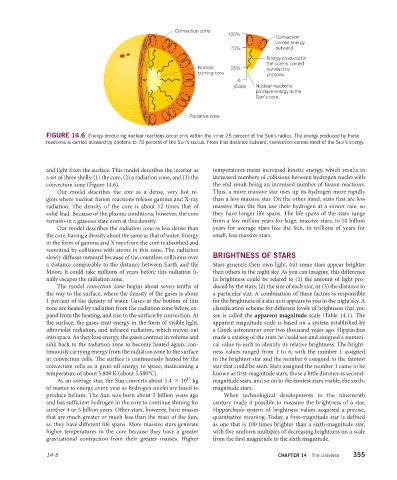
                       FIGURE 14.6  Energy-producing nuclear reactions occur only within the inner 25 percent of the Sun’s radius. The energy produced by these
                        reactions is carried outward by photons to 70 percent of the Sun’s radius. From that distance outward, convection carries most of the Sun’s energy.


                       and light from the surface. This model describes the interior as   temperatures mean increased kinetic energy, which results in
                       a set of three shells: (1) the core, (2) a radiation zone, and (3) the   increased numbers of collisions between hydrogen nuclei with
                       convection zone (Figure 14.6).                          the end  result being an increased number of fusion reactions.
                           Our model describes the  core as a dense, very hot re-  Thus, a more massive star uses up its hydrogen more rapidly
                       gion where nuclear fusion reactions release gamma and X-ray   than a less massive star. On the other hand, stars that are less
                       radiation. The density of the core is about 12 times that of   massive than the Sun use their hydrogen at a slower rate, so
                       solid lead. Because of the plasma conditions, however, the core   they have longer life spans. The life spans of the stars range
                         remains in a gaseous state even at this density.      from a few million years for large, massive stars, to 10 billion
                           Our model describes the radiation zone as less dense than   years for average stars like the Sun, to trillions of years for
                       the core, having a density about the same as that of water.  Energy   small, less massive stars.
                       in the form of gamma and X rays from the core is  absorbed and
                       reemitted by collisions with atoms in this zone. The radiation
                       slowly diffuses outward because of the countless collisions over   BRIGHTNESS OF STARS
                       a distance comparable to the distance between Earth and the   Stars generate their own light, but some stars appear brighter
                       Moon. It could take millions of years before this radiation fi-  than others in the night sky. As you can imagine, this difference
                       nally escapes the radiation zone.                       in brightness could be related to (1) the amount of light pro-
                           The model  convection zone begins about seven-tenths of   duced by the stars, (2) the size of each star, or (3) the distance to
                       the way to the surface, where the density of the gases is about   a particular star. A combination of these factors is responsible
                       1 percent of the density of water. Gases at the bottom of this   for the brightness of a star as it appears to you in the night sky. A
                       zone are heated by radiation from the radiation zone below, ex-  classification scheme for different levels of brightness that you
                       pand from the heating, and rise to the surface by convection. At   see is called the apparent magnitude scale (Table 14.1). The
                       the surface, the gases emit energy in the form of visible light,     apparent magnitude scale is based on a system established by
                       ultraviolet  radiation, and infrared radiation, which moves out   a Greek astronomer over two thousand years ago. Hipparchus
                       into space. As they lose energy, the gases contract in volume and   made a catalog of the stars he could see and assigned a numeri-
                       sink back to the radiation zone to become heated again, con-  cal value to each to identify its relative brightness. The bright-
                       tinuously carrying energy from the radiation zone to the surface   ness values ranged from 1 to 6, with the number 1 assigned
                       in convection cells. The surface is continuously heated by the   to the brightest star and the number 6 assigned to the faintest
                       convection cells as it gives off energy to space, maintaining a   star that could be seen. Stars assigned the number 1 came to be
                       temperature of about 5,800 K (about 5,500°C).           known as first- magnitude stars, those a little dimmer as second-
                                                                      17
                           As an average star, the Sun converts about 1.4 × 10  kg   magnitude stars, and so on to the faintest stars visible, the sixth-
                       of matter to energy every year as hydrogen nuclei are fused to   magnitude stars.
                       produce helium. The Sun was born about 5 billion years ago   When technological developments in the nineteenth
                       and has sufficient hydrogen in the core to continue shining for     century made it possible to measure the brightness of a star,
                         another 4 or 5 billion years. Other stars, however, have masses   Hipparchus’s system of brightness values acquired a precise,
                       that are much greater or much less than the mass of the Sun,   quantitative meaning. Today, a first-magnitude star is defined
                       so they have different life spans. More massive stars generate   as one that is 100 times brighter than a sixth-magnitude star,
                       higher temperatures in the core because they have a greater   with five uniform multiples of decreasing brightness on a scale
                       gravitational contraction from their greater masses. Higher   from the first magnitude to the sixth magnitude.

                       14-5                                                                         CHAPTER 14  The Universe   355

