


Page 409 - 9780077418427.pdf
P. 409
/Users/user-f465/Desktop
          tiL12214_ch15_377-404.indd Page 386  9/3/10  6:17 PM user-f465
          tiL12214_ch15_377-404.indd Page 386  9/3/10  6:17 PM user-f465                                                /Users/user-f465/Desktop


                   four are called the Galilean moons because they were discov-
                   ered by Galileo in 1610. The Galilean moons are named Io,
                   Europa, Ganymede, and Callisto (Figure 15.10). Observations
                   by the  Pioneer and  Voyager spacecrafts revealed some fasci-
                   nating and intriguing information about the moons of Jupiter.
                   Io, for example, was discovered to have active volcanoes that
                   eject enormous plumes of molten sulfur and sulfur dioxide gas.
                     Europa is covered with a 19.3 km (about 12 mi) thick layer of
                   smooth water ice, which has a network of long, straight, dark
                   cracks. Ganymede has valleys, ridges, folded mountains, and
                   other evidence of an active geologic history. Callisto, the most
                   distant of the Galilean moons, was found to be the most heavily
                   cratered object in the solar system.
                      Impact events such as those that marked Callisto are still
                   occurring. In 1994, the Comet Shoemaker-Levy broke apart into
                   a “string of pearls” (Figure 15.11A) and then produced a once-in-
                   a-lifetime spectacle as it proceeded to leave its imprint on  Jupiter
                   as well as on people of Earth watching from the sidelines. The
                   string of 22 comet fragments fell onto Jupiter during July 1994,
                   creating a show eagerly photographed by telescopes around the
                   world (Figure 15.11B). The fragments impacted the upper at-
                   mosphere of Jupiter,  producing visible, energetic fireballs. The
                   aftereffects of these fireballs were visible for about a year. There
                   are chains of craters on two of the Galilean moons that may have
                   been formed by similar events.

                   EXAMPLE 15.1                                           A
                   Assume that one of Jupiter’s moons receives its peak solar energy over
                   a 10 hour long period. How much energy is heating a 1 square meter of
                   the surface of Jupiter’s moon during this peak time?


                   SOLUTION
                   Use the solar energy received from Table 15.1 and multiply by the area
                   and the duration of time this energy is received:
                                           _
                                            cal
                      solar energy received = 0.08     2
                                           c m   ∙s
                                     t = 10 h
                                    A = 1 m 2
                                    Q = ?

                                 Q = (solar energy received) (At)
                   Convert time to seconds :
                                                3 s _
                                                  )
                                         (

                                  t =  10 h   3.6 × 1 0
                                                 h
                                           4
                                   = 3.6 × 1 0    s
                   Convert area to square centimeters:
                                                                          B
                                                 2)
                                                  2
                                         (
                                              4 c m
                                        2
                                  A = 1  m     1 × 1 0       _
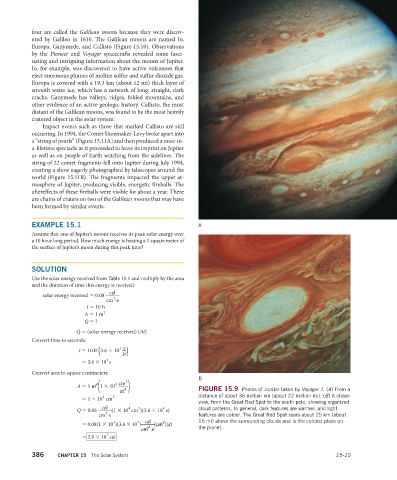
                                                 m                        FIGURE 15.9  Photos of Jupiter taken by Voyager 1. (A) From a
                                          4
                                   = 1 × 1 0    c m    2                  distance of about 36 million km (about 22 million mi). (B) A closer
                                                                          view, from the Great Red Spot to the south pole, showing organized
                                         _         4  2       4           cloud patterns. In general, dark features are warmer, and light
                                          cal
                                   Q =  0.08     2      (1 × 1 0    c m   )(3.6 × 1 0    s)
                                         c m   ⋅s                         features are colder. The Great Red Spot soars about 25 km (about
                                                      4 _
                                              4
                                                              2
                                   = 0.08(1 × 1 0   )(3.6 × 1 0   )    cal      (c m   )(s)  15 mi) above the surrounding clouds and is the coldest place on
                                                         2
                                                       c m   ⋅s           the planet.
                                           7
                                   = 2.9 × 1 0    cal
                   386     CHAPTER 15  The Solar System                                                                15-10

