


Page 412 - 9780077418427.pdf
P. 412
/Users/user-f465/Desktop
          tiL12214_ch15_377-404.indd Page 389  9/3/10  6:17 PM user-f465
          tiL12214_ch15_377-404.indd Page 389  9/3/10  6:17 PM user-f465                                                /Users/user-f465/Desktop


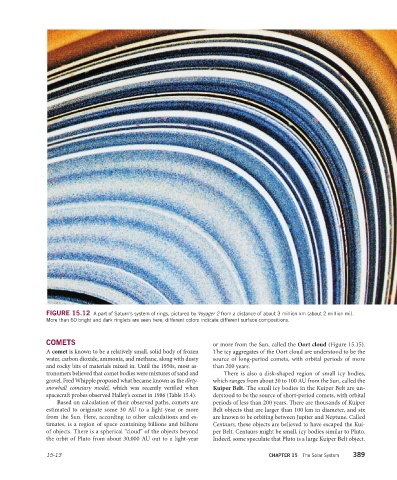
                       FIGURE 15.12  A part of Saturn’s system of rings, pictured by Voyager 2 from a distance of about 3 million km (about 2 million mi).
                        More than 60 bright and dark ringlets are seen here; different colors indicate different surface compositions.


                       COMETS                                                  or more from the Sun, called the Oort cloud (Figure 15.15).
                       A comet is known to be a relatively small, solid body of frozen   The icy aggregates of the Oort cloud are understood to be the
                       water, carbon dioxide, ammonia, and methane, along with dusty   source of long-period comets, with orbital periods of more
                       and rocky bits of materials mixed in. Until the 1950s, most as-  than 200 years.
                       tronomers believed that comet bodies were mixtures of sand and   There is also a disk-shaped region of small icy bodies,
                       gravel. Fred Whipple proposed what became known as the dirty-  which ranges from about 30 to 100 AU from the Sun, called the
                       snowball cometary model, which was recently verified when   Kuiper Belt. The small icy bodies in the Kuiper Belt are un-
                       spacecraft probes observed Halley’s comet in 1986 (Table 15.4).  derstood to be the source of short-period comets, with orbital
                           Based on calculation of their observed paths, comets are     periods of less than 200 years. There are thousands of Kuiper
                       estimated to originate some 30 AU to a light-year or more   Belt  objects that are larger than 100 km in diameter, and six
                       from the Sun. Here, according to other calculations and es-  are known to be orbiting between Jupiter and Neptune. Called
                       timates, is a region of space containing billions and billions     Centaurs, these objects are believed to have escaped the Kui-
                       of objects. There is a spherical “cloud” of the objects beyond   per Belt. Centaurs might be small, icy bodies similar to Pluto.
                       the orbit of Pluto from about 30,000 AU out to a light-year     Indeed, some speculate that Pluto is a large Kuiper Belt object.

                       15-13                                                                     CHAPTER 15  The Solar System   389

