


Page 434 - 9780077418427.pdf
P. 434
/Users/user-f465/Desktop
          tiL12214_ch16_405-432.indd Page 411  9/3/10  6:19 PM user-f465
          tiL12214_ch16_405-432.indd Page 411  9/3/10  6:19 PM user-f465                                                /Users/user-f465/Desktop


                                                                                                         Perpendicular to
                                                                                                         plane of ecliptic
                                   Rotational                                         Vega                      North Star
                                   velocity                                           (A.D. 14,000)             (today)
                                                A   B


                                                                                                                  To the Sun


                         FIGURE 16.10  Earth has a greater rotational velocity at the
                       equator and less toward the poles. As an object moves north or
                       south (A), it passes over land with a different rotational velocity,
                       which produces a deviation to the right in the Northern Hemisphere
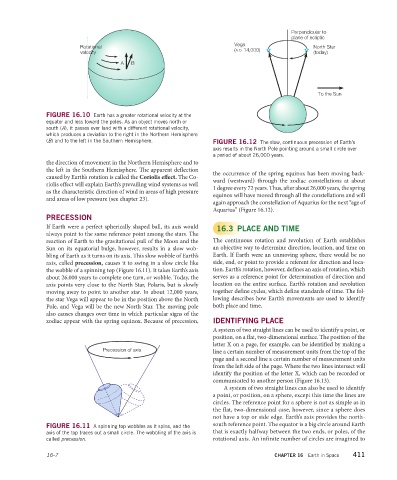
                       (B) and to the left in the Southern Hemisphere.         FIGURE 16.12  The slow, continuous precession of Earth’s
                                                                               axis results in the North Pole pointing around a small circle over
                                                                               a period of about 26,000 years.
                       the direction of movement in the Northern Hemisphere and to
                       the left in the Southern Hemisphere. The apparent deflection   the occurrence of the spring equinox has been moving back-
                       caused by Earth’s rotation is called the Coriolis  eff ect. The Co-  ward (westward) through the zodiac constellations at about
                       riolis effect will explain Earth’s prevailing wind systems as well     1 degree every 72 years. Thus, after about 26,000 years, the spring
                       as the characteristic direction of wind in areas of high pressure   equinox will have moved through all the constellations and will
                       and areas of low pressure (see chapter 23).
                                                                               again approach the constellation of Aquarius for the next “age of
                                                                               Aquarius” (Figure 16.12).
                       PRECESSION
                       If Earth were a perfect spherically shaped ball, its axis would   16.3  PLACE AND TIME
                         always point to the same reference point among the stars. The
                       reaction of Earth to the gravitational pull of the Moon and the   The continuous rotation and revolution of Earth establishes
                       Sun on its equatorial bulge, however, results in a slow wob-  an objective way to determine direction, location, and time on
                       bling of Earth as it turns on its axis. This slow wobble of Earth’s   Earth. If Earth were an unmoving sphere, there would be no
                       axis, called precession, causes it to swing in a slow circle like   side, end, or point to provide a referent for direction and loca-
                       the wobble of a spinning top (Figure 16.11). It takes Earth’s axis   tion. Earth’s rotation, however, defines an axis of rotation, which
                       about 26,000 years to complete one turn, or wobble. Today, the   serves as a reference point for determination of direction and
                       axis points very close to the North Star, Polaris, but is slowly   location on the entire surface. Earth’s rotation and revolution
                       moving away to point to another star. In about 12,000 years,   together define cycles, which define standards of time. The fol-
                       the star Vega will appear to be in the  position above the North   lowing describes how Earth’s movements are used to identify
                       Pole, and Vega will be the new North Star. The moving pole   both place and time.
                       also causes changes over time in which particular signs of the
                       zodiac appear with the spring equinox. Because of precession,   IDENTIFYING PLACE
                                                                               A system of two straight lines can be used to identify a point, or
                                                                               position, on a flat, two-dimensional surface. The position of the
                                                                               letter X  on a page, for example, can be identified by making a
                                          Precession of axis                   line a certain number of measurement units from the top of the
                                                                               page and a second line a certain number of measurement units
                                                                               from the left side of the page. Where the two lines intersect will
                                                                               identify the position of the letter X, which can be recorded or
                                                                               communicated to another person (Figure 16.13).
                                                                                  A system of two straight lines can also be used to identify
                                                                               a point, or position, on a sphere, except this time the lines are
                                                                               circles. The reference point for a sphere is not as simple as in
                                                                               the flat, two-dimensional case, however, since a sphere does
                                                                               not have a top or side edge. Earth’s axis provides the north-
                                                                               south reference point. The equator is a big circle around Earth
                       FIGURE 16.11  A spinning top wobbles as it spins, and the
                       axis of the top traces out a small circle. The wobbling of the axis is   that is exactly halfway between the two ends, or poles, of the
                       called precession.                                      rotational axis. An infinite number of circles are imagined to

                       16-7                                                                        CHAPTER 16  Earth in Space   411

