


Page 441 - 9780077418427.pdf
P. 441
/Users/user-f465/Desktop
          tiL12214_ch16_405-432.indd Page 418  9/3/10  6:19 PM user-f465
          tiL12214_ch16_405-432.indd Page 418  9/3/10  6:19 PM user-f465                                                /Users/user-f465/Desktop


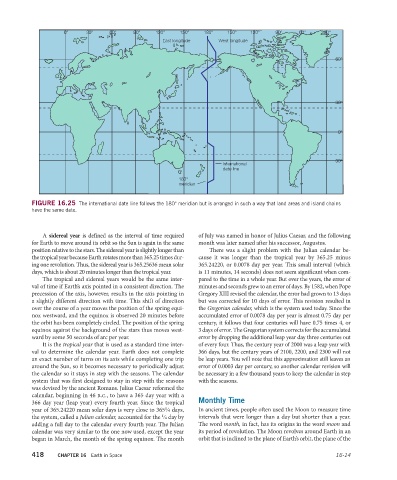
                   FIGURE 16.25  The international date line follows the 180° meridian but is arranged in such a way that land areas and island chains
                   have the same date.


                      A  sidereal year is defined as the interval of time required   of July was named in honor of Julius Caesar, and the following
                   for Earth to move around its orbit so the Sun is again in the same   month was later named after his successor, Augustus.
                     position relative to the stars. The sidereal year is slightly longer than   There was a slight problem with the Julian calendar be-
                   the tropical year because Earth rotates more than 365.25 times dur-  cause it was longer than the tropical year by 365.25 minus
                   ing one revolution. Thus, the sidereal year is 365.25636 mean solar   365.24220, or 0.0078 day per year. This small interval (which
                   days, which is about 20 minutes longer than the tropical year.  is 11 minutes, 14 seconds) does not seem significant when com-
                      The tropical and sidereal years would be the same inter-  pared to the time in a whole year. But over the years, the error of
                   val of time if Earth’s axis pointed in a consistent direction. The   minutes and seconds grew to an error of days. By 1582, when Pope
                   precession of the axis, however, results in the axis pointing in   Gregory XIII revised the calendar, the error had grown to 13 days
                   a slightly different direction with time. This shift of direction   but was corrected for 10 days of error. This revision  resulted in
                   over the course of a year moves the position of the spring equi-  the  Gregorian calendar, which is the system used  today. Since the
                   nox westward, and the equinox is observed 20 minutes before     accumulated error of 0.0078 day per year is  almost 0.75 day per
                   the orbit has been completely circled. The position of the spring   century, it follows that four centuries will have 0.75 times 4, or
                   equinox against the background of the stars thus moves west-    3 days of error. The Gregorian system corrects for the accumulated
                   ward by some 50 seconds of arc per year.               error by dropping the additional leap year day three centuries out
                      It is the tropical year that is used as a standard time inter-  of every four. Thus, the century year of 2000 was a leap year with
                   val to determine the calendar year. Earth does not complete   366 days, but the century years of 2100, 2200, and 2300 will not
                   an exact number of turns on its axis while completing one trip   be leap years. You will note that this approximation still leaves an
                   around the Sun, so it becomes necessary to periodically adjust   error of 0.0003 day per century, so another calendar revision will
                   the calendar so it stays in step with the seasons. The calendar   be necessary in a few thousand years to keep the calendar in step
                   system that was first designed to stay in step with the seasons   with the  seasons.
                   was devised by the ancient Romans. Julius Caesar reformed the
                   calendar, beginning in 46 b.c., to have a 365 day year with a
                     366 day year (leap year) every fourth year. Since the tropical   Monthly Time
                                                               1
                   year of 365.24220 mean solar days is very close to 365 ⁄4 days,   In ancient times, people often used the Moon to measure time
                   the system, called a Julian calendar, accounted for the  ⁄4 day by   intervals that were longer than a day but shorter than a year.
                                                              1
                   adding a full day to the calendar every fourth year. The Julian   The word month, in fact, has its origins in the word moon and
                   calendar was very similar to the one now used, except the year   its period of revolution. The Moon revolves around Earth in an
                   began in March, the month of the spring equinox. The month   orbit that is inclined to the plane of Earth’s orbit, the plane of the

                   418     CHAPTER 16  Earth in Space                                                                  16-14

