


Page 440 - 9780077418427.pdf
P. 440
/Users/user-f465/Desktop
          tiL12214_ch16_405-432.indd Page 417  9/3/10  6:19 PM user-f465
          tiL12214_ch16_405-432.indd Page 417  9/3/10  6:19 PM user-f465                                                /Users/user-f465/Desktop


                                                                               Science and Society


                                                                                                       Saving Time?
                             he purpose of daylight saving time is   Americans who like daylight saving   clock, so they have to plan all their nonfarm
                          Tto make better use of daylight during   time say they like it because it gives them   interactions on a different schedule.
                          the summer by moving an hour of daylight   more light in the evenings, and it saves en-
                          from the morning to the evening. In the   ergy. Some people do not like daylight sav-  QUESTIONS TO DISCUSS
                          United States, daylight saving time is ob-  ing time because it requires them to reset all
                          served from the second Sunday in March   their clocks and adjust their sleep schedule   Divide your group into two subgroups, one
                          to the first Sunday in November. Clocks are   twice a year. They also complain that the act   representing those who like  daylight saving
                          changed on these Sundays according to the   of changing the clock is not saving daylight   time and the other  representing those who
                          saying, “Spring ahead, fall back.” Arizona   at all, but it is sending them to bed an hour   do not. After a few minutes of preparation,
                          and  Hawaii choose not to participate and   earlier. Farmers also complain that plants   have a short debate about the advantages
                          stay on standard time all year.    and animals are regulated by the Sun, not the   and disadvantages of daylight saving time.


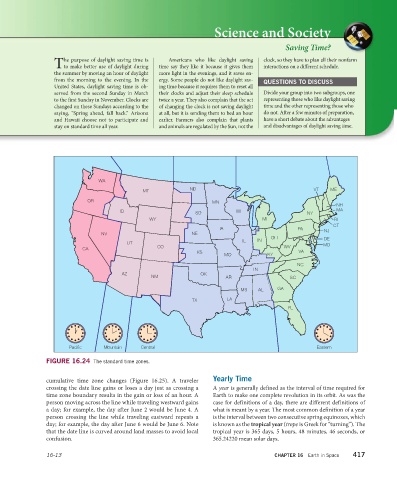
                       FIGURE 16.24  The standard time zones.


                         cumulative time zone changes (Figure 16.25). A traveler   Yearly Time
                       crossing the date line gains or loses a day just as crossing a   A year is generally defined as the interval of time required for
                       time zone boundary results in the gain or loss of an hour. A   Earth to make one complete revolution in its orbit. As was the
                       person moving across the line while traveling westward gains   case for definitions of a day, there are different definitions of
                       a day; for  example, the day after June 2 would be June 4. A   what is meant by a year. The most common definition of a year
                       person crossing the line while traveling eastward repeats a   is the interval between two consecutive spring equinoxes, which
                       day; for example, the day after June 6 would be June 6. Note   is known as the tropical year (trope is Greek for “turning”). The
                       that the date line is curved around land masses to avoid local   tropical year is 365 days, 5 hours, 48 minutes, 46 seconds, or
                       confusion.                                              365.24220 mean solar days.

                       16-13                                                                       CHAPTER 16  Earth in Space   417

