


Page 532 - 9780077418427.pdf
P. 532
/Users/user-f465/Desktop
          tiL12214_ch20_501-520.indd Page 509  9/3/10  6:23 PM user-f465
          tiL12214_ch20_501-520.indd Page 509  9/3/10  6:23 PM user-f465                                                /Users/user-f465/Desktop


                       Step 2: Thickness Removed
                                     11   3
                           V = 1.1 × 10 m                     V _

                                                V = Az   ∴ z =
                                      3  2                    A
                           A = 6.54 × 1 0     km
                                                                   2   2
                            z = ?               Convert the area from km  to m .
                                                           (
                                                                 6
                                                            _
                                                       3   2 1 × 1 0     m    2

                                                6.54 ×  10     km         2 )


                                                              1  km
                                                       9  2
                                                6.54 × 1 0     m
                                                         11
                                                   __       3
                                                    1.1 × 1 0      m


                                                z =
                                                          9
                                                            2
                                                    6.54 × 1 0     m
                                                         11
                                                   _ _       3
                                                    1.1 × 1 0      m


                                                   =

                                                          9
                                                    6.54 × 1 0     m    2
                                                          1
                                                   = 1.7 ×  10    m
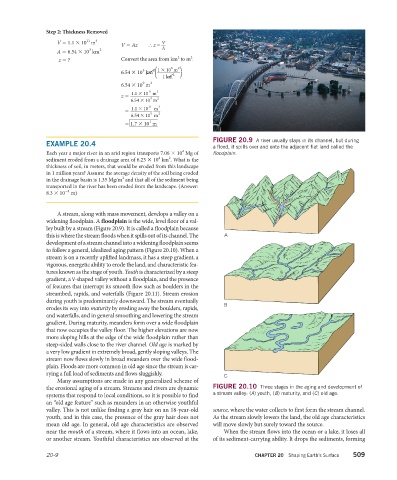
                                                                               FIGURE 20.9  A river usually stays in its channel, but during
                       EXAMPLE 20.4                                            a flood, it spills over and onto the adjacent flat land called the
                                                                     4
                       Each year a major river in an arid region transports 7.06 × 10  Mg of   floodplain.
                                                             4
                                                                2
                       sediment eroded from a drainage area of 6.23 × 10  km . What is the
                        thickness of soil, in meters, that would be eroded from this landscape
                        in 1 million years? Assume the average density of the soil being eroded
                                                 3
                        in the drainage basin is 1.35 Mg/m  and that all of the sediment being
                       transported in the river has been eroded from the landscape. (Answer:
                              −1
                       8.3 × 10  m)
                           A stream, along with mass movement, develops a valley on a
                       widening floodplain. A floodplain is the wide, level floor of a val-
                       ley built by a stream (Figure 20.9). It is called a floodplain because
                       this is where the stream floods when it spills out of its channel. The   A
                       development of a stream channel into a widening floodplain seems
                       to follow a general, idealized aging pattern (Figure 20.10). When a
                       stream is on a recently uplifted landmass, it has a steep gradient, a
                       vigorous, energetic ability to erode the land, and characteristic fea-
                       tures known as the stage of youth. Youth is characterized by a steep
                       gradient, a V-shaped valley without a floodplain, and the presence
                       of features that interrupt its smooth flow such as boulders in the
                       streambed,  rapids, and waterfalls (Figure 20.11). Stream erosion
                       during youth is predominantly downward. The stream eventually
                                                                                  B
                       erodes its way into maturity by eroding away the boulders, rapids,
                       and waterfalls, and in general smoothing and lowering the stream
                       gradient. During maturity, meanders form over a wide floodplain
                       that now occupies the valley floor. The higher elevations are now
                       more sloping hills at the edge of the wide floodplain rather than
                       steep-sided walls close to the river channel. Old age is marked by
                       a very low gradient in extremely broad, gently sloping valleys. The
                       stream now flows slowly in broad meanders over the wide flood-
                       plain. Floods are more common in old age since the stream is car-
                       rying a full load of sediments and flows sluggishly.
                                                                                  C
                           Many assumptions are made in any generalized scheme of
                       the erosional aging of a stream. Streams and rivers are  dynamic   FIGURE 20.10  Three stages in the aging and development of
                       systems that respond to local conditions, so it is possible to find   a stream valley: (A) youth, (B) maturity, and (C) old age.
                       an “old age feature” such as meanders in an other wise youthful
                       valley. This is not unlike finding a gray hair on an 18-year-old   source, where the water collects to first form the stream channel.
                       youth, and in this case, the presence of the gray hair does not   As the stream slowly lowers the land, the old age characteristics
                       mean old age. In general, old age characteristics are observed   will move slowly but surely toward the source.
                       near the mouth of a stream, where it flows into an ocean, lake,   When the stream flows into the ocean or a lake, it loses all
                       or another stream. Youthful characteristics are observed at the   of its sediment-carrying ability. It drops the sediments, forming
                       20-9                                                                  CHAPTER 20  Shaping Earth’s Surface   509

