


Page 58 - 9780077418427.pdf
P. 58
/Users/user-f465/Desktop
          tiL12214_ch02_025-060.indd Page 35  9/1/10  9:55 PM user-f465
          tiL12214_ch02_025-060.indd Page 35  9/1/10  9:55 PM user-f465                                                 /Users/user-f465/Desktop


                           A                                                         Myths, Mistakes, & Misunderstandings

                                                                                 Walk or Run in Rain?
                                                                                 Is it a mistake to run in rain if you want to stay drier? One idea is
                                                                                 that you should run because you spend less time in the rain, so
                                                                                 you will stay drier. On the other hand, this is true only if the rain
                                                                                 lands on the top of your head and shoulders. If you run, you will
                                                                                 end up running into more raindrops on the larger surface area
                                                                                 of your face, chest, and front of your legs.
                                                                                    Two North Carolina researchers looked into this question
                                                                                 with one walking and the other running over a measured dis-
                           B                                                     tance while wearing cotton sweatsuits. They then weighed their
                                                                                 clothing and found that the walking person’s sweatsuit weighed
                                                                                 more. This means you should run to stay drier.


                                                                                2.4 FALLING OBJECTS
                                                                               Did you ever wonder what happens to a falling rock during its
                                                                               fall? Aristotle reportedly thought that a rock falls at a uniform
                                                                               speed that is proportional to its weight. Thus, a heavy rock
                           C                                                   would fall at a faster uniform speed than a lighter rock. As stated
                                                                               in a popular story, Galileo discredited Aristotle’s conclusion by
                                                                               dropping a solid iron ball and a solid wooden ball simultane-
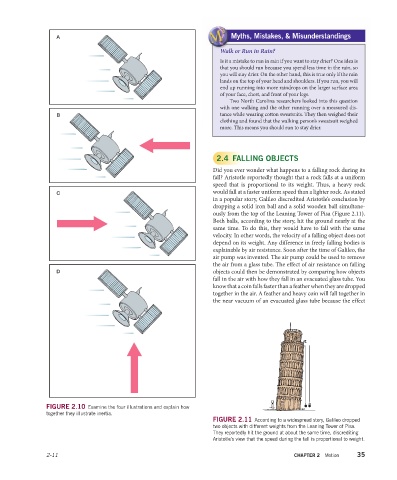
                                                                               ously from the top of the Leaning Tower of Pisa (Figure 2.11).
                                                                               Both balls, according to the story, hit the ground nearly at the
                                                                               same time. To do this, they would have to fall with the same
                                                                                 velocity. In other words, the velocity of a falling object does not
                                                                               depend on its weight. Any difference in freely falling bodies is
                                                                               explainable by air resistance. Soon after the time of Galileo, the
                                                                               air pump was invented. The air pump could be used to remove
                                                                               the air from a glass tube. The effect of air resistance on falling
                           D                                                   objects could then be demonstrated by comparing how objects
                                                                               fall in the air with how they fall in an evacuated glass tube. You
                                                                               know that a coin falls faster than a feather when they are dropped
                                                                               together in the air. A feather and heavy coin will fall together in
                                                                               the near vacuum of an evacuated glass tube because the effect


                        FIGURE 2.10  Examine the four illustrations and explain how
                        together they illustrate inertia.
                                                                               FIGURE 2.11  According to a widespread story, Galileo dropped
                                                                               two objects with different weights from the Leaning Tower of Pisa.
                                                                               They reportedly hit the ground at about the same time, discrediting
                                                                               Aristotle’s view that the speed during the fall is proportional to weight.

                       2-11                                                                               CHAPTER 2  Motion   35

