


Page 59 - 9780077418427.pdf
P. 59
/Users/user-f465/Desktop
          tiL12214_ch02_025-060.indd Page 36  9/1/10  9:55 PM user-f465
          tiL12214_ch02_025-060.indd Page 36  9/1/10  9:55 PM user-f465                                                 /Users/user-f465/Desktop


                   of air resistance on the feather has been removed. When objects   Substituting this equation in the rearranged equation 2.1, the
                   fall toward Earth without air resistance being considered, they   distance relationship becomes
                   are said to be in free fall. Free fall considers only gravity and             _
                                                                                                (
                                                                                                       )


                   neglects air resistance.                                                  d =      v f  + v i  (t)


                                                                                                   2
                                                                          Step 3:  The initial velocity of a falling object is always zero just
                         CONCEPTS Applied                                        as it is dropped, so the v i  can be eliminated,
                                                                                                   v f _
                                                                                                  ( )
                         Falling Bodies                                                        d =          (t)


                                                                                                   2
                     Galileo concluded that all objects fall together, with the
                     same acceleration, when the upward force of air resistance   Step 4:  Now you want to get acceleration into the equation in
                     is  removed. It would be most difficult to remove air from   place of velocity. This can be done by solving  equation 2.2
                     the room, but it is possible to do some experiments that    for the final velocity (v f ), then substituting. The initial
                     provide some  evidence of how air influences falling objects.  velocity (v i ) is again eliminated because it equals zero.
                     1.  Take a sheet of paper and your textbook and drop                          _

                                                                                                   v f  – v i

                        them side by side from the same height. Note the                       a =      t
                        result.
                     2.  Place the sheet of paper on top of the book and drop                  v f  = at
                        them at the same time. Do they fall together?                               at _
                                                                                                   ( )

                     3.  Crumple the sheet of paper into a loose ball, and drop                d =            (t)
                                                                                                    2
                        the ball and book side by side from the same height.
                     4.  Crumple a sheet of paper into a very tight ball, and   Step 5:  Simplifying, the equation becomes
                        again drop the ball and book side by side from the                         1 _


                        same height.                                                           d =     at 2
                                                                                                   2
                        Explain any evidence you found concerning how
                        objects fall.                                                                             equation 2.4
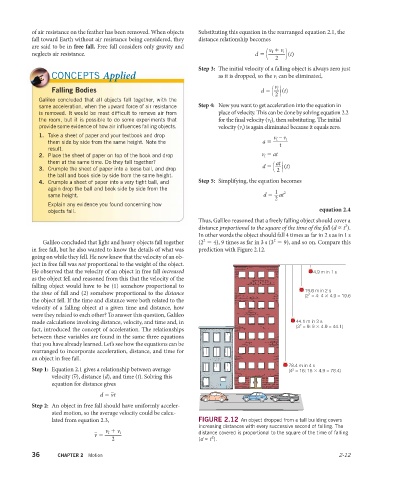
                                                                          Thus, Galileo reasoned that a freely falling object should cover a
                                                                                                                           2
                                                                          distance proportional to the square of the time of the fall (d ∝ t ).
                                                                          In other words the object should fall 4 times as far in 2 s as in 1 s
                                                                            2
                                                                                                   2
                      Galileo concluded that light and heavy objects fall together   (2  = 4), 9 times as far in 3 s (3  = 9), and so on. Compare this
                   in free fall, but he also wanted to know the details of what was   prediction with Figure 2.12.
                   going on while they fell. He now knew that the velocity of an ob-
                   ject in free fall was not proportional to the weight of the object.
                   He observed that the velocity of an object in free fall increased                            4.9 m in 1 s
                   as the object fell and reasoned from this that the velocity of the
                   falling object would have to be (1) somehow proportional to
                   the time of fall and (2) somehow proportional to the distance                             19.6 m in 2 s
                                                                                                              2
                                                                                                             (2  = 4: 4   4.9 = 19.6
                   the object fell. If the time and distance were both related to the
                     velocity of a falling object at a given time and distance, how
                   were they related to each other? To answer this question, Galileo
                   made calculations involving distance, velocity, and time and, in                       44.1 m in 3 s
                                                                                                           2
                                                                                                          (3  = 9: 9   4.9 = 44.1)
                   fact, introduced the concept of acceleration. The relationships
                   between these variables are found in the same three equations
                   that you have already learned. Let’s see how the equations can be
                   rearranged to incorporate acceleration, distance, and time for
                   an object in free fall.
                                                                                                        78.4 m in 4 s
                   Step 1:  Equation 2.1 gives a relationship between average                           (4  = 16: 16   4.9 = 78.4)
                                                                                                         2
                         velocity (v), distance (d), and time (t). Solving this
                         equation for distance gives
                                         d = vt
                   Step 2:  An object in free fall should have uniformly acceler-
                         ated  motion, so the average velocity could be calcu-
                         lated from equation 2.3,                         FIGURE 2.12  An object dropped from a tall building covers
                                                                          increasing distances with every successive second of falling. The
                                           _                              distance covered is proportional to the square of the time of falling
                                           v f  + v i

                                       v =                                    2
                                             2                            (d ∝ t ).
                   36      CHAPTER 2 Motion                                                                             2-12

