


Page 590 - 9780077418427.pdf
P. 590
/Volume/201/MHDQ233/tat78194_disk1of1/0073378194/tat78194_pagefile
          tiL12214_ch23_565-596.indd Page 567  9/23/10  11:07 AM user-f465
          tiL12214_ch23_565-596.indd Page 567  9/23/10  11:07 AM user-f465             /Volume/201/MHDQ233/tat78194_disk1of1/0073378194/tat78194_pagefiles


                                                                                 Increasing altitude  Parcel       Temperature of
                                                                                                                   surrounding air
                                                                                           of air


                                                                                              Temperature
                                                                                              of a rising
                                                                                              parcel of air


                                                                                                  Increasing temperature

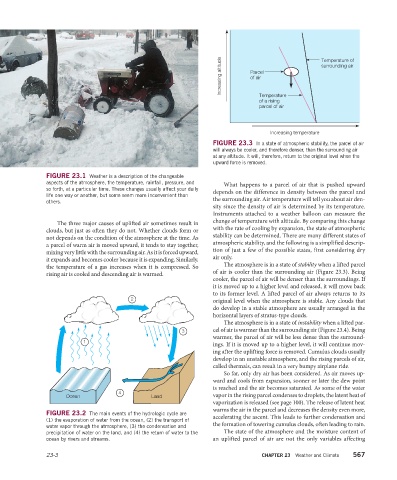
                                                                               FIGURE 23.3  In a state of atmospheric stability, the parcel of air
                                                                               will always be cooler, and therefore denser, than the surrounding air
                                                                               at any altitude. It will, therefore, return to the original level when the
                                                                               upward force is removed.

                        FIGURE 23.1  Weather is a description of the changeable
                       aspects of the atmosphere, the temperature, rainfall, pressure, and
                                                                                  What happens to a parcel of air that is pushed upward
                       so forth, at a particular time. These changes usually affect your daily     depends on the difference in density between the parcel and
                       life one way or another, but some seem more inconvenient than
                                                                               the surrounding air. Air temperature will tell you about air den-
                       others.
                                                                               sity since the density of air is determined by its temperature.
                                                                               Instruments attached to a weather balloon can measure the
                                                                               change of temperature with altitude. By comparing this change
                           The three major causes of uplifted air sometimes result in
                                                                               with the rate of cooling by expansion, the state of  atmospheric
                       clouds, but just as often they do not. Whether clouds form or
                                                                               stability can be determined. There are many  different states of
                       not depends on the condition of the atmosphere at the time. As
                                                                               atmospheric stability, and the following is a simplified descrip-
                       a  parcel of warm air is moved upward, it tends to stay together,
                                                                               tion of just a few of the possible states, first considering dry
                         mixing very little with the surrounding air. As it is forced  upward,
                                                                               air only.
                       it expands and becomes cooler because it is expand ing. Similarly,
                                                                                  The atmosphere is in a state of stability when a lifted parcel
                       the temperature of a gas increases when it is  compressed. So
                                                                               of air is cooler than the surrounding air (Figure 23.3). Being
                         rising air is cooled and descending air is warmed.
                                                                               cooler, the parcel of air will be denser than the surroundings. If
                                                                               it is moved up to a higher level and released, it will move back
                                                                               to its former level. A lifted parcel of air always returns to its
                                                                               original level when the atmosphere is stable. Any clouds that
                                                                               do develop in a stable  atmosphere are usually arranged in the
                                                                               horizontal layers of stratus-type clouds.
                                                                                  The atmosphere is in a state of instability when a lifted par-
                                                                               cel of air is warmer than the surrounding air (Figure 23.4). Being
                                                                               warmer, the parcel of air will be less dense than the surround-
                                                                               ings. If it is moved up to a higher level, it will continue mov-
                                                                               ing after the uplifting force is removed. Cumulus clouds usually
                                                                                 develop in an unstable atmosphere, and the rising parcels of air,
                                                                               called thermals, can result in a very bumpy airplane ride.
                                                                                  So far, only dry air has been considered. As air moves up-
                                                                               ward and cools from expansion, sooner or later the dew point
                                                                               is reached and the air becomes saturated. As some of the water
                                                                                 vapor in the rising parcel condenses to droplets, the latent heat of
                                                                               vaporization is released (see page 100).  The release of latent heat
                                                                               warms the air in the parcel and decreases the density even more,
                       FIGURE 23.2  The main events of the hydrologic cycle are
                                                                               accelerating the ascent. This leads to further condensation and
                       (1) the evaporation of water from the ocean, (2) the transport of
                       water vapor through the atmosphere, (3) the condensation and   the  formation of towering cumulus clouds, often leading to rain.
                       precipitation of water on the land, and (4) the return of water to the   The state of the atmosphere and the moisture content of
                       ocean by rivers and streams.                            an uplifted parcel of air are not the only variables affecting

                        23-3                                                                   CHAPTER 23  Weather and Climate   567

