


Page 593 - 9780077418427.pdf
P. 593
/Volume/201/MHDQ233/tat78194_disk1of1/0073378194/tat78194_pagefile
          tiL12214_ch23_565-596.indd Page 570  9/23/10  11:07 AM user-f465
          tiL12214_ch23_565-596.indd Page 570  9/23/10  11:07 AM user-f465             /Volume/201/MHDQ233/tat78194_disk1of1/0073378194/tat78194_pagefiles


                                                                                   Siberia for some time will become cold and dry. A
                                                                                   large body of air that remains over a warm tropical
                                                                                   ocean, on the other hand, will become warm and
                                                                                   moist. Knowledge about the condition of air masses
                                                                                   is important because they tend to retain the acquired
                                                                     Maritime
                                          Continental                polar (mP)    temperature and moisture characteristics when they
                                           polar (cP)                              finally break away, sometimes moving long distances.
                                                                                   An air mass that formed over Siberia can bring cold,
                        Maritime                                                   dry air to your location, while an air mass that formed
                       polar (mP)                                                  over a tropical ocean will bring warm, moist air.
                                           Cold dry air
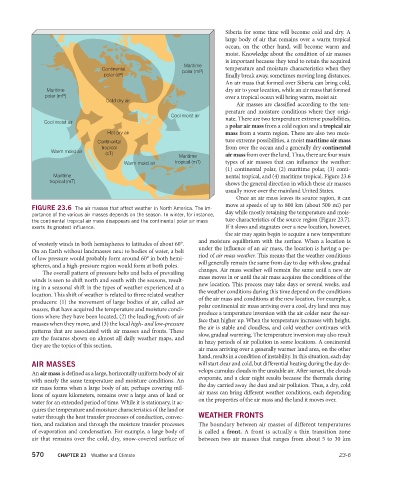
                                                                                      Air masses are classified according to the tem-
                                                                                   perature and moisture conditions where they origi-
                                                                 Cool moist air
                       Cool moist air                                              nate. There are two  temperature extreme possibilities,
                                                                                   a polar air mass from a cold region and a tropical air
                                            Hot dry air                            mass from a warm region. There are also two mois-
                                        Continental                                ture extreme possibilities, a moist maritime air mass
                                          tropical                                 from over the ocean and a generally dry continental
                         Warm moist air    (cT)
                                                                   Maritime        air mass from over the land. Thus, there are four main
                                                 Warm moist air   tropical (mT)    types of air masses that can influence the weather:
                                                                                   (1) continental polar, (2) maritime polar, (3) conti-
                          Maritime                                                 nental tropical, and (4) maritime tropical. Figure 23.6
                         tropical (mT)
                                                                                   shows the general direction in which these air masses
                                                                                   usually move over the mainland United States.
                                                                                      Once an air mass leaves its source region, it can
                                                                                   move at speeds of up to 800 km (about 500 mi) per
                   FIGURE 23.6  The air masses that affect weather in North America. The im-
                   portance of the various air masses depends on the season. In winter, for instance,   day while mostly  retaining the temperature and mois-
                   the continental tropical air mass disappears and the continental polar air mass   ture characteristics of the source region (Figure 23.7).
                   exerts its greatest influence.                                  If it slows and stagnates over a new location, however,
                                                                                   the air may again begin to acquire a new  temperature
                                                                          and moisture equilibrium with the surface. When a location is
                   of westerly winds in both hemispheres to latitudes of about 60°.
                                                                          under the influence of an air mass, the location is  having a pe-
                   On an Earth without landmasses next to bodies of water, a belt
                                                                          riod of air mass weather. This means that the weather conditions
                   of low pressure would probably form around 60° in both hemi-
                                                                          will generally remain the same from day to day with slow, gradual
                   spheres, and a high-pressure region would form at both poles.
                                                                          changes. Air mass weather will remain the same until a new air
                      The overall pattern of pressure belts and belts of prevailing
                                                                          mass moves in or until the air mass acquires the conditions of the
                   winds is seen to shift north and south with the seasons, result-
                                                                          new location. This process may take days or several weeks, and
                   ing in a seasonal shift in the types of weather experienced at a
                                                                          the weather conditions during this time  depend on the conditions
                   location. This shift of weather is related to three related weather   of the air mass and conditions at the new location. For example, a
                     producers: (1) the movement of large bodies of air, called air
                                                                          polar continental air mass  arriving over a cool, dry land area may
                   masses, that have acquired the temperature and moisture condi-
                                                                          produce a temperature inversion with the air colder near the sur-
                   tions where they have been located, (2) the leading fronts of air
                                                                          face than higher up. When the  temperature increases with height,
                   masses when they move, and (3) the local high- and low-pressure
                                                                          the air is stable and cloudless, and cold weather continues with
                   patterns that are associated with air masses and fronts. These
                                                                          slow, gradual warming. The temperature inversion may also result
                   are the features shown on almost all daily weather maps, and
                                                                          in hazy periods of air  pollution in some locations. A continental
                   they are the topics of this section.
                                                                          air mass arriving over a generally warmer land area, on the other
                                                                          hand, results in a condition of instability. In this situation, each day
                   AIR MASSES                                             will start clear and cold, but differential heating during the day de-
                                                                          velops cumulus clouds in the unstable air. After sunset, the clouds
                   An air mass is defined as a large, horizontally uniform body of air
                                                                          evaporate, and a clear night results because the thermals during
                   with nearly the same temperature and moisture conditions. An
                                                                          the day carried away the dust and air pollution. Thus, a dry, cold
                   air mass forms when a large body of air, perhaps covering mil-
                                                                          air mass can bring different weather conditions, each depending
                   lions of square kilometers, remains over a large area of land or
                                                                          on the properties of the air mass and the land it moves over.
                   water for an extended period of time. While it is stationary, it ac-
                   quires the temperature and moisture characteristics of the land or
                   water through the heat transfer processes of conduction, convec-    WEATHER FRONTS
                   tion, and radiation and through the moisture transfer processes   The boundary between air masses of different temperatures
                   of evaporation and condensation. For example, a large body of   is called a  front. A front is actually a thin transition zone
                   air that remains over the cold, dry, snow-covered surface of   between two air masses that ranges from about 5 to 30 km
                   570     CHAPTER 23  Weather and Climate                                                              23-6

