Page 591 - 9780077418427.pdf
P. 591

/Volume/201/MHDQ233/tat78194_disk1of1/0073378194/tat78194_pagefiles
          tiL12214_ch23_565-596.indd Page 568  9/23/10  11:07 AM user-f465
          tiL12214_ch23_565-596.indd Page 568  9/23/10  11:07 AM user-f465             /Volume/201/MHDQ233/tat78194_disk1of1/0073378194/tat78194_pagefile


                                                                          Step 1   Heat from condensation
                                                                                        3
                                                                              m = 1.65 × 10  kg      Q = mL v
                                                                                     cal _           Convert kg to g:
                                                                             L v  = 540              1.65 × 10  kg     _ )
                                                                                     g
                                                                                                                    3
                     Increasing altitude             Parcel                                         Q = 1.65 × 10  g  540
                                                                                                              (
                                                                                                               1 × 10  g
                                                                                                            3


                                                                              Q = ?
                                                                                                                 1 kg
                                                                                                            6
                                                     of air
                                                                                                     1.65 × 10  g
                                                                                                                     cal _
                                                                                                                     g )
                                                                                                                 (
                                                                                                               6
                              Temperature
                                                                                                              8
                                                     a rising parcel
                               of surrounding air    Temperature of                                   = 8.9 × 10  cal
                                                     of air
                                                                          Step 2   Temperature change of air
                                                                                         g
                                                                                       3 _
                                                                             ρ = 1.1 × 10

                                                                                        m 3
                                      Increasing temperature                 V = 1.0 km 3
                                                                                    _
                                                                                     cal

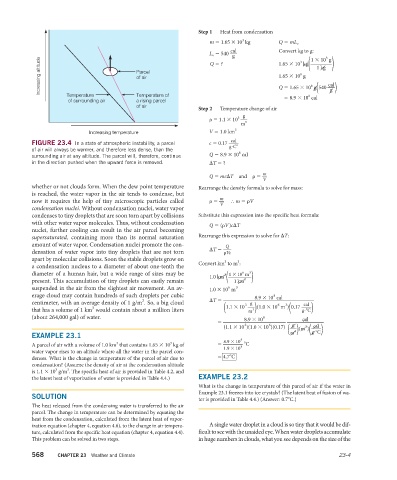
                   FIGURE 23.4  In a state of atmospheric instability, a parcel   c = 0.17
                                                                                    g⋅C°
                   of air will always be warmer, and therefore less dense, than the    8
                     surrounding air at any altitude. The parcel will, therefore, continue   Q = 8.9 × 10  cal
                   in the  direction pushed when the upward force is removed.  ΔT = ?
                                                                                               m _
                                                                             Q = mcΔT and  ρ =

                                                                                               V
                   whether or not clouds form. When the dew point temperature   Rearrange the density formula to solve for mass:
                   is reached, the water vapor in the air tends to condense, but
                                                                                 m _
                   now it requires the help of tiny microscopic particles called   ρ =          ∴ m = ρV

                                                                                 V
                   condensation nuclei. Without condensation nuclei, water vapor
                   condenses to tiny droplets that are soon torn apart by collisions   Substitute this expression into the specific heat formula:
                   with other water vapor molecules. Thus, without condensation
                                                                              Q = (ρV )cΔT
                   nuclei, further cooling can result in the air parcel becoming
                     supersaturated, containing more than its normal saturation   Rearrange this expression to solve for ΔT:
                   amount of water vapor. Condensation nuclei promote the con-    _
                                                                                   Q

                   densation of water vapor into tiny droplets that are not torn   ΔT =
                                                                                  ρVc
                   apart by molecular collisions. Soon the stable droplets grow on
                                                                                   3
                                                                                       3
                                                                          Convert km  to m :
                   a condensation nucleus to a  diameter of about one-tenth the
                                                                                        6
                     diameter of a human hair, but a wide range of sizes may be    3 1 ×  10     m    3
                                                                                   (
                                                                                    _


                                                                              1.0  km         3 )
                     present. This accumulation of tiny droplets can easily remain    1 k m
                   suspended in the air from the slightest air movement. An av-  1.0 × 1 0     m    3
                                                                                    6
                   erage cloud may contain hundreds of such droplets per cubic    ____
                                                                                                   8
                                                                                            8.9 × 1 0    cal
                                                       3
                     centimeter, with an average density of 1 g/m . So, a big cloud   ΔT =     (     3)      6       _
                                                                                         3 g
                                                                                          _
                                                                                                        (
                                                                                                             cal
                                                                                                       3


                                       3
                   that has a volume of 1 km  would contain about a million liters     1.1 × 1 0          (1.0 × 1 0     m   )  0.17     g⋅°C)
                                                                                           m
                   (about 264,000 gal) of water.                                  ___ __
                                                                                               8
                                                                                         8.9 × 1 0
                                                                                                            cal
                                                                                =
                                                                                                 6
                                                                                                         g
                                                                                         3
                                                                                  (1.1 × 1 0   )(1.0 × 1 0   )(0.17) _ 3) ( g⋅°C)
                                                                                                             3 _
                                                                                                       (
                                                                                                                cal
                                                                                                               ( m   )


                     EXAMPLE 23.1                                                       8                m
                                                                                  8.9 × 1 0
                                                                                         °
                                               3
                                                                 3


                     A parcel of air with a volume of 1.0 km  that contains 1.65 × 10  kg of   =   _ 8     C
                                                                                  1.9 × 1 0
                   water vapor rises to an altitude where all the water in the parcel con-
                   denses. What is the change in temperature of the parcel of air due to   = 4.7°C
                   condensation? (Assume the density of air at the condensation altitude
                           3
                              3
                   is 1.1 × 10  g/m . The specific heat of air is provided in Table 4.2, and
                   the latent heat of vaporization of water is provided in Table 4.4.)  EXAMPLE 23.2
                                                                          What is the change in temperature of this parcel of air if the water in
                                                                          Example 23.1 freezes into ice crystals? (The latent heat of fusion of wa-
                   SOLUTION
                                                                          ter is provided in Table 4.4.) (Answer: 0.7°C.)
                   The heat released from the condensing water is transferred to the air
                   parcel. The change in temperature can be determined by equating the
                   heat from the condensation, calculated from the latent heat of vapor-
                   ization equation (chapter 4, equation 4.6), to the change in air tempera-  A single water droplet in a cloud is so tiny that it would be dif-
                   ture, calculated from the specific heat equation (chapter 4,  equation 4.4).   ficult to see with the unaided eye. When water droplets  accumulate
                   This problem can be solved in two steps.               in huge numbers in clouds, what you see depends on the size of the
                   568     CHAPTER 23  Weather and Climate                                                              23-4
   586   587   588   589   590   591   592   593   594   595   596