


Page 596 - 9780077418427.pdf
P. 596
/Volume/201/MHDQ233/tat78194_disk1of1/0073378194/tat78194_pagefile
          tiL12214_ch23_565-596.indd Page 573  9/23/10  11:07 AM user-f465
          tiL12214_ch23_565-596.indd Page 573  9/23/10  11:07 AM user-f465             /Volume/201/MHDQ233/tat78194_disk1of1/0073378194/tat78194_pagefiles


                                                                                  Science and Society


                                                                                                   Urban Heat Islands
                              rban areas are often 2 to 10 degrees      It is possible to reduce the heat is-  break to encourage developers to
                          Uwarmer at night than the surround-  land effect by using alternatives to con-  diminish the heat island effect? Why
                          ing rural areas. Climatologists call this   ventional asphalt and concrete. Resins   or why not?
                          difference the urban heat island effect. This   and rubberized asphalt, for example, do     2.  What are the advantages and dis -
                            effect is created by all the bricks, concrete,   not absorb as much heat during the day.   advantages of required urban plan-
                          and asphalt of buildings, parking lots, and   Landscaping to create islands of “urban   ning,  including the creation of forest
                          streets. These structures are warmed by sun-  forests” also helps.      islands in urban areas?
                          light during the day, then reradiate stored
                                                                                                 3.  What solutions can you think of to
                          heat at night. Building surfaces also disrupt
                                                             QUESTIONS TO DISCUSS                   diminish the urban heat island
                          the normal cooling by infrared radiation.
                                                                                                  effect?
                          Surrounding rural areas are cooler because     1.  Developers are slow to consider taking
                          less heat is absorbed during the day, and   steps to diminish heat island effects.
                          more is released by radiation at night.  Should governments provide a tax


                       wind direction and a rapid increase in the barometric pressure.   clouds. This light rain (and snow in the winter) may last for days
                       Before the cold front arrives, the wind is generally moving toward   as the warm front passes.
                       the front as warm, less dense air is forced upward by the cold,   Sometimes the forces influencing the movement of a cold
                       denser air. The lowest barometric pressure reading is  associated   or warm air mass lessen or become balanced, and the front stops
                       with the lifting of the warm air at the front. After the front passes     advancing. When this happens, a stream of cold air moves along
                       your location, you are in the cooler, denser air that is settling out-  the north side of the front, and a stream of warm air moves
                       ward, so the barometric pressure  increases and the wind shifts   along the south side in an opposite direction. This is called a
                       with the movement of the cold air mass.                 stationary front because the edge of the front is not advancing
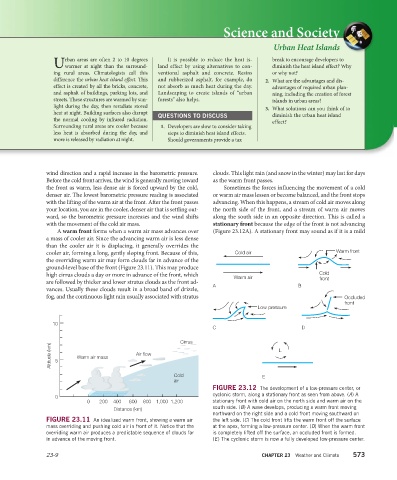
                           A warm front forms when a warm air mass advances over   (Figure 23.12A). A stationary front may sound as if it is a mild
                       a mass of cooler air. Since the advancing warm air is less dense
                       than the cooler air it is displacing, it generally overrides the
                       cooler air, forming a long, gently sloping front. Because of this,   Cold air                    Warm front
                       the overriding warm air may form clouds far in advance of the
                       ground-level base of the front (Figure 23.11). This may produce
                       high cirrus clouds a day or more in advance of the front, which   Warm air                 Cold
                                                                                                                  front
                       are followed by thicker and lower stratus clouds as the front ad-  A                B
                       vances. Usually these clouds result in a broad band of drizzle,
                       fog, and the continuous light rain usually associated with  stratus                                Occluded
                                                                                                                          front
                                                                                              Low pressure


                          10
                                                                               C                            D

                                                                    Cirrus
                         Altitude (km)  5  Warm air mass  Air flow                                   L


                                                                  Cold                         E
                                                                  air
                                                                               FIGURE 23.12  The development of a low-pressure center, or
                          0                                                    cyclonic storm, along a stationary front as seen from above. (A) A
                                     0   200  400  600  800 1,000 1,200        stationary front with cold air on the north side and warm air on the
                                              Distance (km)                    south side. (B) A wave develops, producing a warm front moving
                                                                               northward on the right side and a cold front moving southward on
                       FIGURE 23.11  An idealized warm front, showing a warm air   the left side. (C) The cold front lifts the warm front off the surface
                       mass overriding and pushing cold air in front of it. Notice that the   at the apex, forming a low-pressure center. (D) When the warm front
                       overriding warm air produces a predictable sequence of clouds far   is completely lifted off the surface, an occluded front is formed.
                       in advance of the moving front.                         (E) The cyclonic storm is now a fully developed low-pressure center.

                       23-9                                                                    CHAPTER 23  Weather and Climate   573

