


Page 630 - 9780077418427.pdf
P. 630
/Volume/201/MHDQ233/tat78194_disk1of1/0073378194/tat78194_pagefiles
          tiL12214_ch24_597-622.indd Page 607  9/23/10  11:09 AM user-f465
          tiL12214_ch24_597-622.indd Page 607  9/23/10  11:09 AM user-f465             /Volume/201/MHDQ233/tat78194_disk1of1/0073378194/tat78194_pagefile


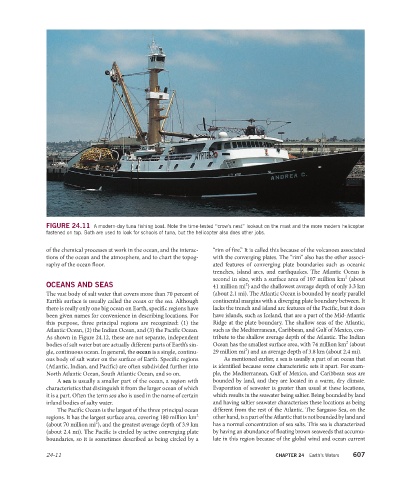
                       FIGURE 24.11  A modern-day tuna fishing boat. Note the time-tested “crow’s nest” lookout on the mast and the more modern helicopter
                       fastened on top. Both are used to look for schools of tuna, but the helicopter also does other jobs.


                       of the chemical processes at work in the ocean, and the interac-  “rim of fire.” It is called this because of the volcanoes associated
                       tions of the ocean and the atmosphere, and to chart the topog-  with the converging plates. The “rim” also has the other associ-
                       raphy of the ocean floor.                               ated features of converging plate boundaries such as oceanic
                                                                               trenches,  island arcs, and earthquakes. The Atlantic Ocean is
                                                                                                                           2
                                                                               second in size, with a surface area of 107 million km  (about
                       OCEANS AND SEAS                                         41 million mi ) and the shallowest average depth of only 3.3 km
                                                                                          2
                       The vast body of salt water that covers more than 70 percent of   (about 2.1 mi). The Atlantic Ocean is bounded by nearly parallel
                       Earth’s surface is usually called the ocean or the sea.  Although   continental margins with a diverging plate boundary between. It
                       there is really only one big ocean on Earth, specific regions have   lacks the trench and island arc features of the Pacific, but it does
                       been given names for convenience in describing  locations. For   have  islands, such as Iceland, that are a part of the Mid-Atlantic
                       this purpose, three principal regions are recognized: (1) the   Ridge at the plate boundary. The shallow seas of the Atlantic,
                         Atlantic Ocean, (2) the Indian Ocean, and (3) the Pacific Ocean.   such as the Mediterranean, Caribbean, and Gulf of Mexico, con-
                       As shown in Figure 24.12, these are not separate, independent   tribute to the shallow average depth of the Atlantic. The Indian
                                                                                                                           2
                       bodies of salt water but are actually different parts of Earth’s sin-  Ocean has the smallest surface area, with 74 million km  (about
                                                                                         2
                       gle, continuous ocean. In general, the ocean is a single, continu-  29 million mi ) and an average depth of 3.8 km (about 2.4 mi).
                       ous body of salt water on the surface of Earth. Specific regions   As mentioned earlier, a sea is usually a part of an ocean that
                       (Atlantic, Indian, and Pacific) are often subdivided further into   is identified because some characteristic sets it apart. For exam-
                       North Atlantic Ocean, South Atlantic Ocean, and so on.  ple, the Mediterranean, Gulf of Mexico, and Caribbean seas are
                           A sea is usually a smaller part of the ocean, a region with   bounded by land, and they are located in a warm, dry climate.
                       characteristics that distinguish it from the larger ocean of which   Evaporation of seawater is greater than usual at these locations,
                       it is a part. Often the term sea also is used in the name of certain   which results in the seawater being saltier. Being bounded by land
                       inland bodies of salty water.                           and having saltier seawater characterizes these locations as being
                           The Pacific Ocean is the largest of the three principal ocean   different from the rest of the Atlantic. The Sargasso Sea, on the
                                                                         2
                       regions. It has the largest surface area, covering 180 million km    other hand, is a part of the Atlantic that is not bounded by land and
                                        2
                       (about 70 million mi ), and the greatest average depth of 3.9 km   has a normal concentration of sea salts. This sea is characterized
                       (about 2.4 mi). The Pacific is circled by active converging plate   by having an abundance of floating brown seaweeds that accumu-
                       boundaries, so it is sometimes described as being circled by a   late in this region because of the global wind and ocean current

                       24-11                                                                       CHAPTER 24  Earth’s Waters   607

