


Page 67 - 9780077418427.pdf
P. 67
/Users/user-f465/Desktop
          tiL12214_ch02_025-060.indd Page 44  9/1/10  9:55 PM user-f465
          tiL12214_ch02_025-060.indd Page 44  9/1/10  9:55 PM user-f465                                                 /Users/user-f465/Desktop


                   an object, the force can be calculated from Newton’s second law   are proportional in a given location on the surface of Earth.
                   of motion,                                             Using conversion factors from inside the front cover of this
                                                                          book, see if you can express your weight in pounds and new-
                                         F = ma
                                                                          tons and your mass in kg.
                   or
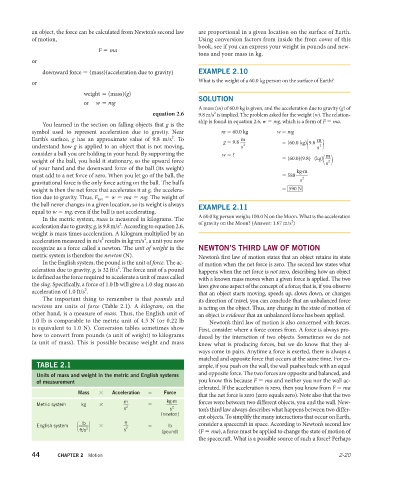
                      downward force = (mass)(acceleration due to gravity)  EXAMPLE 2.10
                                                                          What is the weight of a 60.0 kg person on the surface of Earth?
                   or
                                    weight = (mass)(g)
                                                                          SOLUTION
                                    or  w = mg
                                                                          A mass (m) of 60.0 kg is given, and the acceleration due to gravity (g) of
                                                                               2
                                                           equation 2.6   9.8 m/s  is implied. The problem asked for the weight (w). The relation-
                                                                          ship is found in equation 2.6, w = mg, which is a form of F = ma.
                      You learned in the section on falling objects that g is the
                   symbol used to represent acceleration due to gravity. Near    m = 60.0 kg        w = mg
                                                                 2
                   Earth’s surface,  g has an approximate value of 9.8 m/s . To         m _                      m _
                                                                                                                  2)
                                                                                                              (
                                                                                  g = 9.8             = (60.0 kg)  9.8


                                                                                         2
                    understand how g is applied to an object that is not moving,         s                        s
                   consider a ball you are holding in your hand. By supporting the   w = ?                          m _
                                                                                                                   ( )
                                                                                                     = (60.0)(9.8)    (kg)

                   weight of the ball, you hold it stationary, so the upward force                                   s    2
                   of your hand and the downward force of the ball (its weight)                           _
                                                                                                          kg·m

                   must add to a net force of zero. When you let go of the ball, the                 = 588
                                                                                                            2
                                                                                                             s
                   gravitational force is the only force acting on the ball. The ball’s
                   weight is then the net force that accelerates it at g, the accelera-              =  590 N
                   tion due to gravity. Thus, F net  = w = ma = mg. The weight of
                   the ball never changes in a given location, so its weight is always   EXAMPLE 2.11
                   equal to w = mg, even if the ball is not accelerating.
                                                                          A 60.0 kg person weighs 100.0 N on the Moon. What is the acceleration
                      In the metric system, mass is measured in kilograms. The                           2
                                                2
                   acceleration due to gravity, g, is 9.8 m/s . According to  equation 2.6,   of gravity on the Moon? (Answer: 1.67 m/s )
                   weight is mass times acceleration. A kilogram multiplied by an
                                                        2
                                          2
                   acceleration measured in m/s  results in kg⋅m/s , a unit you now
                   recognize as a force called a newton. The unit of weight in the   NEWTON’S THIRD LAW OF MOTION
                   metric system is therefore the newton (N).             Newton’s first law of motion states that an object retains its state
                      In the English system, the pound is the unit of force. The ac-  of motion when the net force is zero. The second law states what
                                               2
                   celeration due to gravity, g, is 32 ft/s . The force unit of a pound   happens when the net force is not zero, describing how an object
                   is defined as the force required to accelerate a unit of mass called   with a known mass moves when a given force is applied. The two
                   the slug. Specifically, a force of 1.0 lb will give a 1.0 slug mass an   laws give one aspect of the concept of a force; that is, if you observe
                                    2
                   acceleration of 1.0 ft/s .                             that an object starts moving, speeds up, slows down, or changes
                      The important thing to remember is that  pounds and   its direction of travel, you can conclude that an unbalanced force
                     newtons are units of  force (Table 2.1). A  kilogram, on the   is acting on the object. Thus, any change in the state of motion of
                   other hand, is a mea sure of mass. Thus, the English unit of   an object is evidence that an unbalanced force has been applied.
                   1.0 lb is comparable to the metric unit of 4.5 N (or 0.22 lb   Newton’s third law of motion is also concerned with forces.
                   is equivalent to 1.0 N). Conversion tables sometimes show   First, consider where a force comes from. A force is always pro-
                   how to convert from pounds (a unit of weight) to kilograms   duced by the interaction of two objects. Sometimes we do not
                   (a unit of mass). This is possible because weight and mass   know what is producing forces, but we do know that they al-
                                                                          ways come in pairs. Anytime a force is exerted, there is always a
                                                                          matched and opposite force that occurs at the same time. For ex-
                    TABLE 2.1                                             ample, if you push on the wall, the wall pushes back with an equal
                                                                          and opposite force. The two forces are opposite and balanced, and
                    Units of mass and weight in the metric and English systems
                    of measurement                                        you know this because F = ma and neither you nor the wall ac-
                                                                          celerated. If the acceleration is zero, then you know from F = ma
                                  Mass   ×   Acceleration  =  Force
                                                                          that the net force is zero (zero equals zero). Note also that the two
                                                               kg·m
                                                 m _


                    Metric system   kg   ×                    =  _        forces were between two different objects, you and the wall. New-
                                                 s 2            s 2       ton’s third law always describes what happens between two differ-
                                                             (newton)
                                                                          ent objects. To simplify the many interactions that occur on Earth,
                                                 ft _
                                   lb

                                                                lb

                    English system   (     _ 2)           ×             =  (pound)  consider a spacecraft in space. According to Newton’s second law

                                                  2
                                  ft/s
                                                 s
                                                                          (F = ma), a force must be applied to change the state of motion of
                                                                          the spacecraft. What is a possible source of such a force? Perhaps
                   44      CHAPTER 2 Motion                                                                             2-20

