


Page 18 - Focus SPM KSSM F4 2020 - Chemistry
P. 18
Chemistry Form 4  Chapter 3 The Mole Concept, Chemical Formula and Equation
             ACTIVITY 3.2

       Aim:  To determine the empirical formula of copper(II) oxide
                         -3
       Materials:  2 mol dm  sulphuric acid, 1 mol dm  copper(II) sulphate solution, zinc granules, copper(II)
                                                -3
                oxide, anhydrous calcium chloride and wooden splinter.
       Apparatus:  Combustion  tube  with  one  hole  at  the  end,  Bunsen  burner,  flat-bottomed  flask,  thistle
                 funnel, stoppers, glass tube, retort stand and clamp, balance, U-tube, spatula and porcelain
                 dish.
       Procedure:
         1.  The mass of the combustion tube with the porcelain dish in it is weighed.
         2.   One spatulaful of copper(II) oxide is added to the porcelain dish. The tube is weighed again.
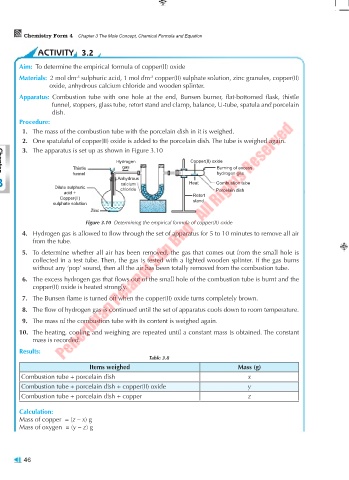
         3.   The apparatus is set up as shown in Figure 3.10
                                     Hydrogen               Copper(II) oxide
                        Thistle        gas                           Burning of excess
                        funnel                                       hydrogen gas
  Chapter
 3                Dilute sulphuric    Anhydrous             Heat     Combustion tube
                                       calcium
                     acid +            chloride                     Porcelain dish
                    Copper(II)                               Retort
                                                             stand
                  sulphate solution
                             Zinc
                            Figure 3.10  Determining the empirical formula of copper(II) oxide
         4.  Hydrogen gas is allowed to flow through the set of apparatus for 5 to 10 minutes to remove all air
           from the tube.
         5.   To determine whether all air has been removed, the gas that comes out from the small hole is
           collected in a test tube. Then, the gas is tested with a lighted wooden splinter. If the gas burns
           without any ‘pop’ sound, then all the air has been totally removed from the combustion tube.
         6.   The excess hydrogen gas that flows out of the small hole of the combustion tube is burnt and the
           copper(II) oxide is heated strongly.
         7.   The Bunsen flame is turned off when the copper(II) oxide turns completely brown.

         8.   The flow of hydrogen gas is continued until the set of apparatus cools down to room temperature.
         9.   The mass of the combustion tube with its content is weighed again.
         10.   The heating, cooling and weighing are repeated until a constant mass is obtained. The constant
           mass is recorded.
       Results:
                                                Table 3.8
                             Items weighed                                 Mass (g)
        Combustion tube + porcelain dish                                      x
        Combustion tube + porcelain dish + copper(II) oxide                   y
        Combustion tube + porcelain dish + copper                             z


       Calculation:
       Mass of copper  = (z – x) g
       Mass of oxygen  = (y – z) g


        46


 03 SPM CHEMISTRY F4.indd   46                                                               27/02/2020   11:23 AM

