


Page 16 - Focus SPM KSSM F4 2020 - Chemistry
P. 16
Chemistry Form 4  Chapter 3 The Mole Concept, Chemical Formula and Equation

      EXAMPLE 3.18
       Phosphoric acid contains 3.06% of hydrogen, 31.63% of phosphorus and 65.31% of oxygen. Calculate
       the empirical formula of the acid. [Relative atomic mass: H,1; O, 16; P, 31]
       Solution
       Based on its percentage composition, each 100 g of phosphoric acid contains 3.06 g of hydrogen, 31.63
       g of phosphorus and 65.31g of oxygen. The calculation based on the 100 g of the acid is as follows.
        Elements                        Hydrogen, H        Phosphorus, P        Oxygen, O
        Mass (g)                           3.06               31.63               65.31
        Number of moles of atoms        3.06   = 3.06      31.63  = 1.02       65.31  = 4.08
                                          1                 31                   16
        Ratio of number of moles of       3.06   = 3         1.02   = 1          4.08   = 4
        atoms                             1.02               1.02                1.02
        Simplest ratio of number of          3                  1                   4
        moles of atoms
  Chapter
 3     3 moles of hydrogen atoms combine with 1 mole of phosphorus atoms and 4 moles of oxygen atoms.
       So, the empirical formula of phosphorus acid is H PO .
                                                  3  4

            ACTIVITY       3.1


       Aim:  To determine the empirical formula of magnesium oxide.
       Materials:  Magnesium ribbon and sand paper.
       Apparatus:  Crucible with lid, tongs, Bunsen burner, tripod stand, pipe-clay triangle and electronic
                  balance.
       Procedure:
         1.   A crucible with its lid is weighed.
         2.   10 cm of magnesium ribbon is cleaned with sand paper to remove its oxide layer.
         3.   The magnesium ribbon is coiled loosely and placed in the crucible. The crucible, its lid and
           content are weighed.
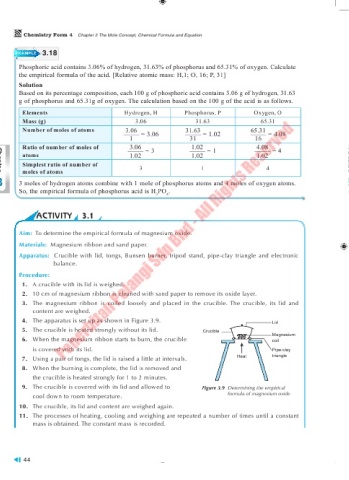
         4.   The apparatus is set up as shown in Figure 3.9.                         Lid
         5.   The crucible is heated strongly without its lid.  Crucible
                                                                                      Magnesium
         6.   When the magnesium ribbon starts to burn, the crucible                  coil
           is covered with its lid.                                                   Pipe-clay
         7.   Using a pair of tongs, the lid is raised a little at intervals.  Heat   triangle
         8.   When the burning is complete, the lid is removed and
           the crucible is heated strongly for 1 to 2 minutes.
         9.   The crucible is covered with its lid and allowed to   Figure 3.9  Determining the empirical
           cool down to room temperature.                               formula of magnesium oxide
         10.   The crucible, its lid and content are weighed again.
         11.   The processes of heating, cooling and weighing are repeated a number of times until a constant
           mass is obtained. The constant mass is recorded.


        44


 03 SPM CHEMISTRY F4.indd   44                                                               27/02/2020   11:23 AM

