


Page 15 - Focus SPM KSSM F4 2020 - Chemistry
P. 15
Chemistry Form 4  Chapter 3 The Mole Concept, Chemical Formula and Equation
        Determining empirical formula

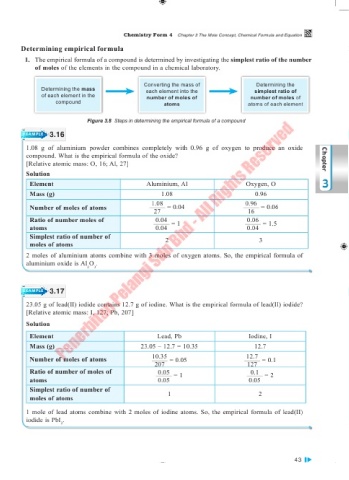
          1.  The empirical formula of a compound is determined by investigating the simplest ratio of the number
            of moles of the elements in the compound in a chemical laboratory.


                                              Converting the mass of             Determining the
              Determining the mass             each element into the             simplest ratio of
              of each element in the           number of moles of              number of moles of
                  compound                          atoms                     atoms of each element


                            Figure 3.8  Steps in determining the empirical formula of a compound

        EXAMPLE 3.16
         1.08  g  of  aluminium  powder  combines  completely  with  0.96  g  of  oxygen  to  produce  an  oxide
         compound. What is the empirical formula of the oxide?
         [Relative atomic mass: O, 16; Al, 27]                                                        Chapter
         Solution
          Element                              Aluminium, Al                  Oxygen, O               3
          Mass (g)                                 1.08                          0.96
                                                1.08                          0.96
          Number of moles of atoms                    = 0.04                       = 0.06
                                                 27                           16
          Ratio of number moles of                0.04   = 1                  0.06   = 1.5
          atoms                                   0.04                        0.04
          Simplest ratio of number of                2                            3
          moles of atoms
         2 moles of aluminium atoms combine with 3 moles of oxygen atoms. So, the empirical formula of
         aluminium oxide is Al O .
                            2  3


        EXAMPLE 3.17
         23.05 g of lead(II) iodide contains 12.7 g of iodine. What is the empirical formula of lead(II) iodide?
         [Relative atomic mass: I, 127; Pb, 207]
         Solution

          Element                                 Lead, Pb                     Iodine, I
          Mass (g)                           23.05 – 12.7 = 10.35               12.7
          Number of moles of atoms               10.35  = 0.05                12.7   = 0.1
                                                 207                          127
          Ratio of number of moles of             0.05   = 1                   0.1   = 2
          atoms                                   0.05                         0.05
          Simplest ratio of number of                1                            2
          moles of atoms

         1 mole of lead atoms combine with 2 moles of iodine atoms. So, the empirical formula of lead(II)
         iodide is PbI .
                    2


                                                                                             43


 03 SPM CHEMISTRY F4.indd   43                                                               27/02/2020   11:23 AM

