


Page 161 - The Design Thinking Playbook
P. 161
1 Creative thinking
        What makes a good visualization?

        Good visualizations direct the eye to what is essential. The trick here is to leave out what’s nonessential.
        This means no art in the sense of embellishing, decorating, or designing beautifully. Our goal must be to be
        as vivid, lifelike, and specific as possible.

        Four properties are crucial in the creation of visualizations:


        •   We focus on what’s important—and leave out all that’s unnecessary.             2 Presentations
        •   We are specific—we don’t create vague drawings.
        •   We make our pictures comprehensible—and are able to make linkages to the content.
        •   We kindle interest—it is delightful to look at the pictures.

        Lilly motivates her students to use visualization for specific design challenges. How would a child-friendly
        can opener look, for instance? The large number of sketches quickly show which lines are identified and
        what symbolism is clear or irritating. Another exercise is to put into a picture what we were just speaking
        about with somebody on the phone. Comics are ideal if you seek inspiration for facial expressions (e.g.,
        Calvin & Hobbes or similar comics collections). Competitions on the Web can be motivating if we want
        to become better. Usually, they are about visualizing individual concepts, which are then published on   3 Documentation
        Facebook or Instagram.


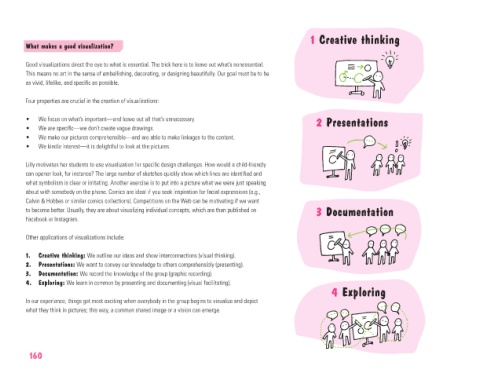
        Other applications of visualizations include:

        1.  Creative thinking: We outline our ideas and show interconnections (visual thinking).
        2.  Presentations: We want to convey our knowledge to others comprehensibly (presenting).
        3.  Documentation: We record the knowledge of the group (graphic recording).
        4.  Exploring: We learn in common by presenting and documenting (visual facilitating).
                                                                                                4 Exploring
        In our experience, things get most exciting when everybody in the group begins to visualize and depict
        what they think in pictures; this way, a common shared image or a vision can emerge.


         160

