


Page 45 - T-I JOURNAL19 4
P. 45
WOMEN INNOVATOR PROGRAMS IN ACADEMIA                        693


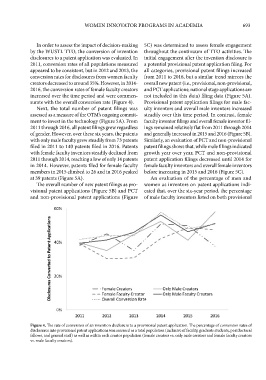
               In order to assess the impact of decision-making  5C) was determined to assess female engagement
             by the WUSTL TTO, the conversion of invention  throughout the continuum of TTO activities. The
             disclosures to a patent application was evaluated. In  initial engagement after the invention disclosure is
             2011, conversion rates of all populations measured  a potential provisional patent application filing. For
             appeared to be consistent, but in 2012 and 2013, the  all categories, provisional patent filings increased
             conversion rates for disclosures from women faculty  from 2011 to 2016, but a similar trend mirrors the
             creators decreased to around 35%. However, in 2014-  overall new patent (i.e., provisional, non-provisional,
             2016, the conversion rates of female faculty creators  and PCT applications; national stage applications are
             increased over the time period and were commen-  not included in this data) filing data (Figure 5A).
             surate with the overall conversion rate (Figure 4).  Provisional patent application filings for male fac-
               Next, the total number of patent filings was   ulty inventors and overall male inventors increased
             assessed as a measure of the OTM’s ongoing commit-  steadily over this time period. In contrast, female
             ment to invest in the technology (Figure 5A). From  faculty inventor filings and overall female inventor fil-
             2011 through 2016, all patent filings grew regardless  ings remained relatively flat from 2011 through 2014
             of gender. However, over these six years, the patents  and generally increased in 2015 and 2016 (Figure 5B).
             with only male faculty grew steadily from 73 patents  Similarly, an evaluation of PCT and non-provisional
             filed in 2011 to 140 patents filed in 2016. Patents  patent filings shows that, while male filings indicated
             with female faculty inventors steadily declined from  growth year over year, PCT and non-provisional
             2011 through 2014, reaching a low of only 14 patents  patent application filings decreased until 2014 for
             in 2014. However, patents filed for female faculty  female faculty inventors and overall female inventors
             members in 2015 climbed to 26 and in 2016 peaked  before increasing in 2015 and 2016 (Figure 5C).
             at 39 patents (Figure 5A).                   An evaluation of the percentage of men and
               The overall number of new patent filings as pro-  women as inventors on patent applications indi-
             visional patent applications (Figure 5B) and PCT  cated that, over the six-year period, the percentage
             and non-provisional patent applications (Figure  of male faculty inventors listed on both provisional


             Figure 4. The rate of conversion of an invention disclosure to a provisional patent application. The percentage of conversion rates of
             disclosures into provisional patent applications was assessed as a total population (inclusive of faculty, graduate students, postdoctoral
             fellows, and general staff) as well as within each creator population (female creators vs. only male creators and female faculty creators
             vs. male faculty creators).

