


Page 709 - MARSIUM'21 COMP OF PAPER
P. 709
688                                        Azifah & Hazarina (2022)

            ■  4.0 DATA ANALYSIS AND FINDINGS

            The questionnaire consists of dependent variable and independent variables that will be evaluated using five-likert scale. SPPS is used to test
            the relationship between dependent variable and independent variables. There were 102 respondents fill in the questionnaire.

            4.1 DEMOGRAPHIC ANALYSIS

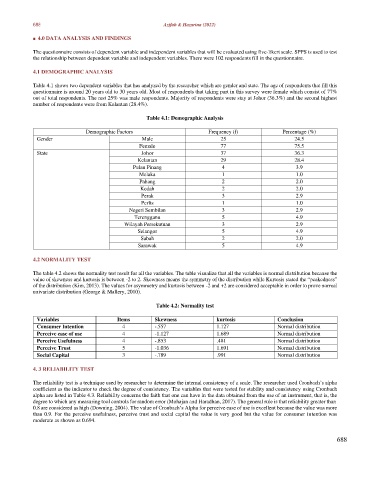
            Table 4.1 shows two dependent variables that has analyzed by the researcher which are gender and state. The age of respondents that fill this
            questionnaire is around 20 years old to 30 years old. Most of respondents that taking part in this survey were female which consist of 77%
            out of total respondents. The rest 25% was male respondents. Majority of respondents were stay at Johor (36.3%) and the second highest
            number of respondents were from Kelantan (28.4%).

                                                 Table 4.1: Demographic Analysis

                             Demographic Factors                      Frequency (f)            Percentage (%)
             Gender                             Male                      25                      24.5
                                               Female                     77                      75.5
             State                              Johor                     37                      36.3
                                               Kelantan                   29                      28.4
                                             Pulau Pinang                 4                        3.9
                                               Melaka                     1                        1.0
                                               Pahang                     2                        2.0
                                               Kedah                      2                        2.0
                                                Perak                     3                        2.9
                                                Perlis                    1                        1.0
                                            Negeri Sembilan               3                        2.9
                                             Terengganu                   5                        4.9
                                          Wilayah Persekutuan             3                        2.9
                                               Selangor                   5                        4.9
                                                Sabah                     2                        2.0
                                               Sarawak                    5                        4.9

            4.2 NORMALITY TEST

            The table 4.2 shows the normality test result for all the variables. The table visualize that all the variables is normal distribution because the
            value of skewness and kurtosis is between -2 to 2. Skewness means the symmetry of the distribution while Kurtosis stated the “peakedness”
            of the distribution (Kim, 2013). The values for asymmetry and kurtosis between -2 and +2 are considered acceptable in order to prove normal
            univariate distribution (George & Mallery, 2010).

                                                     Table 4.2: Normality test

             Variables                  Items       Skewness             kurtosis            Conclusion
             Consumer Intention          4          -.557                1.127               Normal distribution
             Perceive ease of use        4          -1.127               1.689               Normal distribution
             Perceive Usefulness         4          -.853                .481                Normal distribution
             Perceive Trust              5          -1.036               1.691               Normal distribution
             Social Capital              3          -.789                .991                Normal distribution

            4. 3 RELIABILITY TEST

            The reliability test is a technique used by researcher to determine the internal consistency of a scale. The researcher used Cronbach’s alpha
            coefficient as the indicator to check the degree of consistency. The variables that were tested for stability and consistency using Cronbach
            alpha are listed in Table 4.3. Reliability concerns the faith that one can have in the data obtained from the use of an instrument, that is, the
            degree to which any measuring tool controls for random error (Mohajan and Haradhan, 2017). The general rule is that reliability greater than
            0.8 are considered as high (Downing, 2004). The value of Cronbach’s Alpha for perceive ease of use is excellent because the value was more
            than 0.9. For the perceive usefulness, perceive trust and social capital the value is very good but the value for consumer intention was
            moderate as shown as 0.694.


                                                                                                                 688

