


Page 706 - MARSIUM'21 COMP OF PAPER
P. 706
685                                        Azifah & Hazarina (2022)

            al., 2011). Some researchers said that internet-based interactions are regarded as positive factors of offline interaction, involvement, and
            even social capital (Hampton and Wellman, 2003; Ellison et al., 2007). Users that in high social capital level, they tend to use Pinterest to
            search on the high-class destination that provides luxury places. Generating social capital is one of the main motivations of using social
            networking sites (Ellison et al., 2007). During travel, generally, social capital was exhibited by the use of social media to stay connected with
            friends or to share pictures (Singh and Srivastava, 2019). Social capital been manifested in the following forms which are altruism, sharing,
            confirming and bragging (Singh and Srivastava, 2019). Based on research that run by Singh and Srivastava (2019), people use Pinterest to
            make review and sharing information to others on what they experience in certain travel destination. Besides that, today situation people
            have extended family that scattered around the world through social sites like Pinterest, thus users love to share travel photos like sharing
            album photos to family (Singh and Srivastava, 2019). Moreover, at times a degree of peer pressure is also observed as a reason to share
            pictures (Singh and Srivastava, 2019). This prove that the highest rate of social capital, the more user intend to use Pinterest especially during
            and after a vacation. Based on this discussion, the following hypothesis were developed.

            H 4: There is positive significant relationship between social capital and intention to use Pinterest for travel purpose

            2.7 RESEARCH FRAMEWORK MODEL

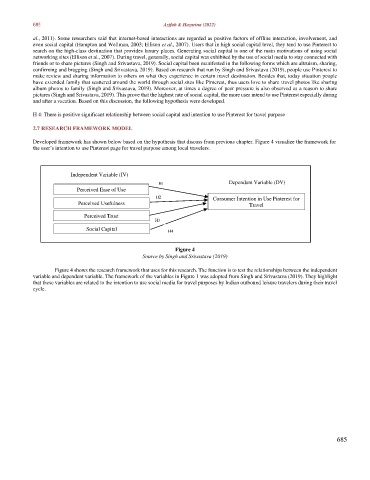
            Developed framework has shown below based on the hypothesis that discuss from previous chapter. Figure 4 visualize the framework for
            the user’s intention to use Pinterest page for travel purpose among local travelers.


                        Independent Variable (IV)
                                                     H1                      Dependant Variable (DV)
                           Perceived Ease of Use
                                                     H2                Consumer Intention in Use Pinterest for
                           Perceived Usefulness                                    Travel

                             Perceived Trust
                                                    H3
                              Social Capital             H4


                                                           Figure 4
                                                Source by Singh and Srivastava (2019)

                   Figure 4 shows the research framework that uses for this research. The function is to test the relationships between the independent
            variable and dependent variable. The framework of the variables in Figure 1 was adopted from Singh and Srivastava (2019). They highlight
            that these variables are related to the intention to use social media for travel purposes by Indian outbound leisure travelers during their travel
            cycle.


                                                                                                                 685

