


Page 946 - MARSIUM'21 COMP OF PAPER
P. 946
947                                        Teo & Dr Adaviah (2021)

                   4.2.2 DISCRIMINANT VALIDITY

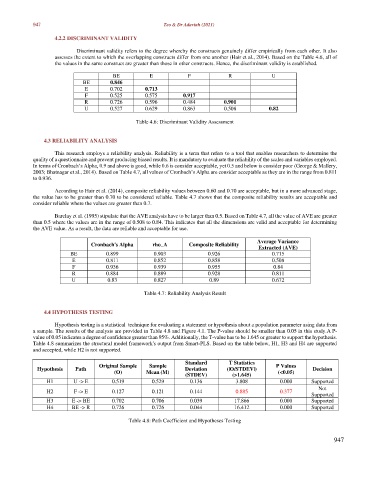
                          Discriminant validity refers to the degree whereby the constructs genuinely differ empirically from each other. It also
                   assesses the extent to which the overlapping constructs differ from one another (Hair et al., 2014). Based on the Table 4.6, all of
                   the values in the same construct are greater than those in other constructs. Hence, the discriminant validity is established.

                                      BE           E           F             R             U
                            BE       0.846
                             E       0.702       0.713
                             F       0.525       0.575        0.917
                             R       0.726       0.596        0.484        0.901
                             U       0.527       0.629        0.863        0.508          0.82

                                              Table 4.6: Discriminant Validity Assessment


                4.3 RELIABILITY ANALYSIS

                   This research employs a reliability analysis. Reliability is a term that refers to a tool that enables researchers to determine the
            quality of a questionnaire and prevent producing biased results. It is mandatory to evaluate the reliability of the scales and variables employed.
            In terms of Cronbach’s Alpha, 0.9 and above is good, while 0.6 is consider acceptable, yet 0.5 and below is consider poor (George & Mallery,
            2003; Bhatnagar et al., 2014). Based on Table 4.7, all values of Cronbach’s Alpha are consider acceptable as they are in the range from 0.811
            to 0.936.

                   According to Hair et al. (2014), composite reliability values between 0.60 and 0.70 are acceptable, but in a more advanced stage,
            the value has to be greater than 0.70 to be considered reliable. Table 4.7 shows that the composite reliability results are acceptable and
            consider reliable where the values are greater than 0.7.

                   Barclay et al. (1995) stipulate that the AVE analysis have to be larger than 0.5. Based on Table 4.7, all the value of AVE are greater
            than 0.5 where the values are in the range of 0.508 to 0.84. This indicates that all the dimensions are valid and acceptable for determining
            the AVE value. As a result, the data are reliable and acceptable for use.

                                                                                      Average Variance
                               Cronbach's Alpha     rho_A       Composite Reliability
                                                                                       Extracted (AVE)
                        BE          0.899           0.903             0.926                0.715
                         E          0.811           0.852             0.858                0.508
                         F          0.936           0.939             0.955                0.84
                         R          0.884           0.889             0.928                0.811
                         U           0.83           0.827             0.89                 0.672

                                                 Table 4.7: Reliability Analysis Result


                4.4 HYPOTHESIS TESTING

                   Hypothesis testing is a statistical  technique for evaluating a statement or hypothesis about a population parameter using data from
            a sample. The results of the analysis are provided in Table 4.8 and Figure 4.1. The P-value should be smaller than 0.05 in this study. A P-
            value of 0.05 indicates a degree of confidence greater than 95%. Additionally, the T-value has to be 1.645 or greater to support the hypothesis.
            Table 4.8 summarizes the structural model framework's output from Smart-PLS. Based on the table below, H1, H3 and H4 are supported
            and accepted, while H2 is not supported.

                                  Original Sample   Sample    Standard       T Statistics   P Values
             Hypothesis   Path                                Deviation     (|O/STDEV|)                 Decision
                                       (O)       Mean (M)     (STDEV)         (>1.645)       (<0.05)
                H1       U -> E       0.519        0.529        0.136          3.808          0.000     Supported
                                                                                                          Not
                H2       F -> E       0.127        0.121        0.144          0.885          0.377
                                                                                                        Supported
                H3       E -> BE      0.702        0.706        0.039          17.866         0.000     Supported
                H4       BE -> R      0.726        0.726        0.044          16.412         0.000     Supported

                                            Table 4.8: Path Coefficient and Hypotheses Testing


                                                                                                                947

