


Page 947 - MARSIUM'21 COMP OF PAPER
P. 947
948                                        Teo & Dr Adaviah (2021)


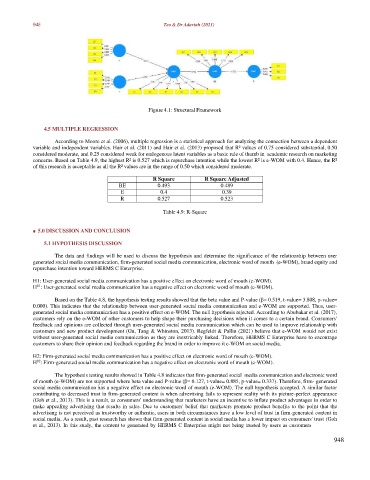
                                                  Figure 4.1: Structural Framework


                4.5 MULTIPLE REGRESSION

                   According to Moore et al. (2006), multiple regression is a statistical approach for analyzing the connection between a dependent
            variable and independent variables. Hair et al. (2011) and Hair et al. (2013) proposed that R² values of 0.75 considered substantial, 0.50
            considered moderate, and 0.25 considered weak for endogenous latent variables as a basic rule of thumb in  academic research on marketing
            concerns. Based on Table 4.9, the highest R² is 0.527 which is repurchase intention while the lowest R² is e-WOM with 0.4. Hence, the R²
            of this research is acceptable as all the R² values are in the range of 0.50 which considered moderate.

                                                    R Square         R Square Adjusted
                                        BE           0.493                0.489
                                         E            0.4                  0.39
                                         R           0.527                0.523

                                                       Table 4.9: R-Square


            ■  5.0 DISCUSSION AND CONCLUSION

                5.1 HYPOTHESIS DISCUSSION

                   The data and findings will be used to discuss the hypothesis and  determine the significance of the relationship between user
            generated social media communication, firm-generated social media communication, electronic word of mouth  (e-WOM), brand equity and
            repurchase intention toward HERMS C Enterprise.

            H1: User-generated social media communication has a positive effect on electronic word of mouth (e-WOM).
             01
            H : User-generated social media communication has a negative effect on electronic word of mouth (e-WOM).

                   Based on the Table 4.8, the hypothesis testing results showed that the beta value and P-value (β= 0.519, t-value= 3.808, p-value=
            0.000). This indicates that the relationship between user-generated social media communication and e-WOM are supported. Thus, user-
            generated social media communication has a positive effect on e-WOM. The null hypothesis rejected. According to Abubakar et al. (2017),
            customers rely on the e-WOM of other customers to help shape their purchasing decisions when it comes to a certain brand. Consumers'
            feedback and opinions are collected through user-generated social media communication which can be used to improve relationship with
            customers and new product development (Gu, Tang & Whinston, 2013). Regfeldt & Pallin (2021) believe that e-WOM would not exist
            without user-generated social media communication as they are inextricably linked. Therefore, HERMS C Enterprise have to encourage
            customers to share their opinion and feedback regarding the brand in order to improve it e-WOM on social media.

            H2: Firm-generated social media communication has a positive effect on electronic word of mouth (e-WOM).
             02
            H : Firm-generated social media communication has a negative effect on electronic word of mouth (e-WOM).

                   The hypothesis testing results showed in Table 4.8 indicates that firm-generated social  media communication and electronic word
            of mouth (e-WOM) are not supported where beta value and P-value (β= 0.127, t-value= 0.885, p-value= 0.337). Therefore, firm- generated
            social media communication has a negative effect on electronic word of mouth (e-WOM). The null hypothesis accepted. A similar factor
            contributing to decreased trust in firm-generated content is when advertising fails to represent reality with its picture-perfect appearance
            (Goh et al., 2013). This is a result, as consumers' understanding that marketers have an incentive to inflate product advantages in order to
            make appealing advertising that results in sales. Due to customers' belief that marketers promote product benefits to the point that the
            advertising is not perceived as trustworthy or authentic, users in both circumstances have a low level of trust in firm-generated content in
            social media. As a result, past research has shown that firm-generated content in social media has a lower impact on consumers' trust (Goh
            et al., 2013). In this study, the content to generated by HERMS C Enterprise might not being trusted by users as customers

                                                                                                                948

